Jaykay Enterprises Ltd Quarterly Results: A Massive Surge in Other Income
General information and entertainment, not investment advice. The author is not a SEBI-registered adviser or research analyst. No recommendation, no promised returns. Markets carry risk including loss of capital. Figures may not be current. Consult a registered adviser before acting.
1 — At a Glance
The market is observing a major transition in Jaykay Enterprises Ltd as the business attempts to pivot from a dormant shell into an advanced technology provider. Total revenue from operations expanded significantly to ₹258.05 crore for the full financial year ended March 31, 2026, compared to ₹80.64 crore in the preceding year. Net profit followed a similar upward trajectory, arriving at ₹232.54 crore against ₹7.02 crore in the prior period.
However, a granular evaluation of the underlying data shows that the financial performance is heavily influenced by non-operating factors rather than purely organic sales execution. Other income climbed to ₹201.95 crore in FY26 from ₹18.31 crore in FY25, which marks a significant concentration of non-core profitability. This introduces high volatility into the headline performance metrics.
Operational efficiency signals a mixed situation. While the top-line numbers show dramatic acceleration, cash generation from operations stands at ₹40.33 crore for the full year. This reveals a clear divergence between GAAP accounting profits and direct cash accumulation, a pattern that frequently characterizes companies undergoing deep restructuring.
A fundamental guideline of corporate analysis establishes that structural transformation requires long-term operational proof. The venture into defense components and 3D printing systems places the entity in high-growth sectors, but the legacy overheads and asset revaluations complicate the near-term baseline. The subsequent sections will examine whether the operational engine can sustain the current valuation parameters.
2 — Introduction
Jaykay Enterprises Ltd was originally incorporated in 1961 and operates under the historic J K Organisation banner. For multiple decades, the corporate vehicle maintained a minimal presence in active manufacturing, recording baseline annual sales of just ₹0.30 crore between FY17 and FY21.
The company officially exited the purview of the Board for Industrial and Financial Reconstruction (BIFR) on December 1, 2016, following the legislative repeal of the Sick Industrial Companies Act. Since that exit, management has initiated a series of systematic re-allocations to build an operational base in modern engineering segments.
Corporate actions over the last few blocks point to an aggressive entry into additive manufacturing, rapid prototyping, 3D printing, and defense aerospace sub-assemblies. To finance these capital-intensive moves, the firm executed a rights issue approved in July 2023 targeting a fundraise of ₹150 crore.
The structural blueprint has been further expanded via active subsidiary management and step-down equity stakes. The business environment has effectively migrated from a inactive corporate shell into an active investment engine focused on advanced tooling. Prices referenced across this educational review are not live, and all relevant ratios utilize a lagged reference price of ₹179.74 per share.
3 — Business Model: WTF Do They Even Do?
For nearly six decades, this company achieved a state of corporate hibernation so deep that its annual revenue wouldn’t cover the baseline maintenance cost of a modern corporate office. Then, management suddenly discovered defense engineering and additive manufacturing, turning a legacy shell into a complex web of aerospace joint ventures and engineering labs.
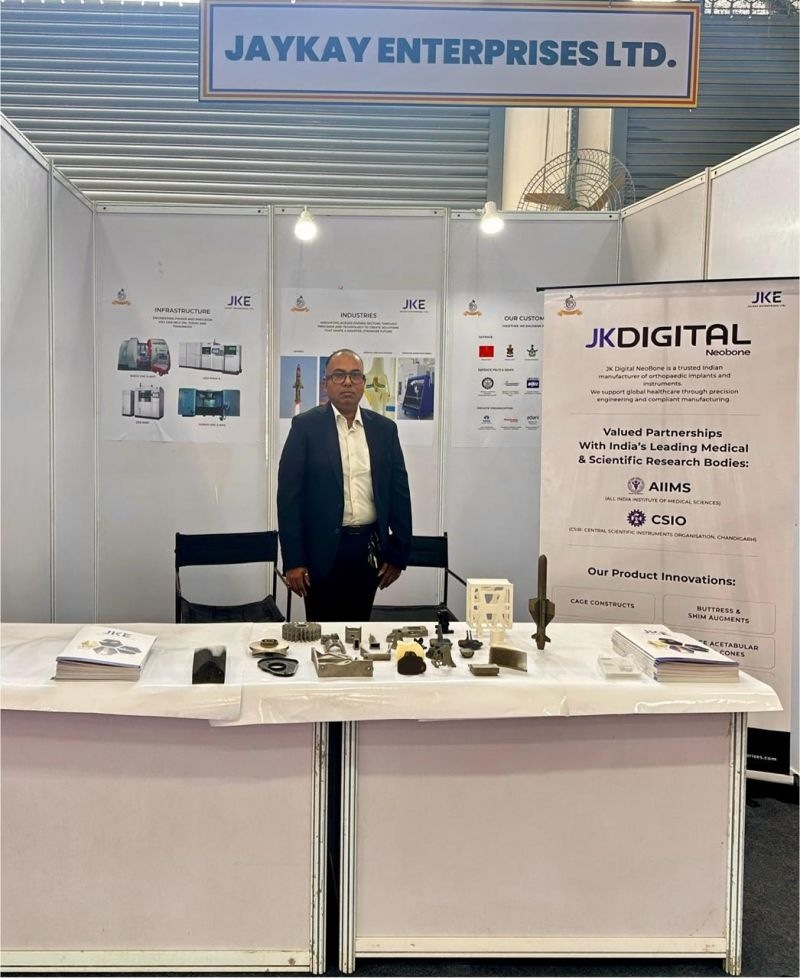
The business model now claims expertise in additive manufacturing systems, powder metallurgy, large-scale digital manufacturing, and even underwater mines. It is a product portfolio that reads like a high-tech incubator blueprint mixed with a defense procurement manual.
To implement this vision, the company signed a joint venture agreement in January 2021 with Additive 3D Pte Ltd (an affiliate of EOS Singapore) to form Neumesh Labs Private Limited, holding a 70% stake. Neumesh Labs, however, closed the block with accumulated losses of ₹62.27 lakh and a negative net worth of ₹43.05 lakh. This indicates that printing three-dimensional metal parts is currently more effective at consuming cash than returning operational cash flows.
In July 2023, management set up two new wholly-owned subsidiaries: JK Defence & Aerospace Limited and JK Digital & Advance Systems Private Limited. To fast-track execution, JK Defence acquired a 76.41% stake in Allen Reinforced Plastics, which manufactures critical composite components for the BrahMos and Akash missile programs. This step-down entity appears to be carrying the weight of actual industrial production while the parent entity supplies the financial lines.
If defense and technical consulting weren’t diverse enough, management amended the Memorandum of Association to add hotels, resorts, clubs, and real estate development to its official business clauses. The corporate identity now spans missile parts and luxury hospitality, presenting an interesting mix to the market.
Does adding real estate development and luxury resort operations clarify the core engineering focus, or does it simply ensure the annual report remains an unpredictable read?
4 — Financials Overview
Figures are consolidated, in ₹ crore.
The quarterly financial summary derived from the data sheet reflects the following trends: