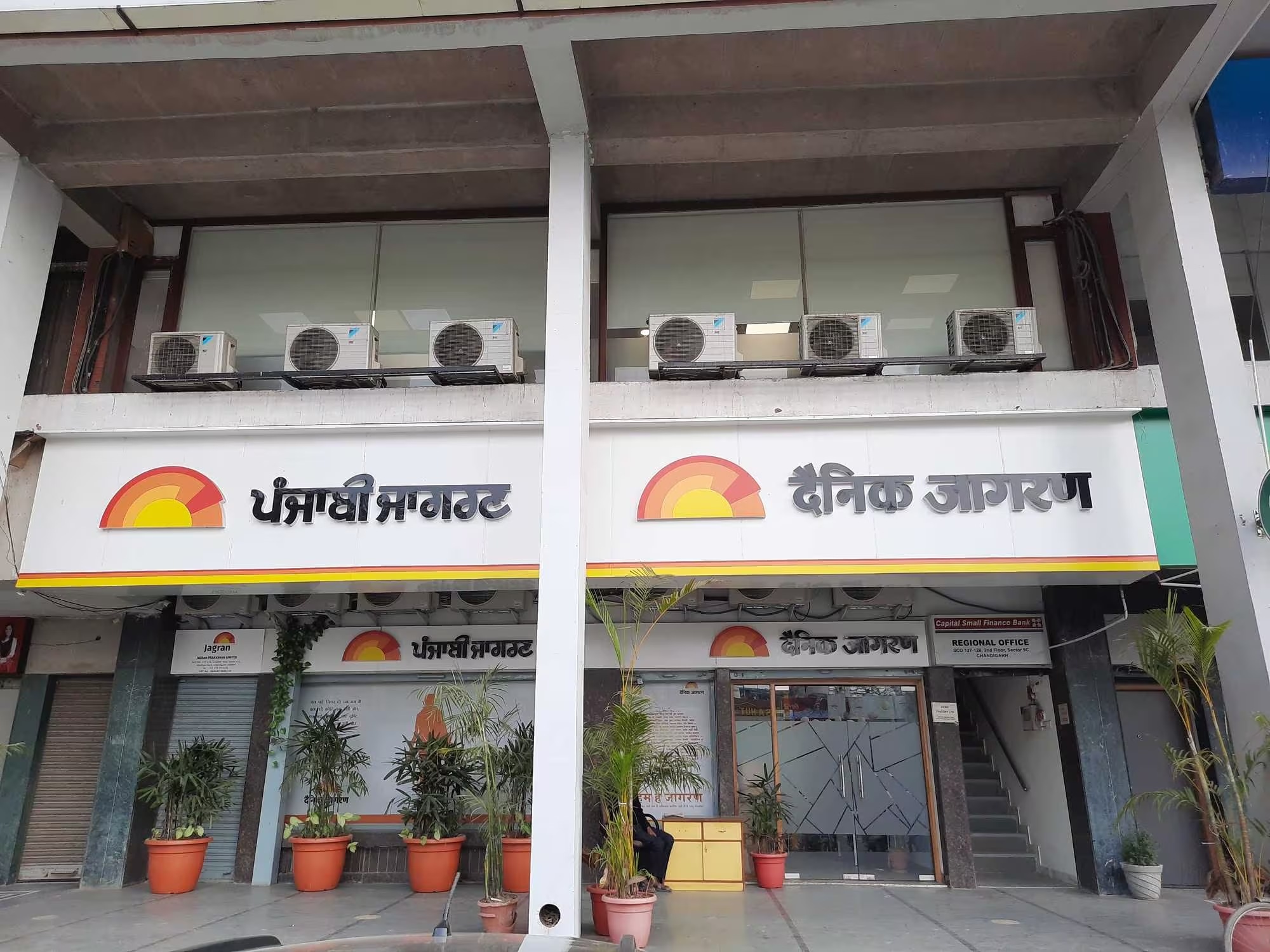
Jagran Prakashan FY2026: A Stumble Masquerading as Stability
General information and entertainment, not investment advice. The author is not a SEBI-registered adviser or research analyst. No recommendation, no promised returns. Markets carry risk including loss of capital. Figures may not be current. Consult a registered adviser before acting.
1. At a Glance
Revenue inched down to ₹1,876 Cr in FY2026, against ₹1,888 Cr in FY2025. The company’s net profit jumped 50% to ₹197 Cr, but here’s the catch: last year it was artificially depressed by a ₹94 Cr profit write-down (FY2025 had a tax recovery that masked operational stress). Strip away the noise, and the company’s media heartland—print and radio—faces structural headwinds while non-core income and a ₹123 Cr tax accounting gift kept the bottom line alive.
The balance sheet is fortress-like: ₹1,083 Cr net cash against ₹1,361 Cr market cap. Shareholder payouts are heroic—110% dividend payout last year suggests the firm is returning cash faster than it earns it sustainably. The stock trades at 6.9x reported earnings, the lowest among peers, because markets are pricing in a business that is old, expensive, and trapped in a shrinking category.
Does a pile of cash compensate for a media empire that generates low single-digit organic growth and declining reader engagement in print? The numbers suggest it does not.
2. Introduction
Jagran Prakashan is India’s media establishment made manifest: Dainik Jagran, the flagship Hindi daily, is the country’s most-read newspaper. The company also runs Radio City (39 stations, ~19% market share), a digital portfolio (Jagran.com, HerZindagi, Vishvas.News, and others), and out-of-home advertising.
Internally, the business splits into Printing & Publishing (80% of revenue, ₹1,500 Cr in FY2026), Radio (12%, ₹225 Cr), and Others—digital, OOH, events (8%, ₹150 Cr). Print remains the cash machine; radio was loss-making for years until recently turning profitable.
In May 2026, the company was rocked by an extraordinary general meeting (EGM) that approved removal of seven independent directors and one whole-time director, a move linked to an oppression petition filed by Chairman Mahendra Mohan Gupta and Whole-Time Director Shailesh Gupta against majority shareholders within the promoter family (Jagran Media Network Investment Pvt Ltd holds 67.97% of JPL). Implementation of the director removals remains stayed pending NCLT proceedings. The company has had no Managing Director since September 30, 2023.
A tax demand of ₹1.2 Cr plus penalty was received on March 25, 2026 for AY2024-25; the company says it will appeal. None of this materially impacts near-term operations, but the governance fog is thick.
3. Business Model: WTF Do They Even Do?
Print: The fading fortress. Dainik Jagran reaches 84+ million readers across 13 states with 300+ editions. It is a fortress brand in the Hindi belt—UP, Uttarakhand, Bihar, Jharkhand, Punjab, Haryana, NCR. Mid-Day (English), Inquilab (Urdu), and Nai Dunia (regional) fill gaps. Readership is real; the economics are crumbling. Newsprint costs stay volatile (₹1,000/tonne blended, softening from peaks). Ad volumes follow the economic cycle and have flatlined post-elections (FY2024 saw a General Election bounce that evaporated by H1 FY2025).
Radio: From loss-making to break-even. Music Broadcast Ltd (MBL), the radio subsidiary, runs 39 Radio City stations across tier-1, tier-2, and tier-3 cities. It held 19% volume market share last quarter. For three years, radio bled cash; FY2024–2026 showed it pivoting to profit via cost discipline. CRISIL sees it as a high-fixed-cost model that could generate outsized cash once it hits scale.
Digital, OOH, Events: The hope. These segments grew from 8% of revenue (FY2019) to 16% (FY2025). Jagran.com is a top-10 news portal. HerZindagi targets women’s health and wellness. Vishvas.News does fact-checking (a niche, but growing). OOH (outdoor advertising) and event management are small but high-margin. This is where the company believes future growth lives—outside the print death spiral.
The model is transitional but stalled: print shrinks, radio stabilises, digital grows too slowly to offset print decline. Net-net, revenue is flat to down.
4. Financials Overview
Figures are consolidated, in ₹ crore.
Metric
FY2026
FY2025
YoY Change
Revenue
1,876
1,888
-0.6%
EBITDA
250
160
+56%
Net Profit
197
94
+110%
EPS (annualised)
9.05
6.02
+50%
Wait. EBITDA ₹250 Cr (13.3% margin) on revenue ₹1,876 Cr. That’s a margin recovery. Let me parse the year.
Operating margin bottomed in Q1 FY2026 (negative, as the company wrote off some assets) and recovered thereafter. Newsprint costs softened—peak in Q1 FY2024 (₹1,000+/tonne), now stable. The company raised employee salaries and invested in digital capex, which hit H1 FY2025 (EBITDA margin fell to 8%). By FY2026 Q4, OPM stabilised at 10%.
Other income was a ₹123 Cr gift. This dwarfs the operating base. Last year, FY2025, the company logged ₹106 Cr other income; FY2026, ₹123 Cr. For context: Operating Profit for FY2026 = ₹250 Cr, minus Interest ₹20 Cr, Depreciation ₹86 Cr = PBT ₹144 Cr. Add Other Income ₹123 Cr: PBT becomes ₹267 Cr. The reported PBT is ₹267 Cr—exactly so. Other income is capital gains, interest accruals, and accounting adjustments on the ₹1,083 Cr cash pile.
Net profit ₹197 Cr came in at 74% of PBT, tax paid ₹82 Cr (31% effective tax rate). Not unusual. But the story is: Jagran’s core media business (EBITDA ₹250 Cr on ₹1,876 Cr sales) is stable but uninspiring. The headline profit is inflated by capital returns on a cash fortress.
Dividend payout was 110% of reported net profit. That is ₹217 Cr paid out of ₹197 Cr earned. The company is mining equity. This is unsustainable for a shrinking business, but it signals confidence: the board sees no capex needs and doesn’t fear balance sheet deterioration.
5. Market Expectations & Historical Multiples
This section describes how the market is currently pricing the company and how that compares with its own history and peer group. It is descriptive, not predictive.
Metric
Current
Historical Avg (5Y)
Peer Median
P/E
6.9x
10.0x
8.6x
EV/EBITDA
3.66x
4.5x
3.8x
P/B
0.68x
1.1x
0.58x
ROE
9.94%
8.46%
9.95%
ROCE
12.8%
12.13%
12.13%
The market currently pays 6.9x earnings, versus its own 5-year average of 10x. Among peers (DB Corp, Sandesh, HT Media, Hindustan Media), the median P/E sits at 8.6x. Jagran trades at a discount because revenue growth is near-zero (TTM: -1%), while peers like DB Corp (P/E 10.8x) benefit from a recovery narrative post-elections.
Return on equity stands at 9.94%, barely below the peer median (9.95%), but return on capital employed (ROCE) of 12.8% is in line with peers at 12.13%. This suggests the company is deploying its shrinking equity base at returns that match the cost of capital—it is not adding or destroying value on the margin.
The market appears to be pricing in a mature, dividend-paying utility that generates modest cash and has no capex needs. It is not pricing in growth, not pricing in a recovery, and not pricing in a digital transformation. It is pricing a slow fade.
The central tension is whether a balance sheet with ₹1,083