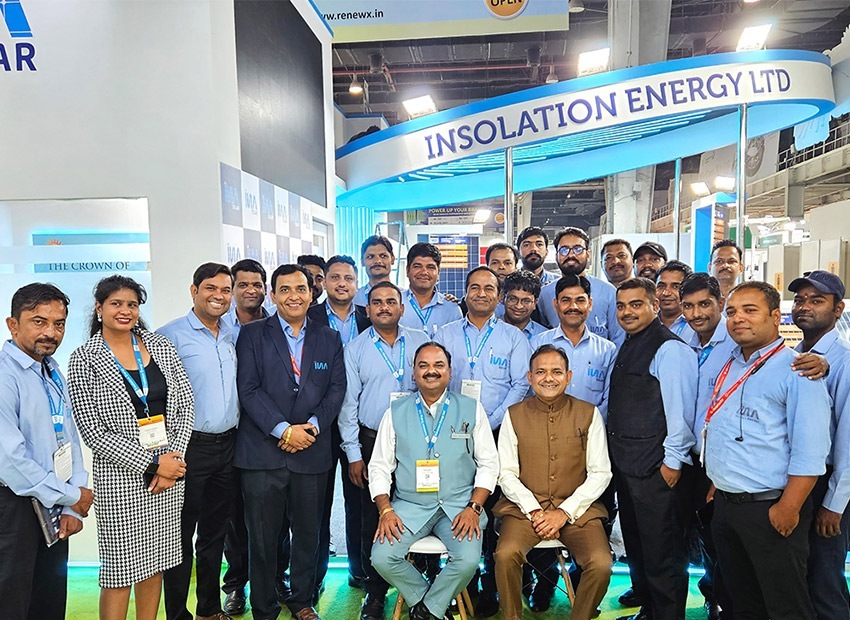
Insolation Energy FY26: A 61% Revenue Surge Meets a ₹2,500 Crore Capital Expansion Gambit
Section 1 — At a Glance
Insolation Energy Limited has engineered a remarkable scaling trajectory, culminating in an annual revenue operational high of ₹2,146.02 crore for the fiscal year ended March 31, 2026. This represents a 60.9% year-on-year expansion from FY25’s baseline of ₹1,333.76 crore, anchored by aggressive manufacturing volume growth and deep execution of solar engineering, procurement, and construction contracts. Net profit tracked this momentum, reaching ₹200.63 crore against ₹126.20 crore in the prior fiscal period.
However, this explosive top-line growth has introduced significant structural shifts across the balance sheet. Total borrowings scaled sharply from ₹108.09 crore to ₹887.91 crore within a twelve-month window, reflecting the heavy capital requirements of the company’s ongoing multi-gigawatt backward integration initiatives. While a massive QIP capital pool of ₹395 crore in late FY25 initially compressed leverage metrics, execution requirements for upcoming infrastructure have quickly absorbed that cushion.
Explosive capital expansion in a cyclical technology space creates a compounding risk framework where execution delays directly pressure underlying asset productivity.
The primary operational focus now centers on the successful stabilization of upcoming production lines and managing an expanded working capital cycle. Investors are closely monitoring whether the high asset-turnover model can maintain its underlying capital efficiency as the organization transitions into a highly leveraged, backward-integrated manufacturing platform.
Section 2 — Introduction
Insolation Energy Limited, founded in 2015 and headquartered in Jaipur, Rajasthan, has rapidly progressed from a regional player into a primary contender within the domestic renewable hardware landscape. The company completed a pivotal corporate milestone on March 9, 2026, successfully migrating its equity listing from the BSE SME platform to the Main Boards of both the BSE and NSE.
This structural migration aligns with a deep operational transformation. From its initial base as a 200 MW solar module assembly unit, the firm is positioning itself to capture the massive structural tailwinds generated by India’s domestic solar manufacturing mandates.
Section 3 — Business Model: WTF Do They Even Do?
At its core, Insolation Energy is a business that buys incredibly sophisticated, razor-thin sheets of imported silicon cells, packages them between layers of glass and aluminum under the brand name “INA Solar,” and sells them before the technology updates itself out of relevance. Manufacturing drives 87% of their top line, while the remaining 13% comes from trading and executing solar EPC assignments for public and private developers.
The structural problem with pure module assembly is that it possesses all the economic moats of an assembly line putting together pre-fabricated furniture. To fix this lack of pricing power, management has embarked on a vertical integration spree, assembling capabilities in everything from aluminum frames to solar power conditioning units and tubular lead-acid batteries. They are effectively trying to transition from a simple midstream builder into a fully integrated solar ecosystem player, hoping the market will treat them like a premium utility asset rather than a commoditized hardware manufacturer.
Section 4 — Financials Overview
Figures are consolidated, in ₹ crore.
Quarterly Performance Trajectory
Metric
Q4 FY26 (Mar 2026)
Q3 FY26 (Dec 2025)
QoQ Change (%)
YoY Change (%)
Revenue
793.93
575.34
38.0%
100.1%
Operating Profit
110.65
74.77
48.0%
93.1%
PAT
69.84
50.72
37.7%
64.8%
Reported EPS (₹)
3.17
2.30
37.8%
65.1%
The business exhibits a profoundly lumpy, quarter-end heavy billing cycle, with utility developers performing massive product pull-forwards in the final weeks of the fiscal year. Q4 FY26 revenue hit a record ₹793.93 crore, effectively matching the total business generated during the entire twelve months of FY24.
Volatile, back-ended quarterly dispatches frequently mask structural cost escalations that show up only when the annual cash flows settle.
What is Management Promising in the Coming Quarters?
During the June 2026 conference call, management displayed a high degree of confidence regarding their operational runway. The CEO noted that their total module manufacturing capacity has scaled to 5.5 GW, giving them massive volume visibility. Management explicitly guided for an FY27 production and sales target of approximately 2 GW, calling it an “easy and comfortable target” to execute.
Furthermore, the Chairman outlined a long-term roadmap targeting an FY28 revenue base exceeding ₹5,000 crore, contingent on the timely commercialization of their upcoming internal cell lines.
Section 5 — Valuation Discussion: Fair Value Range Only
1. Trailing P/E Multiple Methodology
With a closing market price of ₹124.50 and a full-year FY26 reported EPS of ₹9.10, Insolation Energy trades at an implicit P/E multiple of 13.68x. While traditional power infrastructure giants and premium integrated utilities like JSW Energy (46.5x) or Adani Green (130.9x) command steep valuation multiples, pure-play capital equipment manufacturers face structural discounts. Applying a conservative peer-adjusted manufacturing P/E band