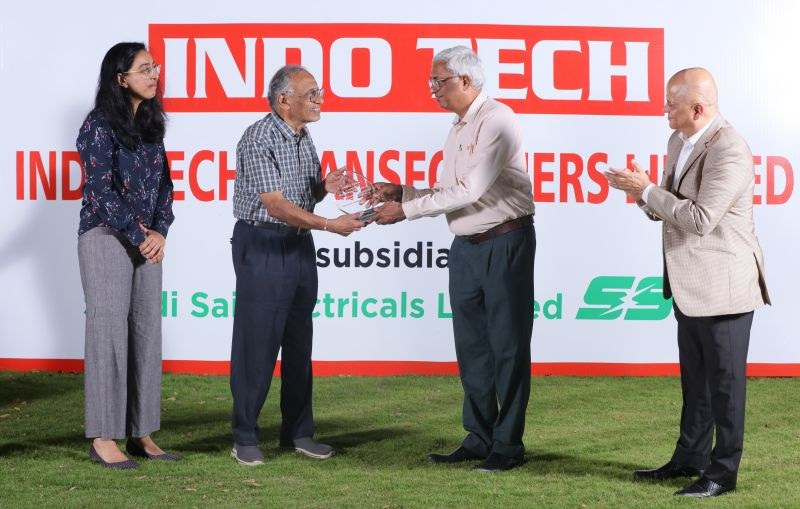
IndoTech Transformers Ltd — More Than Meets the (Balance) Sheet
Date of Publishing -
Spotted a factual error — a wrong number, date, or fact? Tell us and we will check the source.
Page 1 — Why This Stock?
IndoTech Transformers Ltd isn’t just any small-cap company; it’s one that has transformed itself (pun intended) dramatically over the past decade. We chose this stock for analysis because of its educational value – it highlights how a struggling manufacturer can turn around with the right industry tailwinds and management moves. Also, let’s be honest, who can resist a company with “Transformers” in its name that delivered a whopping 923% stock return in 3 years[1]? Indo Tech’s journey from losses to profits (and the corresponding share price rollercoaster) offers a real-life case study in corporate revival. The firm operates in the power infrastructure space, making heavy-duty electrical transformers – a business that’s critical to keeping the lights on (literally). In the mid-2010s, Indo Tech was flirting with oblivion (negative net worth and mounting debt), but by the mid-2020s it had reinvented itself as a profitable, high-growth enterprise riding India’s infrastructure boom[2][3]. This stark “zero-to-hero” storyline, combined with the inherently electrifying nature of its products, made it an ideal (and yes, entertaining) choice for a deep-dive analysis.
Page 2 — Management Mic Drop (Concall)
On recent conference calls, Indo Tech’s management has been positively electrified in their commentary. They proudly announced a strong order book of about ₹700 crore as of June 2024 (to be executed by March 2025) – giving them solid near-term revenue visibility[4]. Management attributed this to surging demand, especially from renewable energy projects and grid upgrades, quipping that the transformer industry is “flushed with orders” amid India’s capex boom[5]. They also guided for healthy operating margins around the mid-teens (~14% range) on the back of economies of scale[6]. In true mic-drop fashion, the team emphasized their confidence in sustaining market share and margins despite rising input costs, thanks to measures like price variation clauses in ~50% of contracts (so they won’t get completely fried by copper and steel prices)[7]. Of course, management didn’t shy away from admitting challenges: they noted intense competition and high customer concentration – with top clients making up over 60% of sales[8]. But the overall tone was upbeat. In one call, they practically basked in the glow of their turnaround, highlighting improved profit margins and a net cash position on the balance sheet (a subtle flex that they have more cash than debt)[9]. One noteworthy development in FY2025: the CEO who led much of the turnaround, Mr. Shridhar Gokhale, resigned in April 2025 to “pursue personal interests”[10] – a move the management discussed tactfully. They assured investors that a smooth transition was in place (the Whole-Time Director, Mr. M. Purushothaman, took over the helm). In short, recent concalls have been a mix of factual boasting and frank discussion, with management dropping one-liners about strong demand and execution, leaving analysts with the impression that this transformer company is fully charged up for the future.
Page 3 — Business Model
Indo Tech’s business model is refreshingly straightforward (no complex crypto-fintech AI jargon here): they build and sell transformers. Not the shape-shifting robot kind from the movies, but the heavy electrical devices that step up or step down voltage in power grids. The company offers a wide array of transformer solutions – from plain-vanilla distribution transformers found on city power poles to mid-size and large power transformers up to 245 kV for substations[11]. They even make mobile substation transformers, essentially transformers on wheels or skids for emergency and remote applications[12] (think of it as the food-truck version of a power station). Indo Tech primarily serves utilities, renewable energy farms, and industrial customers – basically anyone who needs to “transform” electricity from one voltage level to another (which, in a developing economy like India, is a lot of folks). The company prides itself on quality and reliability: it operates modern manufacturing facilities in Tamil Nadu with dust-free assembly bays and a NABL-accredited testing lab to ensure each transformer can handle the voltage without letting out the magic smoke[13].
A key element of Indo Tech’s setup is its parentage. It’s a subsidiary of Shirdi Sai Electricals Ltd. (SSEL), which holds ~70% of Indo Tech’s equity[14]. This parental backing isn’t just for show – SSEL’s decades of industry experience and larger scale provide synergistic benefits. For instance, Indo Tech can tap into joint procurement of raw materials (scoring better prices on expensive inputs like electrical steel and copper) and leverage SSEL’s relationships to win orders[15]. In a fragmented and highly competitive transformer market, Indo Tech positions itself as a niche player that punches above its weight by focusing on custom solutions and timely execution. The transformer industry in India has many players (from giants to tiny regional firms), so price competition is fierce[16]. Indo Tech’s strategy has been to differentiate on technical capability and service – delivering specialized transformers (e.g. inverter-duty transformers for solar/wind farms, mobile units for fast deployment) and ensuring they meet stringent quality standards. Essentially, the company makes money the old-fashioned way: manufacture product, sell product, repeat – but it has steadily moved up the value chain to higher-rating transformers and carved out a solid reputation in its segment. As their tagline might as well be: “We’re empowering the future with cutting-edge transformers”[17] – a slightly grandiose way of saying they keep the grid running, one transformer at a time.
Page 4 — Big Numbers (Financials)
Let’s talk numbers – because behind all the puns, Indo Tech’s financial story is genuinely dramatic. Picture a rollercoaster: Revenue in FY2014 was a mere ₹94 crore, and the company posted a net loss of ₹19 crore that year[18][19]. Fast forward to FY2025, revenue hit ₹612 crore with a net profit of ₹64 crore[18][19]. Yes, you read that right – the company went from bleeding red ink to a healthy profit, effectively transforming its P&L (okay, one more pun). This growth wasn’t linear or overnight; for much of the 2010s, Indo Tech struggled. Sales even declined in some years (e.g. dropping from ₹190 Cr in FY2016 to ₹149 Cr in FY2017 amid a downturn) and profit remained elusive until around 2018-2019. The inflection began around FY2019-FY2020 when operations breakeven was achieved and then, with a strong industry upcycle, sales exploded from ₹205 Cr in FY2020 to ₹503 Cr by FY2024[18]. That’s roughly a 2.5x jump in four years. Even more impressively, operating profit margins (OPM) climbed from negative territory (the company used to lose money on every rupee of sales back in 2014–2017) to about 14% by FY2024[20]. In FY2025, OPM was ~13% and net profit margin about 10.2%[21]. So every ₹100 of sales now yields roughly ₹10 of bottom-line profit – a far cry from the ₹-20 of loss per ₹100 in the dark days of FY2014.
This stellar turnaround is also reflected in growth rates. Over the last 5 years (FY20–FY25), revenue CAGR was ~24–30% and profit CAGR over 100%[22]. (When you grow from almost nothing to something, triple-digit CAGR is easier – but still, 100%+ is eye-popping.) The company has delivered compounded profit growth of ~102% annually in the past five years[22], which is not a typo – it’s what happens when PAT goes from ₹2 Cr to ₹64 Cr in half a decade. Return metrics too flipped from negative to excellent (more on that in the Ratios section). Shareholders who had the foresight (or luck) to ride this wave were rewarded generously: the stock’s 3-year return is ~923%[1], reflecting the market’s re-rating of Indo Tech from a near-dead stock to a growth darling. In summary, the big numbers tell a “from rags to riches” tale – revenues have grown ~6.5x and profits went from below zero to solidly positive. It’s as if the company found its ON switch around 2018 and has been powering up ever since. For a bit of context, FY2025 revenue ₹612 Cr and PAT ₹64 Cr put Indo Tech firmly in the small-to-mid size category among capital goods companies – but with growth that many larger peers would envy. As analysts, we’re both impressed and amused: impressed by the hard figures, amused because Indo Tech truly lived up to its name and transformed when few thought it could.
Page 5 — Fair Value Range Calculation
(Disclaimer: This is for academic illustration only – we’re not playing stock oracle here, just showing how one might think about valuation.)
Valuing a transformer manufacturer can be as challenging as guessing the lifetime of a transformer fuse. But let’s give it a humorous try with a couple of approaches:
Earnings Multiple (P/E) Approach: Indo Tech’s EPS for FY2025 is about ₹72.65[23]. The stock currently trades around 25.7× earnings (P/E ~25.7)[24], indicating the market expects solid growth to continue. If we take a more conservative view, one might apply a P/E of say 20× (assuming growth moderates) or an optimistic view of 30× (if growth stays high and investors remain excited). That gives an indicative fair value range of roughly ₹1,450 to ₹2,180 per share (₹72.65 EPS × 20 to 30). That’s a wide range – reflecting how sensitive valuations are to sentiment. At 20×, the valuation is implying a more grounded outlook, whereas 30× is pricing in a lot of future success. Think of it as valuing a pizza place: at 20×, we assume it’ll sell a lot of pizzas; at 30×, we assume it’ll franchise globally and maybe cure world hunger on the side.
Book Value/Base Value Approach: Indo Tech’s book value per share is about ₹264[24]. The stock’s P/B is currently ~7×[25], which is quite high for a manufacturing company (investors are paying seven rupees for one rupee of net assets, betting those assets generate high returns). If one assumed a more modest long-term P/B of say 4×–5× (for a steady-state industrial firm), the fair value might be in the ₹1,056–₹1,320 range. On the flip side, if you believe this company deserves a premium like a tech firm (say 8× book), you’d get ~₹2,112. Again, a large spread – welcome to the art of valuation!
Discounted Cash Flow (DCF) Approach: For the finance nerds. We won’t bore with the algebra, but a DCF would involve projecting Indo Tech’s future cash flows and discounting them to present value. Suppose we assume earnings grow ~15% annually for the next 5 years (as new capacity comes online) then taper to ~5% growth, and use a discount rate around 10%. Plugging in some rough numbers (with FY25 profit ~₹64 Cr as a base, and translating profit growth to cash flow growth), one might get a DCF-based value somewhere in the ballpark of ₹1,600–₹1,800 per share. This mid-range implies the current market price is in the “fair” zone if those growth assumptions pan out. But tweak any assumption (growth rate, margins, discount rate) and the DCF output will swing – much like a transformer’s output with a fluctuating input.
Relative Peer Multiples (EV/EBITDA etc.): If we compare to peers in the electrical equipment sector, typical EV/EBITDA multiples might be around 12–15× for steady players, higher for fast growers. Indo Tech’s EBITDA in FY25 was roughly ₹76 Cr (operating profit ₹85 Cr minus some other income, plus depreciation)[18][26]. At, say, 15× EV/EBITDA, the enterprise value would be ~₹1,140 Cr. Adding cash (~₹40 Cr by FY25) and subtracting debt (~₹8 Cr), equity value would be ~₹1,172 Cr – which translates to about ₹1,100 per share. However, this might undervalue the growth prospects (since peers might not be growing as fast). If we used a higher multiple like 20× (rewarding its growth), EV becomes ₹1,520 Cr and equity value ~₹1,552 Cr, giving about ₹1,460 per share.
As you can see, depending on the method and assumptions, the “fair value” of Indo Tech could be anywhere from around ₹1,100 at the low end to ₹2,000+ at the high end. That’s a huge range – which is why we emphasize this is not a prediction, just an academic exercise in valuation. The stock is currently about ₹1,865 (as of late Aug 2025)[24], which the market seems to think is justified by its growth. In sum, we estimate a broad fair value range perhaps between ₹1,500 to ₹2,000 (no precise targets, just a range where various methods converge) for learning purposes. Take this with a pinch of salt; valuing a high-growth turnaround like Indo Tech is like trying to guess how many Transformers sequels Hollywood will make – it involves a lot of speculation. No investment advice here – just showing the math behind the madness!
Page 6 — What-If Scenarios
Let’s play out some hypothetical what-if scenarios for Indo Tech’s business performance, toggling the variables like a voltage regulator. (No share price projections here, just business outcomes.)
🌞 High-Voltage Optimism (Bull Case): Imagine a scenario where everything goes right. The government’s infrastructure push continues unabated, renewable energy projects keep mushrooming, and Indo Tech successfully expands its capacity by 2,500 MVA by FY27 as planned[27]. In this rosy world, by say FY27–FY28 the company could double its revenues to around ₹1,200–₹1,300 Cr (roughly in line with utilizing the new capacity fully and perhaps gaining some market share). Operating margins might hold around 12–15% (perhaps even inch up if economies of scale kick in). That would yield an operating profit in the ₹150–₹180 Cr range and potentially net profits around ₹100–₹120 Cr (assuming stable finance costs and taxes). Essentially, Indo Tech would be nearly 2x its current size in a few years, solidifying its position in the industry. Under this scenario, the company might become a mid-cap darling – think of it as Optimus Prime mode, leading the pack. Key enabling assumptions here: successful execution of the capex (new production lines running smoothly), continued high demand (order book stays >1.5× annual sales providing full visibility[28]), and raw material prices remain in check or pass-through mechanisms work. This scenario sees Indo Tech as a major beneficiary of India’s electrification drive, possibly venturing more into exports (currently negligible) if domestic demand slows. It’s the kind of upside that justifies the strong investor enthusiasm we’ve seen.
⛅ Steady Current (Base/Mid Case): In a middle-of-the-road scenario, Indo Tech grows but not at lightning speed. Perhaps capacity constraints and some market saturation mean growth in FY26 is modest (management indeed guided that FY26 may see muted growth due to near-full capacity utilization[29]). So maybe revenue grows ~10–15% annually for a while, putting it around ₹800–₹900 Cr in a couple of years. Margins stay in the ~10–13% zone (the company guided to maintain double-digit margins, albeit with slight compression in FY25[30]). That would translate to annual profit growth in the teens as well – healthy but not mind-blowing. The company in this scenario generates enough profit to self-fund expansions (as it’s doing) and gradually increase sales. It remains a strong niche player but doesn’t dramatically outpace the industry. This steady current scenario is akin to the company humming along like a well-maintained transformer: not overheating, not sparking – just reliably doing its job. Indo Tech would still be a success story, just a more tempered one. Key assumptions: demand is solid but not exponential, competition maybe limits how much market share or pricing power Indo Tech can grab, and the company focuses on operational efficiency to squeeze out a bit more margin. Essentially, Indo Tech cruises rather than races.
🌩️ Short-Circuit Setback (Bear Case): Now for the not-so-fun scenario – what if things go wrong? For instance, a sharp increase in raw material prices (CRGO steel or copper) without adequate price escalation clauses could jolt the margins. Recall that about 59% of FY25 contracts were fixed-price[31], meaning if input costs spike, Indo Tech eats the cost on those orders. In a bear case, we might see margins slip back to single digits (say OPM falls to 8-9%). Additionally, if a major client (or a few of them) delay orders or payments, Indo Tech’s high customer concentration could hurt revenue growth and cash flow[8]. Let’s say revenue stagnates around ₹600–₹650 Cr for a couple of years (no growth) due to a slowdown in orders or execution issues. With thinner margins, annual net profit could drop to the ₹30–₹40 Cr range (back to FY2022 levels). This would be disappointing given recent trends – essentially flat sales and falling profits. Such a scenario could occur if the broader power sector hits a slowdown, or competitors undercut prices to grab market share (price wars can erode the profitability for everyone). Another risk: working capital blowout – if Indo Tech has to hold more inventory or receivables balloon (say customers take longer to pay), it could crimp operating cash flow and force the company to take short-term debt, putting strain on the balance sheet again. And we haven’t even mentioned external shocks: policy changes, or say a technology shift (what if in 5 years some new tech reduces the need for traditional transformers? Unlikely in the near term, but who knows). In this short-circuit scenario, Indo Tech would still exist, but its financial performance would look more like the mid-2010s (mediocre) than the high-flying 2020s. Think of it as the company getting stuck with a voltage fluctuation – not enough juice to move the needle.
⚙️ Wild Card (Transformers: The Next Generation): As a fun hypothetical, what if Indo Tech diversifies or does something unexpected? For instance, maybe it develops smart transformers with IoT sensors that command premium pricing, or it enters an allied business (like EV charging infrastructure equipment). This could open new revenue streams. Or, being a bit whimsical, perhaps Indo Tech partners with an international player to export transformers to other emerging markets – suddenly making exports say 20% of revenue instead of <1% currently (exports were virtually nil in FY25[32]). These are speculative, but the point is the range of outcomes is fairly broad for a small company in a growing sector.
In all cases, note that we carefully avoided mentioning share prices. These scenarios are about business performance, which ultimately would influence investor perception. Indo Tech’s future could range from supercharged growth to a moderate grind to a shaky ride if challenges hit. As observers, we’ll watch which path it takes – while making more transformer puns, of course.
Page 7 — What’s Cooking (SWOT Analysis)
Let’s break down Indo Tech’s Strengths, Weaknesses, Opportunities, and Threats, with a side of humor:
Strengths:
Shocking Growth Momentum: The company has delivered exceptional growth in recent years – profits compounded at 102% CAGR over the last 5 years[22], and return ratios have surged (ROCE ~37–38% recently[33]). This indicates strong execution and a product in high demand. Once upon a time, growth was transformer-ative (couldn’t resist) and Indo Tech seized the moment.
Healthy Financial Position (Almost Debt-Free): Indo Tech is virtually debt-free now[34]. It has a tiny debt-to-equity of ~0.03 and even sits on net cash. This strength gives it resilience – no heavy interest burden draining profits, and capacity to raise funds if needed. Essentially, its balance sheet won’t short-circuit under stress.
Supportive Promoter & Legacy: Being a subsidiary of Shirdi Sai Electricals Ltd (SSEL) brings credibility and advantages[14]. The promoters have ~30 years of industry experience and have helped secure economies of scale (joint sourcing of materials, etc.)[15]. It’s like having a big sibling in the same school – fewer bullies will mess with you and you get hand-me-down resources. This backing likely helped Indo Tech navigate tough times and now to capitalize on opportunities.
Improving Efficiency: The company dramatically improved its working capital management. Debtor days dropped from 100 to ~73 days[35], meaning it’s collecting cash from customers faster. Inventory management also got better, trimming the cash conversion cycle. In FY25, working capital cycle was ~129 days, improved from 150+ days in earlier years[36]. Better efficiency = more cash and less reliance on borrowing. (They basically learned to stop providing free, indefinite credit to customers – always a good thing.)
Focused Product Niche with Quality Edge: Indo Tech isn’t trying to do everything; it focuses on transformers and related equipment, where it has deep expertise. It has state-of-the-art manufacturing (dust-free EHV assembly, advanced testing labs)[13] which not every competitor, especially smaller ones, can boast. This commitment to quality and specialization is a strength – customers (like state utilities or big EPC contractors) trust that Indo Tech can deliver reliable transformers on time. The proof? A robust order book and repeat orders from reputed clients (including giants like Adani, Tata Power Solar, etc.)[37].
Weaknesses:
High Customer Concentration: Indo Tech’s top 10 customers account for about 62% of revenue (FY24)[38]. That’s a bit dangerous – losing even one major client or a slowdown in one segment can dent sales significantly. It’s like having only a few big power plants buying your transformers; if one project gets shelved, your factory might be idling.
Working Capital Intensive Business: Despite improvements, this business inherently ties up a lot of cash in inventory and receivables. Transformers are big, bespoke products – you often build them before you get paid, and sometimes clients take their sweet time to pay. Indo Tech had a working capital of ~22% of sales in FY24[39]. This means cash is constantly locked in things that aren’t cash. If not managed well, it can strain liquidity (in the past, Indo Tech even had negative net worth due to cumulative losses and high working capital needs – ouch).
Intense Competition & Pricing Pressure: The transformer industry in India is highly fragmented and competitive[16]. There are bigger players (with global backing) and many smaller ones willing to undercut prices. Indo Tech, being a mid-sized player, faces pressure to keep prices low to win orders, which can squeeze margins. It doesn’t have monopoly power or unique tech to allow premium pricing – a 10 MVA transformer from Indo Tech is more or less as good as one from Competitor X, so customers often choose based on price + delivery. This also means any capacity glut in the industry could hurt Indo Tech’s profitability.
No Dividend Despite Profits: This might irk income-focused investors – the company hasn’t been paying dividends even after turning profitable (dividend payout 0%)[40]. It’s retaining all earnings for growth/expansion, which is understandable for a growing company, but it’s a weak point for those who expected some juice (cash rewards). Essentially, shareholders must be content with value appreciation (which, granted, has been huge) and not yearly cheques.
Promoter Share Pledge: A notable red flag is that 77.8% of the promoters’ holding is pledged[25]. In simpler terms, the majority owners have taken loans and put up their Indo Tech shares as collateral. This doesn’t directly affect day-to-day operations, but it’s a financial risk: if Indo Tech’s share price falls a lot, lenders might dump those shares, creating pressure on the stock. It also might signal that the parent company (SSEL) or promoters needed cash elsewhere. It’s like a sword hanging overhead – usually not a problem when things go well, but in a crisis, it can make things worse. This is a governance weak point that savvy investors watch warily.
Opportunities:
Power Infrastructure Boom: India is investing heavily in power infrastructure – from renewable energy (solar/wind farms) to strengthening transmission & distribution networks. The demand for transformers is on a secular uptrend