Search for Stocks /

Indo US Bio-Tech FY26: Profit Falls 19% While Inventory Swells to Nearly a Full Year of Sales

Spotted a factual error — a wrong number, date, or fact? Tell us and we will check the source.

General information and entertainment, not investment advice. The author is not a SEBI-registered adviser or research analyst. No recommendation, no promised returns. Markets carry risk including loss of capital. Figures may not be current. Consult a registered adviser before acting.

1 — At a Glance

Here is a seed company that grew sales from ₹24 crore to ₹110 crore over ten years, and in its most recent year did something that deserves a second look: revenue rose to ₹110.44 crore, yet net profit fell to ₹13.12 crore from ₹16.27 crore the year before — a 19% drop. Operating cash flow, positive for four straight years, swung to an outflow of ₹12.58 crore. Borrowings more than doubled, from ₹14.84 crore to ₹37.03 crore. And inventory closed the year at ₹99.05 crore — against annual sales of ₹110.44 crore.

That last number is the one worth sitting with. A seed processor is now holding stock worth nearly its entire year’s revenue, and it borrowed to do it.

Around the same period, the statutory auditor resigned mid-term, a new one was appointed subject to shareholder approval, and disclosed income-tax demands sit under dispute across seven assessment years. None of these are conclusions. They are line items.

The question this year poses: when a growing business stops generating cash, where did the money go — and the balance sheet answers before the narrative does.

2 — Introduction

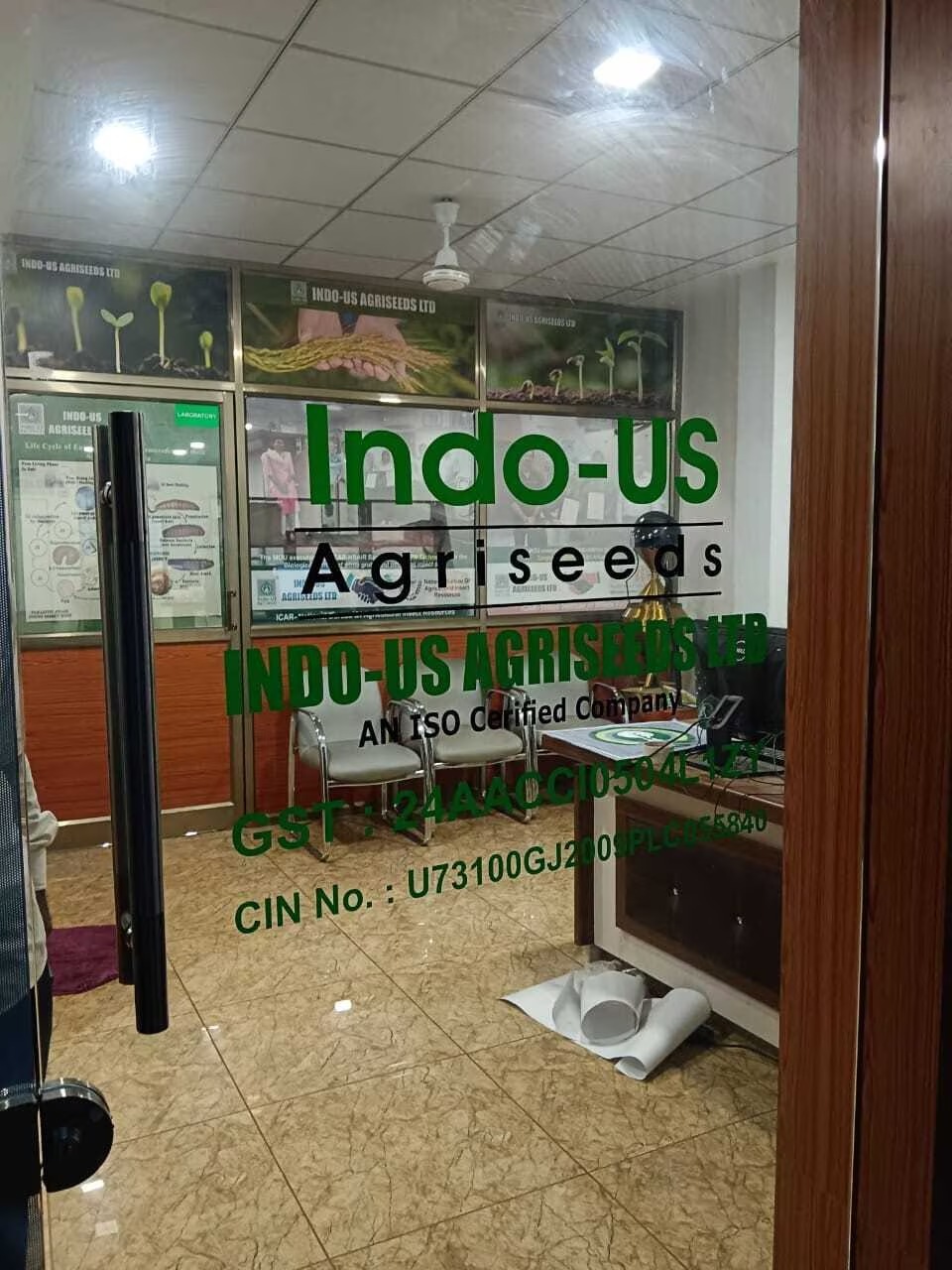
Indo US Bio-Tech Ltd, incorporated in 2004 and based in Ahmedabad, produces and processes commercial and vegetable seeds. It breeds, produces, processes, packs, and markets hybrid and open-pollinated varieties, working through seed-production agreements with growers who are reimbursed for cultivation expenses.

The company holds an ISO 9001:2015 certificate, is a member of the National Seed Association of India, and carries DSIR recognition for an in-house R&D unit. In September 2024 it migrated from the BSE SME platform to the BSE and NSE main boards. A 1:1 bonus issue was recommended in August 2023, which is why the equity share count doubled to roughly 2.01 crore shares in FY24 — a detail that matters when reading per-share figures later.

The last twelve months carried several corporate events: audited FY26 results approved on 29 May 2026, a statutory-auditor change in June, and a postal ballot in July covering an independent director’s regularisation and the new auditor’s appointment. Each is recorded in its place below.

3 — Business Model: WTF Do They Even Do?

They sell seeds. A lot of kinds of seeds.

The catalogue is genuinely wide: vegetable seeds (tomato, okra, brinjal, gourds of at least four varieties, carrot, onion, watermelon), oil seeds (castor, groundnut, sesamum, mustard, soybean), spices (cumin, isabgul), pulses, cereals, and a line of Indo US-branded hybrid cotton running from the 918 to the 999. The model is R&D-led breeding at one end and a marketing network at the other, with growers doing the actual cultivation on leased land in between.

That leased-land arrangement is the structural quirk. The company owns no land; factory buildings and cold storage sit on long-term leasehold properties with no lease-rental obligations, per the auditor’s report. It compensates farmers per rate agreements, then processes and sells what comes back.

INDO US BIO-TECH LIMITED Provides Hybrid Vegetable Seeds, Cotton Seeds, Oil Seeds, Spices Seeds, Pulses Seeds and Cereals Seeds | Suppliers, Dealers

FY23 disclosures put production sales at about 86% of revenue and traded goods at 14%, with agricultural activities forming roughly 89% of segment revenue. Exports have reached the USA, Palestine, Kuwait, Cameroon, Sri Lanka, and Mauritius.

It is an asset-light frame on paper — no owned land, leased premises — which makes it all the more striking that so much capital has ended up parked in one place. A seed business is seasonal by nature; inventory and cultivation cycles swing hard. But the model’s whole promise is that seeds turn into sales. This year, a great many of them stayed seeds.

Does an asset-light lease model still count as asset-light when ₹99 crore of working capital is tied up in stock?

4 — Financials Overview

Figures are standalone, in ₹ crore.

MetricLatest Q (Mar 2026)YoY (Mar 2025)QoQ (Dec 2025)
Revenue26.0233.3822.80
Operating Profit3.234.584.15
PAT1.973.003.00
EPS (₹)0.981.841.50

The March quarter shows revenue down 22% against the same quarter last year, and net profit down 46%. Sequentially, revenue rose 14% off the December quarter while profit fell — the March quarter’s operating margin was 12.4%, the softest of the recent set, and the tax charge landed at 17.2% versus low-single-digit rates in prior quarters, which compressed the bottom line further.


The board approved the audited FY26 results on 29 May 2026 with an unmodified audit opinion. The auditor’s report carried an emphasis-of-matter paragraph noting confirmations still pending on certain trade receivables, trade payables, and advances to growers, and flagging that details of cash sales to retail farmers could not be verified.

5 — Market Expectations & Historical Multiples

This section describes how the market is currently pricing the company and how that compares with its own history and peer group. It is descriptive, not predictive.

MetricCurrentHistorical AveragePeer Median
P/E~13x17.1x
P/B1.9x
ROE15.3%17.2% (5-yr)
ROCE14.5%14.5%

The market currently pays about 13x earnings here, against a peer median of 17.1x and an industry figure of 18.9x. On return on equity, the current 15.3% sits below the company’s own five-year average of 17.2%. ROCE at 14.5% matches the peer-set median exactly.

What the market appears to be weighing is visible in the numbers above: a business that compounded sales at roughly 23% over five years, set against a profit line that fell this year and an operating cash flow that turned negative. The multiple below the peer median reflects a market pricing the profit decline and the working-capital build, per the figures on the balance sheet and cash-flow statement — not a verdict this entry offers.

One factual observation: the market is currently assigning this company a lower earnings multiple than the median of its listed peer group.

6 — What’s Cooking

The spice this year is governance, not order wins.

On 15 June 2026, statutory auditor Gautam N Associates resigned mid-term, with the stated reason being administrative and operational restructuring of the company’s audit assignments; the outgoing firm’s letter noted the appointment of an auditor based nearer the registered office in Ahmedabad. The board approved Bhagat & Associates as the incoming statutory auditor, subject to shareholder approval, with a postal ballot notice published on 4 July 2026 also covering the regularisation of an independent director.

Separately, an ED (Raipur) PMLA summons dated 20 November 2025 was issued for the company’s Principal Officer, with no formal charges stated as of that disclosure. The September 2025 AGM had earlier sought approval for borrowings up to ₹250 crore, charges up to ₹100 crore, the Managing Director’s reappointment, and related-party transactions up to ₹10 crore.

Each item is reported here at its disclosed scope. What they add up to is left to the reader.

7 — Balance Sheet

ItemMar 2024Mar 2025Mar 2026
Net Worth62.7578.5292.53
Borrowings14.3314.8437.03
Other Liabilities7.384.493.54
Total Liabilities84.4697.85133.10
Total Assets84.4697.85133.10

Assets equal liabilities in each column, as they must.

  • Borrowings jumped ₹22.19 crore in a single year — the balance sheet grew ₹35 crore, and two-thirds of that expansion was debt-funded.
  • Inventory closed at ₹99.05 crore, up from ₹70.69 crore, and now sits at about 74% of total assets. The godown is doing heavy lifting.
  • Cash rose to ₹6.12 crore from ₹0.25 crore, but against ₹37.03 crore of borrowings, the company sits in a net-debt position of roughly ₹31 crore.

Net worth is climbing steadily on retained earnings. The trouble is not the equity side; it is what the money bought — and stock that hasn’t sold isn’t cash, however neatly it lines the shelves.

8 — Cash Flow: Sab Number Game Hai

YearOperatingInvestingFinancing
Mar 20242.22-2.531.22
Mar 20251.42-0.79-1.48
Mar 2026-12.58-1.5019.96

The story traces in one line: operating activities consumed ₹12.58 crore, investing took another ₹1.50 crore, and financing supplied ₹19.96 crore to cover the gap and then some. The cash-flow statement attributes the operating drain principally to a ₹29 crore increase in inventories over the year.

A profitable P&L and a negative operating cash flow in the same year is the oldest tension in accounting: profit is an opinion until it clears the working-capital gate.

9 — Ratios: Sexy or Stressy?

RatioValue
ROE15.3%
ROCE14.5%
P/E~13x
PAT Margin11.9%
D/E0.40

ROE at 15.3% shows the equity still earning a respectable return, though below its own recent trend. ROCE at 14.5% tells the same story with debt folded in — capital is working, if less briskly than before. The PAT margin of 11.9% describes a business that keeps roughly twelve paise of every sales rupee after tax, aided by a tax rate that has run notably low. Debt-to-equity of 0.40 sits modest on its face — a ratio that looked far tamer before borrowings doubled, since the equity denominator also grew.

10 — P&L Breakdown: Show Me the Money

YearRevenueOperating ProfitOther IncomePATEPS (₹)
Mar 202472.84110.328.244.11
Mar 2025103.84190.1816.278.11
Mar 2026110.44170.0513.126.54

The honest part first: other income is negligible — ₹0.05 crore against ₹17 crore of operating profit. This profit is the real business, not a portfolio of one-off gains. What you see is what the seeds earned.

The trajectory is the point. Revenue kept climbing, but operating profit slipped from ₹19 crore to ₹17 crore and PAT fell from ₹16.27 crore to ₹13.12 crore. FY25 stands out as the peak; FY26 grew the top line while giving ground below it.

On EPS: it fell from ₹8.11 to ₹6.54, moving in the same direction as PAT — both down. No share-count sleight of hand here; the bonus dilution had already worked through in FY24, so this drop is a genuine profit decline, not an arithmetic artefact.

11 — Peer Comparison

CompanyRevenue (Qtr)PAT (Qtr)P/E
L T Foods2,906.70135.6721.2
KRBL1,525.50155.3813.1
Kaveri Seed107.11-27.8115.7
GRM Overseas597.2021.6127.9
Indo US Bio-Tech26.021.9713.3

At ₹26 crore of quarterly revenue, Indo US is a fraction of the size of the rice-and-foods majors it shares a screen with — KRBL and L T Foods each turn over more in a quarter than Indo US does in several years. Against the closest comparable in pure seeds, Kaveri Seed, Indo US carries a similar multiple while Kaveri posted a quarterly loss. Indo US sits at roughly the peer median on ROCE and below it on the earnings multiple — a small company priced at a small-company multiple.

12 — Miscellaneous: Shareholding & Promoters

Holder% (Mar 2026)
Promoters68.29
FIIs0.18
Public31.53

Promoter holding stepped down from 70.18% to 68.29% during the year — a drop of 1.88 percentage points. The controlling individual, Jagdishkumar Devjibhai Ajudiya, holds 48.82%, with the balance spread across family members and Indo US Agriseeds Limited. The shareholder base widened sharply: the number of shareholders climbed from around 250 in mid-2023 to over 4,500 by March 2026, tracking the migration to the main boards. FII presence appeared for the first time this year, at a token 0.18%.

13 — Corporate Governance: Angels or Devils?

The record here carries several disclosed items, stated as facts.

The statutory auditor, Gautam N Associates, resigned effective 15 June 2026, mid-term; the company cited administrative and operational restructuring, and Bhagat & Associates was appointed subject to shareholder approval. The FY26 audit opinion was unmodified, but carried an emphasis of matter on pending confirmations for trade receivables, payables, and grower advances, and on cash sales to farmers whose customer details could not be verified. Depreciation is charged on a written-down-value basis, with management asserting no significant impairment.

Disputed income-tax demands span assessment years 2013-14 through 2023-24, the largest being ₹142.16 lakh for AY 2020-21 pending at the ITAT stage. An ED (Raipur) PMLA summons dated 20 November 2025 was issued for the Principal Officer, with no formal charges disclosed. The tax rate has run low relative to reported profit. Pledged promoter shares stand at zero. Each of these is a line on the record, not a signal.

14 — Industry Roast & Macro Context

The Indian seed sector is a business of biology on a fixed calendar. You plant when the monsoon says so, harvest when the crop says so, and sell when the sowing season arrives — miss the window and the inventory waits a full year for the next chance. It is a sector where working capital is structurally heavy, because you fund a crop cycle upfront and collect at the end, and where a bad monsoon rewrites everyone’s projections regardless of how good the genetics are.

Competition runs from listed majors with national distribution down to regional players, and pricing on many field crops brushes against state procurement and rate contracts. Hybrid seed development demands genuine R&D spend for genetics that farmers will actually re-buy. It is an industry that rewards patience and punishes anyone who mistakes a full godown for a finished sale — a distinction this year makes vivid.

15 — EduInvesting Verdict

StrengthsWeaknesses
Sales compounded ~23% over 5 years; broad seed catalogueFY26 profit fell 19%; operating cash flow turned negative ₹12.58 cr
Negligible other income — profit is operationalInventory at ₹99 cr, near a full year of sales
Zero pledged promoter shares; DSIR-recognised R&DBorrowings doubled to ₹37 cr; net-debt position
OpportunitiesThreats
Cold-storage and biotech-lab expansion plansMid-term auditor resignation; PMLA summons pending
Export presence across six countriesDisputed tax demands; unverifiable cash sales flagged by auditor

For a decade this was a straightforward compounding story: more seeds, more sales, more profit. FY26 introduces a complication the earlier years didn’t have — a company that grew its top line while its profit, its cash, and its auditor all moved the other way. The seeds are real and the demand looks real; the question the balance sheet leaves open is when ₹99 crore of inventory becomes ₹99 crore of cash.

A record of steady growth, and a year where every number below the top line asks to be watched.

Leave a Reply