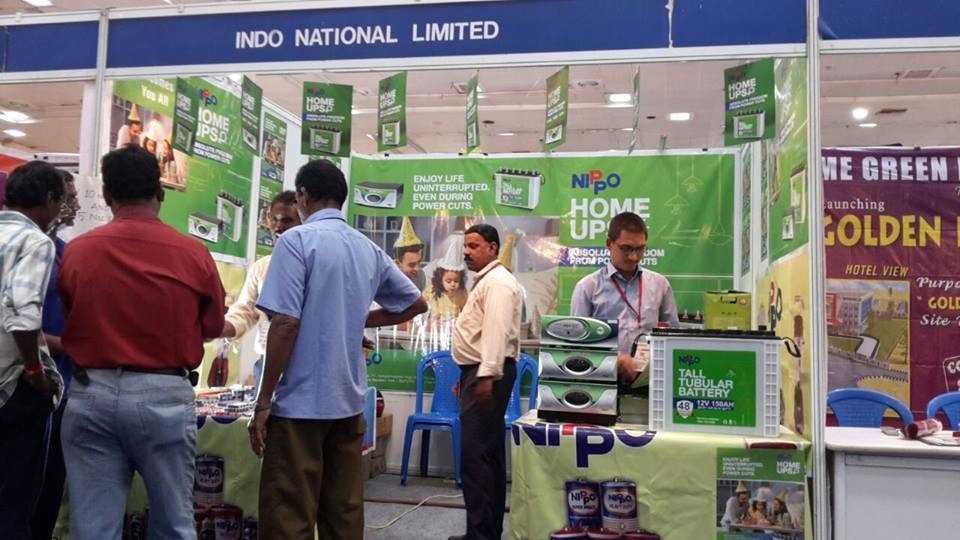
Indo National Ltd H1 FY26: Batteries, Blades & Bold Moves – When Nippo Decided To Shock The Market (Literally)
1. At a Glance
Indo National Ltd — better known to 80s kids as “Nippo – the battery with a longer life” — has returned to the headlines, and this time it’s not just for lighting up torches. The ₹321 crore company, trading around ₹426 per share, recently dropped its Half-Yearly FY26 results — a cocktail of drama, diversification, and a few electric jolts.
With a market cap of ₹321 crore, book value ₹531, and debt-to-equity just 0.10, Indo National looks like a company that spends more time in yoga retreats than in boardrooms. The ROE of 36.7% and ROCE of 32.9% scream operational efficiency, but the sales growth of -21.9% whispers “Houston, we have a problem.”
The stock trades at 0.8x book value, giving that classic “value investor temptation” — cheap but confusing. Despite a 1.17% dividend yield, poor sales growth and rising working capital days suggest the batteries are draining faster than the management wants to admit.
Still, Indo National’s H1 FY26 isn’t boring — they’ve been on an acquisition spree, merged subsidiaries, and even got their subsidiary Kineco Kaman featured in India’s Gaganyaan and Chandrayaan-3 missions. Who knew a company famous for torches would also light up space?
2. Introduction
Indo National started life in 1972 selling batteries when “power backup” meant an extra torch in the kitchen. Over five decades, it’s evolved from “AA battery king” to a multi-segment player in consumer goods, composite structures, and now even medical tech (through acquisitions like Medcuore).
But let’s not sugarcoat it — the road’s been rough. Revenue fell from ₹641 crore in FY24 to ₹467 crore in FY25, and profit slipped into a ₹10 crore loss. The operating margin, once double digits, has turned negative like an old Nippo battery left inside a remote for two monsoons.
Yet, Indo National isn’t rolling over. The company’s pivot into LEDs, mosquito bats, and razors shows it’s trying to reinvent itself for modern households. And then there’s the aerospace twist — its subsidiary Kineco Kaman building composite assemblies for ISRO and BAE Systems. A battery company contributing to space missions — talk about career growth!
So yes, Indo National’s H1 FY26 results look like a fusion of Duracell’s engineering department and a Bollywood plot twist — mergers, acquisitions, space, and even a power purchase agreement with a hospital.
3. Business Model – WTF Do They Even Do?
If you think Indo National only sells batteries, you’re in for a surprise. The company’s product mix reads like a departmental store catalogue: Zinc Carbon and Alkaline batteries, LED torches, mosquito swatters, electrical accessories, razors, and now even air purifiers (thanks to Medcuore).
But that’s not all — Indo National also owns Kineco Kaman Composites, which manufactures aerospace-grade composite structures. This subsidiary supplied assemblies for India’s Gaganyaan human space mission and bagged a ₹100 crore contract from BAE Systems. If that’s not diversification, nothing is.
The core business still remains Consumer Goods (71% of revenue), but Composite & Aerospace contributes a growing 29%. With 17 lakh retail touchpoints and 2,500 stockists, Indo National’s distribution is powerful — but its pricing power? Debatable.
And now, with Helios Strategic Systems merging in, and the acquisition of Medcuore Technologies, Indo National seems to be transforming from a humble torch maker to an ambitious conglomerate. The only question — can it manage so many wires without short-circuiting?
4. Financials Overview – The Half-Yearly Pulse Check
Half Yearly Results (₹ in crore)
Metric
H1 FY26 (Sep 2025)
H1 FY25 (Sep 2024)
Prev Half (Mar 2025)
YoY %
QoQ %
Revenue
239.0
248.7
216.5
-3.9%
+10.4%
EBITDA
6.75
4.11
-3.88
+64.3%
NA
PAT
2.15
1.03
0.08
+108.7%
+2587%
EPS (₹)
1.51
1.36
0.11
+11.0%
+1273%
Commentary: After months of voltage drops, Indo National’s numbers show a faint pulse. Revenue is down marginally YoY but recovering sequentially. EBITDA has turned positive, marking a sharp turnaround from losses last year. PAT has more than doubled YoY, proving that perhaps