Indigo Paints FY26: The ₹1,405 Crore Masterclass in Trading Margins for Market Share
Section 1 — At a Glance
A structural pivot has arrived at Indigo Paints Limited. For eight consecutive quarters, the company navigated a stubbornly subdued decorative paint market, only to hit a geopolitical brick wall in March 2026. The Middle East conflict triggered an abrupt, unprecedented 50% to 100% spike in critical raw materials, squeezing the industry’s supply chains. Indigo responded with a consolidated full-year revenue growth of 4.8%, reaching ₹1,405 crore in FY26, up from ₹1,340.7 crore in FY25. Consolidated profit after tax (PAT) landed at ₹152.2 crore, excluding a one-off gratuity provision of ₹6.13 crore.
While the headline numbers indicate a slow trek, investor attention is locked onto a deeper fundamental shift: management is officially abandoning its long-held strategy of aggressively overprotecting gross margins. Indigo is moving from margin defense to market-share offense, openly signaling its willingness to tolerate a 200 to 250 basis point compression in gross margins to fund aggressive trade schemes and painter loyalty tokens.
The structural risk remains immediate. For instance, working capital days have ballooned heavily from 60 days to 107 days, indicating that pushing volume through the dealer network is requiring a lot more financial grease than it used to. Volume growth has historically trailed value growth, raising questions about real consumer pull versus aggressive channel pushing.
Earnings quality must always be judged by cash efficiency, not accounting declarations. With the massive Jodhpur water-based plant expansion finally ending its heavy spending cycle in June 2026, the company is promising a structural shift into a free-cash-flow monster. The teaser for the coming quarters is clear: will this structural shift create a nimbler market competitor, or will it simply erode Indigo’s premium valuation?
Section 2 — Introduction
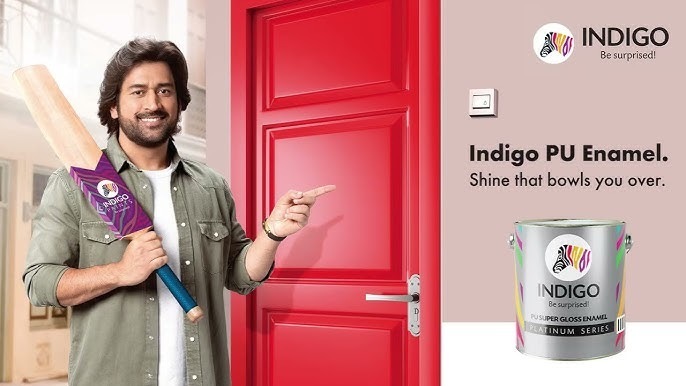
Indigo Paints has built its corporate identity on being the nimble David throwing uniquely textured stones at the massive Goliaths of the Indian decorative paints industry. From its incorporation in 2000, the company systematically avoided head-on price wars with institutional titans. Instead, it carved out highly profitable strongholds by inventing its own product sub-categories, backing them up with heavy spending on high-profile brand ambassadors like MS Dhoni and Mohanlal.
Recently, the strategy has faced structural friction. The domestic decorative paint market has turned into a brutal cage match, featuring aggressive new corporate entrants with deep pockets and legacy players expanding their capacities. Indigo’s response has been a multi-pronged transition, dubbed the “Indigo 2.0 Strategy.” This involves expanding beyond its traditional Southern strongholds into under-penetrated northern markets, establishing “Color Canvas” experiential retail stores, and moving aggressively into the B2B construction chemicals space.
Section 3 — Business Model: WTF Do They Even Do?
If you think Indigo Paints simply puts colored liquid into tin cans, you are missing the entire corporate hustle. They are a decorative lifestyle brand masquerading as a chemical processor. The core model relies on being a “category creator.” Instead of fighting over generic white wall paint, they invented things like Metallic Emulsions, Tile Coat Emulsions, and Floor Coat Emulsions, maintaining an 80% to 90% market share in these specialized niches.
The business operates via a three-legged distribution framework consisting of over 19,350 active dealers, 12,217 tinting machines installed inside those dealerships, and 55 supply depots spread across 28 states. From the factory, inventory flows directly to the 55 depots, which then restock the active dealers. Tinting machines act as the ultimate competitive moat—once a dealer lets Indigo install a machine inside their shop, they are effectively married to the product ecosystem.
To prevent being pigeonholed purely as a retail wall-paint brand, Indigo acquired a 51% stake in Apple Chemie in April 2023 for ₹29.3 crore. This move split the business model into two distinct universes. Retail waterproofing and construction chemicals are sold directly through Indigo’s existing dealer network under the “Protect Plus” series. Meanwhile, Apple Chemie functions as a B2B infrastructure play, supplying high-tech construction chemicals to massive institutional infrastructure contractors like L&T, BG Shirke, and Afcons.
Section 4 — Financials Overview
Figures are consolidated, in ₹ crore.
Quarterly Performance Table
Metric
Latest Quarter (Q4 FY26)
YoY
QoQ
Revenue
₹425.30
+9.70%
+16.03%
EBITDA
₹95.60
+5.31%
+45.07%
PAT
₹59.20
-1.17%
+64.44%
EPS (Reported)
₹12.03
+0.67%
+58.71%
The numbers tell a fascinating story of operational resilience colliding with treasury market-to-market drama. On a standalone basis, Q4 FY26 revenue came in at ₹397.9 crore, up 8.4% YoY. The company managed an impressive standalone gross margin of 48.6%, proving that its premium product mix can withstand quite a bit of geopolitical friction.
However, standalone PAT growth stayed virtually flat at 0.77%, landing at ₹57.3 crore. This mismatch wasn’t an operational failure; it was entirely driven by fixed-income treasury volatility. Standalone other income collapsed from ₹5.6 crore in Q4 FY25 to a microscopic ₹0.19 crore in Q4 FY26 due to mark-to-market losses caused by adverse bond yield movements.
What is Management Promising in the Coming Quarters?
During the May 2026 earnings conference call, the Managing Director delivered a highly confident outlook, explicitly mapping out the financial milestones for the upcoming fiscal years:
“We are embarking on an aggressive growth path… expecting double-digit gross revenue growth trend to continue in the upcoming quarters. For Apple Chemie, we have strong order visibility and are expecting a 30% plus growth rate in FY27 as we expand outside Maharashtra into MP, the East, and the South.”
Management also declared that the heavy investment phase is officially over, explicitly telling the market:
“We do not envisage any further major capex until FY29. The heavy investment cycle is largely complete.”