01 — At a Glance
The Shipping Container That Prints Shiny Metals
Indian Metals & Ferro Alloys (IMFA) is India’s largest fully integrated ferro-chrome producer, accounting for 20% of India’s output and 25% of exports. They dig up chrome ore from their captive mines, blast it in furnaces powered by their own electricity generators, and ship it primarily to China (because stainless steel appliances aren’t going to make themselves). Q3 FY26 saw PAT jump 40.7% YoY to ₹131 crore, driven mostly by “prices” going up by ~₹6,000 per tonne — management’s one-word answer to every question: “prices.” They also just acquired Tata Steel’s Kalinganagar ferro-chrome unit for ₹610 crore, positioning themselves to become the world’s sixth-largest ferro-chrome producer by FY27. The stock is up 92.8% in one year. Your auditor hasn’t slept in weeks.
The Setup: IMFA is a fully integrated ferro-chrome play with captive chrome ore mines valid till 2049/2055 and in-house power generation. They’re not buying raw materials at market prices like some charitable NGO. They dig it themselves. This is how you stay profitable when commodity prices swing wildly.
02 — Introduction
The Steely Pursuit: Turning Chrome Into Cash Since 1961
Look, if you’re reading this on your phone, your stainless steel phone frame probably has IMFA’s ferro-chrome in it. Not directly, but through seven supply-chain handshakes. Your kitchen sink? IMFA. Your car’s exhaust system? IMFA again. The company has been quietly building shiny metals since 1961, which makes it older than half of India’s independence and more relevant than most of your investment theses.
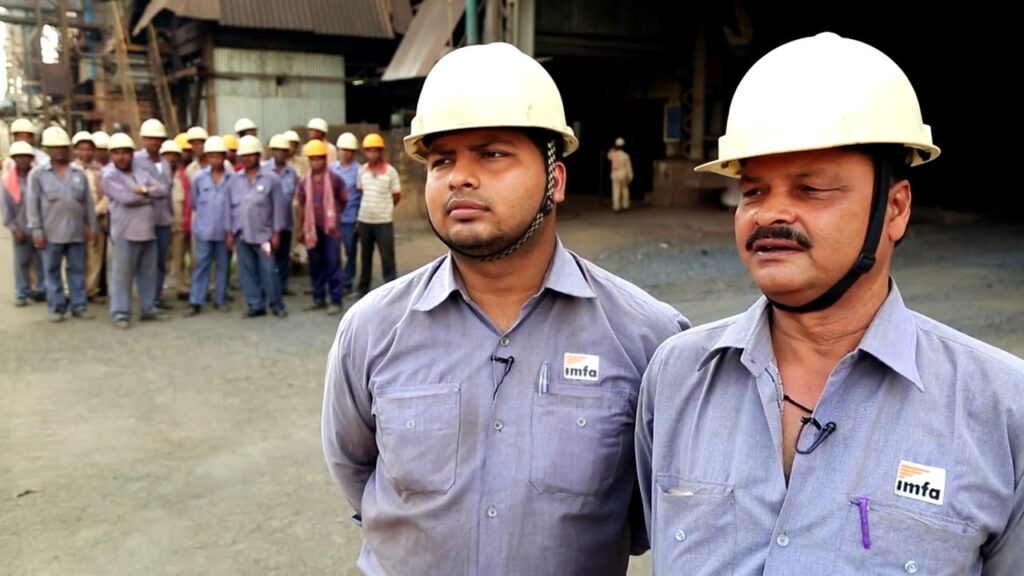
IMFA operates out of Odisha (Therubali and Choudwar plants), mines chrome ore from Sukinda and Mahagiri, and ships ~96% of production overseas. They’re basically a global ferrochrome dealer with a made-in-India stamp. The business model is stupidly simple: mine ore → smelt with power (we generate our own) → sell globally → repeat. There’s no AI. There’s no blockchain. There’s no pivot to sustainable nicotine testing. It’s pure commodity excellence wrapped in the boring shell of “fully integrated operations.”
But here’s where it gets spicy: In Q3 FY26, management walked into their concall and casually announced they’d bought Tata Steel’s entire Kalinganagar ferro-chrome plant for ₹610 crores. Tata was bored with making shiny metals. IMFA was hungry. Now IMFA will transform from a 260K-tonne-per-annum player to a 400–500K tonne global power by FY27. That’s not just expansion — that’s a hostile takeover of the amino acids of shiny metal manufacturing.
Concall Quote (Feb 2026): “We believe in long-term contracts and offtake arrangements. We don’t really have spot sales.” Translation: They’re selling committed tonnage at monthly/quarterly pricing, not playing roulette in the commodities casino like some traders with Telegram groups.
03 — Business Model: WTF Do They Even Do?
Digging Holes, Making Shiny Things, Shipping to China. Rinse. Repeat.
IMFA’s business model is what a perfectly integrated commodity business looks like if you’re not allowed to complain about volatility. Here’s the stack:
Step 1: The Ore Extraction. They own two captive chrome ore mines (Sukinda and Mahagiri, valid through 2049/2055 — that’s basically forever). In FY26, they’re targeting 850,000 tonnes of ore raising (up from ~725,000 tonnes in FY25). By FY27, they’re targeting 1 million tonnes. Underground mining expansion is underway with ~₹1,000 crore capex planned over 4–5 years, mostly via MDO contracts to avoid balance-sheet bloat.
Step 2: The Smelting. Raw ore gets smelted into ferro-chrome using electric furnaces. IMFA operates 6 furnaces at Therubali/Choudwar (284,000 TPA capacity) plus a 30 MVA furnace in the POSCO JV. They use ~2.5 tonnes of chrome ore and ~0.65 tonnes of metallurgical coke per tonne of ferro-chrome produced. In Q3, they produced 67,196 tonnes and sold 64,802 tonnes (inventory management is not an afterthought here).
Step 3: The Power Generation. They generate ~204.55 MW of captive power (mostly thermal, increasingly from renewable PPAs). In Q3, they generated 256.17 million units. This is the moat. When base load power costs are killing your competitors, IMFA is sipping chai and asking “what volatility?”
Step 4: The Export Machine. ~96% of production goes overseas, primarily to China, Japan, and Taiwan. Clients include POSCO, Tsingshan Group, and every major stainless steel producer who doesn’t want to get caught without shiny-metal supply. Management positions this as “long-term offtake arrangements” at monthly/quarterly pricing — not spot market gambling.
The Kalinganagar Play (The New Spice). Acquired Tata Steel’s Kalinganagar plant (₹610 crore) with 99 MVA of smelting capacity (~100,000 tonnes production, plus a partially complete 50,000 tonne furnace needing ~₹50 crore and 1 year to commission). Management expects weighted-average EBITDA savings of ₹1,500–2,000 per tonne due to logistics: closer to captive mines, stainless steel customers, and Paradip port. This is structural cost advantage, not luck.
Market Share20%India Output
Export Share25%India Exports
Captive Mines2Till 2049/55
Power Gen204.55MW Capacity
Consumption Norms (Direct from Concall): Coke per FC tonne = 0.65; Chrome ore per FC tonne = 2.5. These ratios stay stable. When they tell you they’re producing 67,196 tonnes in Q3, you can reverse-engineer the ore volume (~168K tonnes), coke cost (~43K tonnes at ~USD250/tonne), and power usage. No magic. Just math.
💬 If your competitor doesn’t own their own mines and power plant, how do they survive when commodity prices crash? Drop your thoughts.
04 — Financials Overview
Q3 FY26: The Numbers That Made Management Say “Prices”