1. At a Glance
The Indian Hume Pipe Company Limited presents a fascinating case study in financial structural change. Founded in 1926, this infrastructure veteran is celebrating its centenary year with a paradox: its core operational pipeline and engineering business is facing severe structural friction, while its legacy real estate assets are providing massive liquidity cushions. For the financial year ended March 31, 2026, the company reported a headline Net Profit of ₹141.11 crore. However, a deeper forensic look reveals that this profit was heavily supported by an exceptional gain of ₹64.33 crore from selling its freehold land in Azamabad, Hyderabad, to ASBL Private Limited for ₹173.96 crore.
This follows an even larger land monetization event in FY25, where the sale of Yelhanka, Bengaluru land fetched ₹559.00 crore, generating an exceptional net gain of ₹545.22 crore. While these asset sales have dramatically upgraded the company’s liquidity, net worth, and credit ratings, they mask an underlying operational slowdown. Core revenue from operations for FY26 dropped to ₹1,305.57 crore from ₹1,491.23 crore in FY25. More concerningly, the fourth quarter ended March 31, 2026, witnessed a core operational profit contraction, with quarterly Net Profit dropping to ₹22.98 crore compared to ₹49.93 crore in the corresponding quarter of the previous year.
The structural financial realities of the company are highlighted by its working capital dynamics. Operating within the state government Engineering, Procurement, and Construction (EPC) ecosystem, the company struggles with extended milestone billings and a high volume of retention money. This creates an inherently long collection cycle, which sits at 136 days for FY26. Although cash flows from operations improved substantially to ₹293.65 crore due to intense receivable realizations during the year, core operational margins remain thin and highly exposed to volatile raw material inputs like steel and cement.
Investors face an interesting dilemma: a business with a substantial order book of ₹3,922.66 crore as of late 2025 that provides solid medium-term operational visibility, paired with an extraordinary collection of non-core real estate assets that continue to be unlocked. Yet, the core engine’s execution efficiency is dragging, and its return ratios are suppressed relative to peers. Can the company convert its massive cash cushion into high-yielding operational growth, or will it remain a slow-moving asset play wrapped inside a concrete pipe?
2. Introduction
Analyzing a century-old entity requires looking through multiple financial layers. The Indian Hume Pipe Company operates across two distinct segments: its primary Construction/EPC division and its emerging Real Estate monetization portfolio. Over the last few years, management has intentionally pivoted toward large-scale, turnkey government water supply infrastructure projects, under initiatives like the Har Ghar Jal scheme. Consequently, pure pipe manufacturing now contributes less than 10% to total revenues, transforming the firm into a complete project execution house.
From a long-term capital allocation perspective, the business model is heavily front-loaded with working capital. Dealing with state government departments means navigating procedural delays, certification bottlenecks, and prolonged milestone finalizations. This structural lag often leaves a substantial portion of the company’s funds tied up as retention money. This makes the company’s operational performance highly cyclical on a quarter-on-quarter basis.
The true structural transformation over the past 24 months, however, lies on the asset side of the balance sheet. Management has systematically executed land development agreements and straight sales of its idle, historically low-cost factory land banks in major urban areas like Pune, Bengaluru, and Hyderabad. These actions have injected hundreds of crores of cash into the equity base. While this has cleaned up leverage metrics, it presents a unique valuation puzzle for long-term analysts.
3. Business Model – WTF Do They Even Do?
To put it bluntly, this company spends most of its time digging trenches, casting massive concrete and steel cylinders, and laying down the critical hydraulic networks that transport water across India. They are the ultimate plumbers of macro-infrastructure. If a municipal corporation wants to set up a massive drainage network, an irrigation department needs to move river water across agricultural zones, or a hydroelectric plant requires high-pressure penstock steel pipes, they call this company.
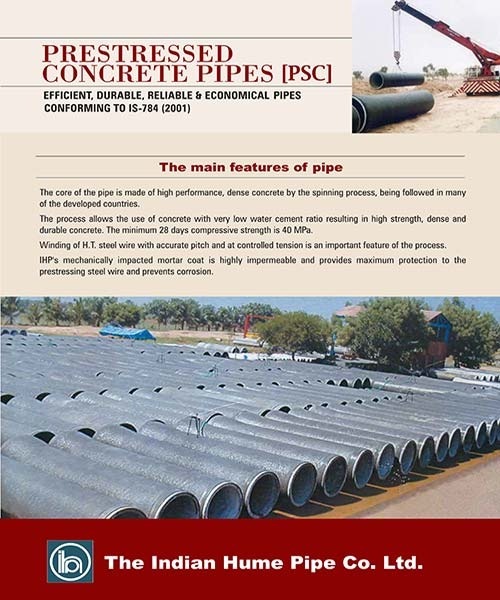
The company operates 19 manufacturing facilities spread strategically across India. These plants produce specialized hardware including Bar Wrapped Steel Cylinder (BWSC) pipes and Prestressed Concrete Cylinder Pipes (PCCP). These lines are engineered to handle high pressures and serve as durable alternatives to standard mild steel or ductile iron pipes. They also cast heavy concrete railway sleepers to supply the Indian Railways, maintaining a steady, albeit low-margin, institutional relationship.
The primary engine of the company is driven by turnkey EPC infrastructure contracts, which bring in more than 90% of total revenue. On the flip side, direct external commercial pipe manufacturing sales account for less than 10% of their operations,