ICE Make Refrigeration FY26: 40% Revenue Surge, Profitability Left Behind
General information and entertainment, not investment advice. The author is not a SEBI-registered adviser or research analyst. No recommendation, no promised returns. Markets carry risk including loss of capital. Figures may not be current. Consult a registered adviser before acting.
1. At a Glance
Revenue crossed ₹667 crore, up 41% on FY25’s ₹472 crore. But profit fell 53% to ₹11 crore. EBITDA margin compressed to 6.4% from 9.1%. The company built three factories on debt, and those plants ran half-empty all year.
The order book sat at ₹237 crore—good coverage, but the new verticals have to work. Management promised FY27 “margin recovery.” Depreciation ballooned to ₹17 crore from ₹8 crore, signalling heavy capex.
One question: does the margin promise hold?
2. Introduction
ICE Make, founded in 1993 and based in Gandhinagar, Gujarat, makes refrigeration equipment: cold rooms for dairies, freezers for quick commerce, ammonia systems for food processors. The company listed in November 2017 and migrated to NSE Main Board in October 2020.
In FY26, management chose speed over margins. The company commissioned three major facilities: a continuous-panel line in Bavla (November 2024, 200 units/day), a commercial-freezer plant (December 2024), and ramped visi-cooler production to 8,000 units annually.
Revenue jumped 41%. But raw material inflation, launch-phase staffing, and warehousing costs consumed the gain. Management’s concall line in June 2026: “We consciously prioritised long-term growth over short-term profitability.”
3. Business Model: WTF Do They Even Do?
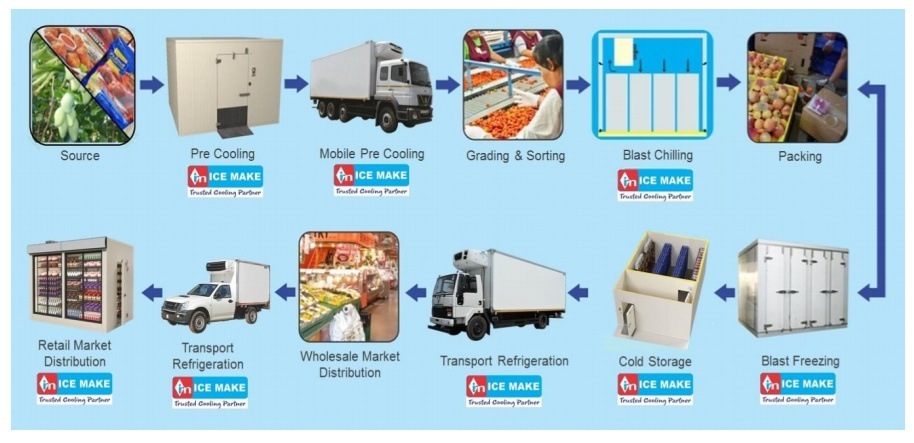
Cold rooms (42% of FY26) are on-site installations for blast chilling and storage. High ticket, long project cycles, fat margins at scale. Commercial refrigeration (14%), visi coolers and chest freezers (26% combined, new), transport refrigeration (6%), and industrial systems (3%) fill the portfolio. Ammonia and project work added 9%.
Distribution: 70% direct sales; 30% through 65 dealers in 16 Indian cities. Clientele spans Amul, Unilever, Coca-Cola, IRCTC—dairy, pharma, retail, logistics. West India dominates (56% of FY24 sales); East, North, South at 14%, 12%, 12%. Quick commerce (dark-store cold rooms) was 13% of FY26 revenue.
Gross margins: continuous panels 14–16%, chest freezers and visi coolers 20–22%. But in FY26, aggressive pricing to build volume compressed realized margins across the portfolio.
4. Financials Overview
Figures are consolidated, in ₹ crore.
Metric
FY26
FY25
YoY Change
Revenue
667
472
+41.3%
EBITDA
46
43
+6.8%
PAT
11
23
-52.8%
EPS
6.90
14.72
-53.1%
EBITDA margin compressed from 9.1% to 6.9%. That 220 basis point drop landed in three places: one-time wage-code and gratuity provisions (~₹4 crore, per management), higher depreciation on the new plants (₹17 crore vs ₹8 crore a year ago), and interest climb to ₹12.4 crore from ₹3.9 crore (debt-funded capex).
Management flagged on the Q4 FY26 concall (June 2026): when the one-time items are excluded, the “underlying” FY26 EBITDA margin would have been “closer to 7%.” Even cleaned, that is weak vs the 9.1% baseline.
Q4 FY26 stood apart: revenue ₹254 crore (42% of annual, slightly front-loaded), PAT ₹9.72 crore. Order book at the end was ₹237 crore, enough to cover Q1 and part of Q2 FY27.
5. Market Expectations & Historical Multiples
This section describes how the market is currently pricing the company and how that compares with its own history and peer group. It is descriptive, not predictive.
Metric
Current
Historical Average (10yr)
Peer Median
P/E
112.7
31–50
31
EV/EBITDA
31.5
15–25
18
ROE
8.2%
17.5%
11.6%
ROCE
10.8%
20%+
14.4%
The market currently pays 112x earnings here, against a peer median of 31x. This valuation sits far above both the company’s own 10-year average and the peer set, despite the fact that profitability collapsed in FY26 and return ratios (ROE 8.2%, ROCE 10.8%) fell to decade lows.