01 — At a Glance
The Government’s Oil Machine Just Woke Up
- 52-Week High / Low₹508 / ₹320
- Q3 FY26 Revenue (Standalone)₹1,15,153 Cr
- Q3 FY26 PAT (Standalone)₹4,011 Cr
- Quarterly EPS (Q3)₹18.85
- Annualised EPS (Q3×4)₹75.40
- Book Value (Per Share)₹267
- Price to Book1.51x
- Dividend Yield (TTM)2.59%
- Debt / Equity1.11x
- 9M FY26 PAT (Consolidated)₹12,274 Cr
Auditor’s Opening Note: HPCL closed Q3 FY26 with ₹1,15,153 crore quarterly revenue and ₹4,011 crore standalone PAT — up 57.7% QoQ and a massive 32.6% YoY. Nine months consolidated PAT stands at ₹12,274 crore, up 206% YoY from a base of ₹4,000 crore. The Visakh Residue Upgradation Facility commissioned in January 2026 is expected to deliver $2.5/barrel incremental GRM. The Barmer greenfield refinery is in final commissioning with first products expected in February 2026. Meanwhile, the stock is priced at 5.6x P/E — barely above Mumbai’s real estate valuations — making institutional money nervous that they’re missing something. They probably are.
02 — Introduction
The Boring Refinery Play That’s Actually Fascinating
Welcome to HPCL — Hindustan Petroleum Corporation Limited. Yes, it’s a government-owned refiner, oil marketer, and operator of 22,953 retail outlets. No, it doesn’t have a blockchain strategy. Yes, it processes 18+ million metric tonnes of crude annually. No, the stock isn’t sexy in WhatsApp groups. And yet — ₹12,274 crore PAT in nine months, a 206% YoY earnings growth, leverage moving from 1.37x to 0.86x in a single quarter, and a management team that sounds like they actually know what they’re doing on a concall.
The company sits at the intersection of three megatrends: refining capacity expansion (Barmer greenfield coming online), operational efficiency (Samriddhi programme delivering ₹1,260 crore in benefits YTD), and deleveraging (interest costs dropping ₹250–300 crore YoY). Meanwhile, every analyst report warns of excise duty increases that haven’t arrived for six months running.
India’s largest lubricant refinery. Second-largest retail network. Coastal refineries in Mumbai and Visakhapatnam with logistical advantages. A 74% stake in a ₹72,937-crore greenfield refinery-petrochemical complex in Rajasthan. And a stock price that’s essentially unchanged for a decade despite compound earnings growth and consistent dividend payouts. The market’s verdict: “Nice company, terrible stock.” The stock’s response: trade at a 50% discount to asset value. Something’s got to give.
Concall Note (Jan 2026): “The harder exam questions have been solved. Projects are coming to fruition. We are on a solid trajectory.” — HPCL Management. Translation: refineries are being commissioned, leverage is collapsing, and we’re not messing about with guidance.
03 — Business Model: Refine It. Market It. Repeat.
From Crude to Pump. The Unsexy Basics.
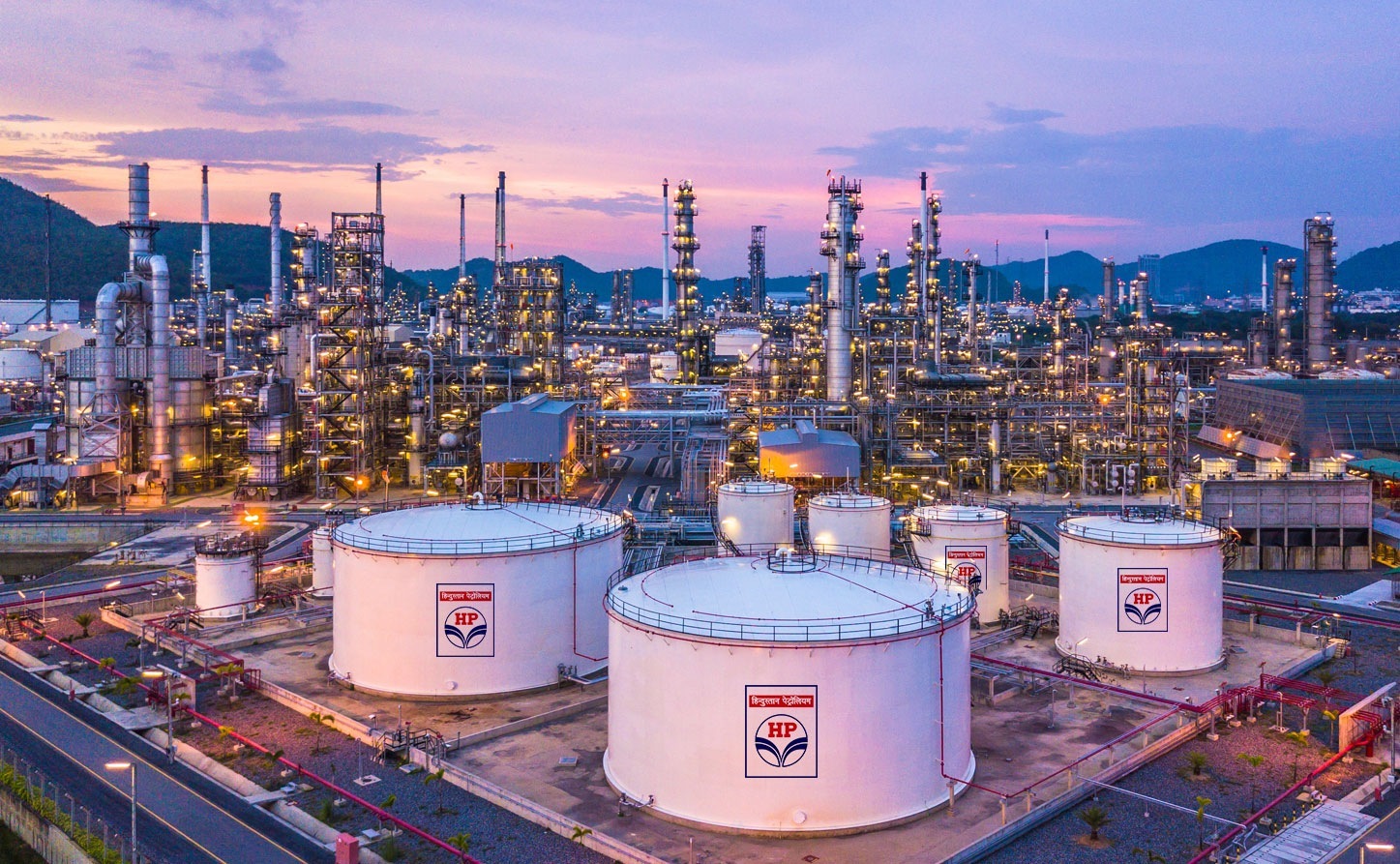
HPCL operates the complete downstream petroleum value chain. Take crude oil (mostly imported). Run it through two coastal refineries — Mumbai (9.5 MMTPA capacity) and Visakhapatnam (13.7 MMTPA pre-RUF expansion). Process it using refinery units like crude distillation, hydrotreating, reforming, fluid catalytic cracking. Generate diesel, petrol, aviation fuel, LPG, bitumen, and petrochemical feedstock. Distribute through 5,134 km of cross-country pipelines. Sell via 22,953 retail outlets and 6,370 LPG distributors to 97 million LPG consumers. Repeat quarterly.
The magic is in scale and location. Coastal refineries mean lower crude logistics costs and inventory holdings compared to inland competitors. Market share of 20.5% in India’s petroleum products. A 13.44% stake in India’s total refining capacity. Plus HPCL owns India’s largest lubricant refinery and operates JVs: 74% of HRRL (Rajasthan Refinery, 9 MMTPA), 16.95% of MRPL (Mangalore, 15 MMTPA), and 50% of HMEL (Bhatinda, 11.3 MMTPA). The refinery network is the moat. Everything else is execution.
Refining profitability swings on Gross Refining Margin (GRM) — measured in USD/barrel, the spread between crude cost and product selling prices. Q3 FY26 GRM was $8.85/barrel (down from $9.08/bbl in FY24 due to B-80 crude contamination at Mumbai). Management targets distillate yields of 82% at Visakh post-RUF stabilization. The Barmer refinery’s delayed coker and advanced units are designed for bottom-of-barrel conversion — essentially converting heavy residue into more valuable middle distillates. Not thrilling for the general public. A 1% yield improvement = tens of crores in annual value.
Refining Cap.~47 MMTPACurrent + In-Progress
Market Share20.5%Petroleum Products
Retail Outlets22,953India Coverage
9M PAT₹12,274 Cr+206% YoY
Capex Reality Check: HPCL has committed ₹71,814 crore for the Rajasthan Refinery project, of which ₹61,821 crore has been spent as of Sep 2025 (89% completion). The fuel refinery portion is 95% complete. The project cost has remained stable — no further escalation anticipated. Capex guidance for next year will be ₹13,000–15,000 crore annually, with a wider spread across refining, marketing, renewable energy, and CGD networks.
💬 Question: If HPCL’s 9-month PAT is up 206% and Q3 earnings alone are ₹4,011 crore (annualizes to ~₹16,000 crore), why hasn’t the stock doubled? Are markets just pricing in mean reversion or is there something about refining cycles you’re missing?
04 — Financials Overview
Q3 FY26: The Numbers That Matter
Result type: Quarterly Results | Q3 FY26 EPS: ₹18.85 | Annualised EPS (Q3×4): ₹75.40 | 9M FY26 EPS: ~₹57.65 (estimated)
| Metric (₹ Cr) |
Q3 FY26 Dec 2025 |
Q3 FY25 Dec 2024 |
Q2 FY26 Sep 2025 |
YoY % |
QoQ % |
| Revenue | 1,15,153 | 1,10,608 | 1,00,856 | +4.1% | +14.2% |
| Operating Profit (EBIT) | 6,998 | 5,495 | 6,852 | +27.3% | +2.1% |
| OPM % | 6% | 5% | 7% | +100 bps | -100 bps |
| PAT (Standalone) | 4,011 | 3,023 | 3,859 | +32.6% | +4.0% |
| EPS (₹) | 18.85 | 14.22 | 18.14 | +32.6% | +3.9% |
Earnings Recalculation Note: CMP ₹405 ÷ Annualised EPS ₹75.40 = P/E 5.37x (screener shows 5.60x — minor rounding on EPS basis). The 9-month FY26 consolidated PAT of ₹12,274 crore annualizes to roughly ₹16,365 crore if Q4 tracks linearly. Current market cap of ₹86,166 crore ÷ ₹16,365 crore = implied forward P/E of ~5.3x. For context, the industry median P/E (refining/marketing peers) is 6.66x for IOC and 6.13x for BPCL. HPCL at 5.6x trades at a 10–15% discount despite superior project execution and deleveraging momentum. The 32.6% YoY PAT growth is driven by: (i) operational efficiencies from Samriddhi programme, (ii) lower interest costs from deleveraging, (iii) stable GRM and marketing margins.
05 — Valuation: Fair Value Range
What’s This Refinery Actually Worth?
Join 10,000+ investors who read this every week.