Health X Platform: Mar 2026: A Pharmacy Platform That Looks Like a Treasury
General information and entertainment, not investment advice. The author is not a SEBI-registered adviser or research analyst. No recommendation, no promised returns. Markets carry risk including loss of capital. Figures may not be current. Consult a registered adviser before acting.
1. At a Glance
Health X Platform trades at ₹281 (prices referenced are not live), a 465x current earnings multiple on reported FY26 net profit of ₹1.18 Cr—where the majority, ₹57.1 Cr, arrived as one-time treasury income.
Strip that out, the operating PAT is negative. Flip the lens: the company runs ₹1,319 Cr in annual revenue through a pharmacy supply network (B2B retailer Shakti and B2C SastaSundar), while holding ₹518.68 Cr in cash and investments—about 55% of market cap.
The market pays 0.68x sales, a fraction of listed diagnostics peers (2–14x). The tension: a platform with scale and zero debt, buried under treasury income and a restructuring scheme that will separate healthcare from finance.
What’s actually cooking underneath?
2. Introduction
Health X Platform (formerly Sastasundar Ventures) was incorporated in 1989 and spent its early decades as a holding vehicle. In 2022, it sat on ₹1,798 Cr revenue—a spike driven by consolidations. Since then, revenue has flattened (₹1,319 Cr in FY26, down from ₹1,432 Cr in FY24).
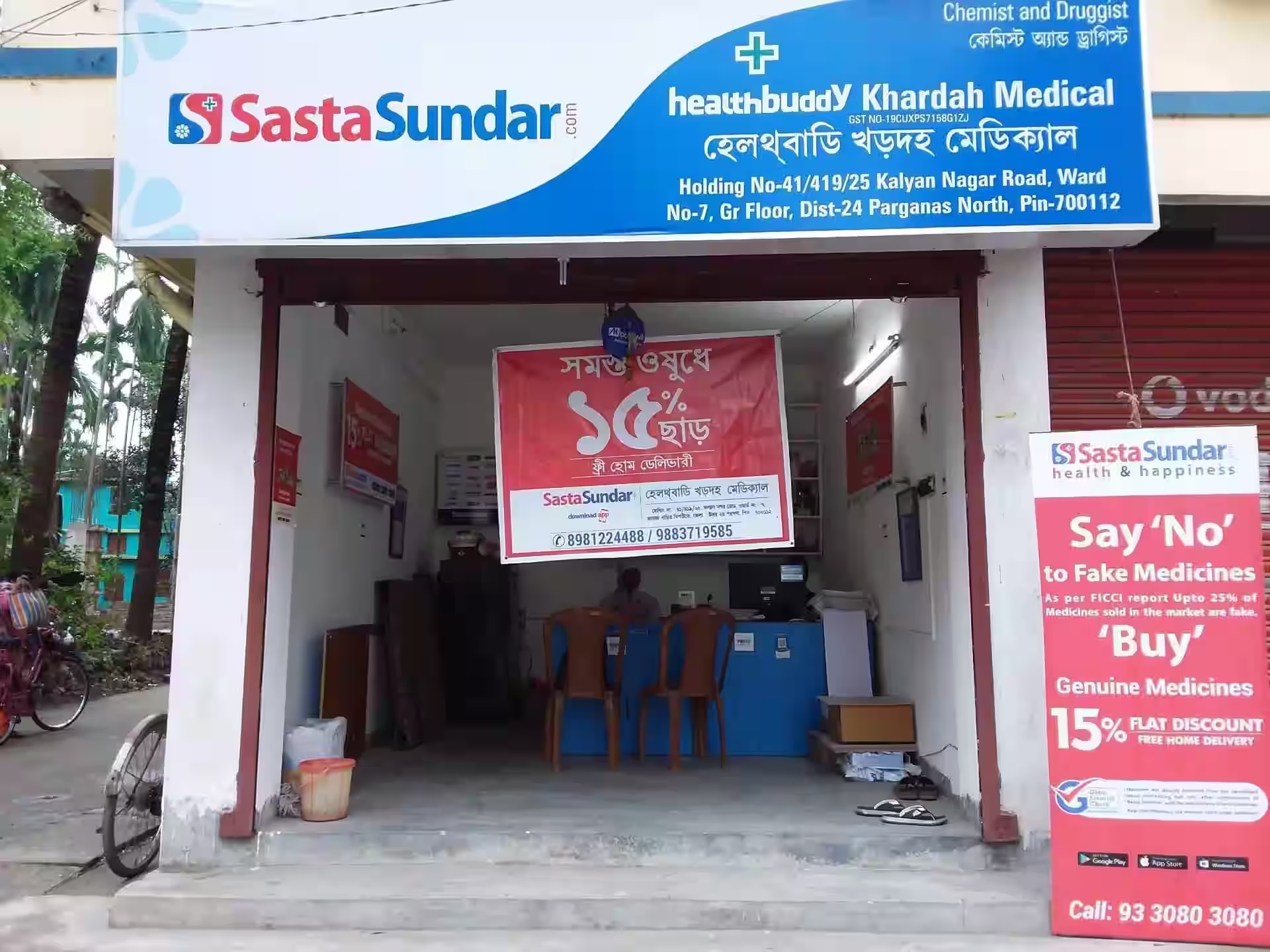
The core business is a digital pharmacy network: Retailer Shakti (B2B, supplying medicines to retail pharmacies), SastaSundar (B2C e-commerce and partnership with Flipkart Health+), and Genu Path Labs (diagnostics, nascent). The group also owns Microsec Resources, an NBFC focused on lending and wealth management—which will be demerged in a planned restructuring to arrive in FY27.
A name change to “Health X Platform” took effect in February 2026. The board approved a composite demerger and merger scheme in June 2026: the NBFC peels off into a separate listed entity, and Sastasundar Healthbuddy (the healthcare subsidiary) will merge into the parent, simplifying the structure.
The stock has given 1% absolute return over the past 12 months.
3. Business Model: WTF Do They Even Do?
Retailer Shakti (B2B Supply Chain)
A platform that supplies medicines, wellness, and FMCG to 65,000 retail pharmacies across India. The value pitch: next-day delivery, no credit (cash/bank transfers only), and pricing 1.5–2% better than traditional distributors. Management claims this forces retailers into less than 1% credit cost via NBFC/bank loans, offsetting the credit-free model.
The network is lean and capital-efficient: receivables sit at ₹7.66 Cr (2.1 debtor days), inventory at ₹144.65 Cr (44 inventory days). No cash burn on credit float. The moat is speed and transparency, not lock-in.
Growth has stalled: management attributed prior quarter slowness to automation bottlenecks at the Baruipur fulfillment center (West Bengal). Capex expansion underway: ₹10 Cr for 80,000 sq ft in WB, plus new centers in Noida (1 lakh sq ft, 1.5 year timeline) and Northeast.
SastaSundar B2C + HealthBuddy Local
The B2C arm sells medicines, diagnostics, and wellness via app and a network of 293 local “HealthBuddy” centers (target 400 by Mar 2027). Orders are 100% digital; HealthBuddies handle last-mile. Management claims the model is “contribution-positive” at the gross margin level, with investment only in salaries and ads (₹15 Cr + ₹11 Cr stated).
The reality is opaque: the concall framed it as “cash positive,” but the P&L shows consolidated losses. The unit economics story relies on management narrative alone; public financials don’t isolate the segment.
JITO (New Private Label)
Launched in Q3 FY26: a private-label generic-generic program sold through the retailer network. Stated unit economics are 30% gross margin and 25% contribution margin—much higher than the core distribution (7–8% gross). Management targets 2–3% of revenue mix next year, scaling to 10% in 3–4 years.
This is the only material margin expansion play in the pipeline.
4. Financials Overview
Figures are consolidated, in ₹ crore.
Metric
FY26
FY25
YoY
FY24
2Y Trend
Revenue
1,319.3
1,158.6
+13.9%
1,432.0
-7.9% (2Y CAGR)
EBITDA
104.5
-12.0
—
-14.1
—
PAT
1.18
-91.2
—
8.88
—
EPS (₹)
0.37
-28.66
—
2.79
—
What Happened
FY26 revenue grew 13.9% YoY, reversing FY25 decline. EBITDA swung from -₹12 Cr to +₹104.5 Cr—a seemingly dramatic recovery, except the concall revealed the nuance: operating EBIT was close to breakeven (Q3: ₹1 Cr), propped by ₹57.14 Cr in other income (treasury gains, most likely from the Flipkart Health+ stake sale in Oct 2024 where the company realized gains).
Operating profit (from P&L sheet) was ₹111 Cr—respectable until you account for the fact that ₹57 Cr of “other income” is a one-timer. Strip it: operating PAT ≈ ₹1.18 – ₹57.14 ≈ -₹56 Cr.
The core business is not yet profitable.
FY25 was a bloodbath: ₹178.77 Cr loss in other income (a reversal or impairment, likely), PAT down to -₹91.2 Cr.
Management guidance (from Feb 2026 concall):
Retailer Shakti to achieve EBITDA breakeven by Q4 FY26, EBITDA-positive in FY27.
B2C to reach contribution-margin positive in FY27, PAT positive in FY28–29.
These are target statements, not forecasts. Execution risk is material.