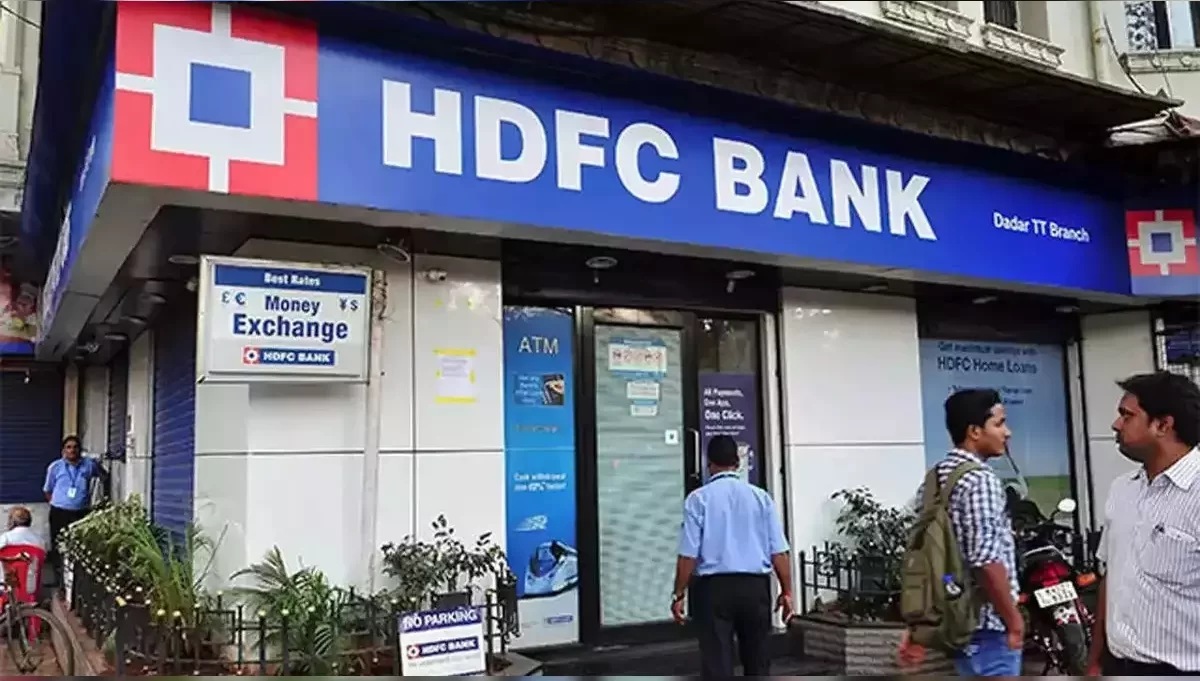
HDFC Bank:
₹18,654 Cr PAT. 14.4% ROE.
Largest Private Bank Hits CD Ratio Ceiling.
Margins under pressure. Deposit growth softer than ambitions. Credit-to-deposit ratio at uncomfortable levels post-merger. But it’s still India’s largest private bank, and the numbers don’t lie — they just whisper.
The Merger Hangover That Won’t Quit
- 52-Week High / Low₹1,020 / ₹835
- Q3 FY26 Net Profit₹18,654 Cr
- 9M FY26 PAT₹55,450 Cr
- Q3 EPS (₹)12.11
- Annualised EPS (Q3×4)₹48.44
- Book Value₹364
- Price to Book2.35x
- Dividend Yield1.28%
- Debt / Equity6.20x
- Credit-Deposit Ratio98.02%
India’s Biggest Private Bank Discovers the Joys of Maturity
HDFC Bank is not a story anymore. It’s a fact. It’s the largest private sector bank in India by assets (₹40 lakh crore as of Sep 2025), the second-largest by advances (₹27.46 lakh crore), and the only private bank classified as a Domestically Systemically Important Bank (D-SIB) by the RBI. It sits on 9,545 branches, 20,993 ATMs, and a customer base of ~100 million. When HDFC Bank sneezes, the banking sector checks its fever.
But there’s a problem. In July 2023, it merged with its promoter HDFC Ltd. That acquisition was supposed to be India’s banking equivalent of uniting Europe — one continent, one currency, infinite synergies. What actually happened: a ₹27+ lakh crore balance sheet overnight, bloated deposits (₹28 lakh crore), surging liabilities, and a CEO now managing something close to a non-bank. ROE fell from 17–18% pre-merger to 14.4% post-merger. ROCE sits at 7.51%, which is… fine? Ordinary? Not “largest bank in India” energy.
Q3 FY26 delivered ₹18,654 crore profit, up 12.2% YoY. But margins are down. CASA ratio is down. Deposit growth is “softer than ambitions,” per management itself. The CD ratio conversation has become the elephant in the concall — management says it’s not constrained by it, but then goes on to explain why they need to rebalance the balance sheet urgently. If you’re not constrained, why do you sound so concerned?
Let’s talk about India’s largest private bank, the merger that changed everything, and the numbers that suggest maturity was always the destination.
It’s a Bank. A Really, Really Big One.
HDFC Bank takes deposits, lends them out, makes money on the spread, and uses other income (investments, fee income, forex) to buff up the margins. Boring? Absolutely. The most profitable business in India? Also yes. Retail advances now make up 56% of the advances book (up from 55% pre-merger) — homes, auto loans, personal loans. Wholesale banking is 27% of revenue. Insurance (HDFC Life + HDFC Ergo post-merger) is 17%. Treasury and others make up the rest.
Pre-merger, HDFC Bank had a 70% CD ratio (industry best-in-class). Post-merger, it inherited HDFC Limited’s massive deposit base but also its mortgage portfolio. In one quarter, CD ratio went from 70% to 104%. Management now talks about a “glide path” to 85–90% over “1-2 years.” That’s a 20% balance sheet restructuring happening in slow motion.
The franchise is absurdly strong. It has market share in 14.5% of India’s advances and 11.9% of deposits. Market leader in mortgages, personal loans, debit cards (5 crore issued, 3x industry average spend per card). It’s the bank your white-collar uncle uses, the one your landlord trusts, and the one every NRI homebuyer defaults to. In fintech land, it’s boring. In return on equity land, it used to deliver 17–18% pre-merger. Now it’s 14.4%, which is respectable but disappointing for a franchise this large.
Q3 FY26: The Numbers (And The Whispers)
Result type: Quarterly Results | Q3 FY26 EPS: ₹12.11 | Annualised EPS (Q3×4): ₹48.44 | Full-year FY25 EPS: ₹46.26
Source table
| Metric (₹ Cr) | Q3 FY26 Dec 2025 |
Q3 FY25 Dec 2024 |
Q2 FY26 Sep 2025 |
YoY % | QoQ % |
|---|---|---|---|---|---|
| Revenue | 87,067 | 85,040 | 86,994 | +2.4% | +0.1% |
| Net Interest Income | 47,710 | 46,914 | 46,741 | +1.7% | +2.1% |
| NIM % | 3.18% | 3.24% | 3.23% | -6 bps | -5 bps |
| Other Income | 39,860 | 27,154 | 31,567 | +46.8% | +26.2% |
| PAT | 18,654 | 18,340 | 20,364 | +1.7% | -8.4% |
| EPS (₹) | 12.11 | 11.54 | 12.76 | +4.9% | -5.1% |
What’s This Bank Actually Worth?
Method 1: P/E Based
FY25 full-year EPS = ₹46.26. Q3 annualised EPS = ₹48.44 (forward proxy). Sector median P/E = 15.4x. HDFC Bank historically justified premium of 1.1x–1.3x sector (moat, scale, franchise). Fair P/E band: 16x–20x.
Range: ₹741 – ₹970
Method 2: P/BV Based
Book Value = ₹364. Historical P/BV: 2.5x–3.5x (pre-merger). Post-merger depression: 2.2x–2.8x. Conservative band: 2.2x–2.8x.
Range: ₹801 – ₹1,019
Method 3: DCF Based
Base earnings: ₹46.26 (FY25). Growth: 8–10% annually (system + HDFC synergy recovery). Terminal growth: 3%. Cost of equity: 11.5%.
→ Terminal Value (3% growth / 8.5% cap rate): ~₹620/sh
→ Intrinsic Value: ~₹854/sh (near CMP)
Range: ₹780 – ₹950
Post-Merger Chaos, Repriced for Patience
🔴 The CD Ratio Elephant: Nobody’s Saying It, Everyone’s Thinking It
Post-HDFC merger, the credit-to-deposit ratio jumped from 70% (best-in-class) to 104% (system-constrained) overnight. Q3 CD ratio: 98.02% (down from 104% in Mar 2024, but still high). Management concall (Jan 2026): “We don’t think we shall be constrained by the CD ratio.” Also management: targets 90–96% for FY26, then 85–90% for FY27. Draw your own conclusions about urgency. The rebalancing will mean slower credit growth (guided at system rate for FY26, above-system for FY27), higher deposit-chasing, and possibly aggressive pricing wars in mortgages and auto loans.
⚠️ Margin Pressure & NIM Compression
- • NIM down 6 bps YoY to 3.18% (9M FY26 annualised)
- • Root cause: term deposit re-pricing lag (5 quarters for rate cuts to flow through)
- • Bank has passed 2/3 of 125 bps policy move into deposits
- • Cost of funds down only 10–11 bps QoQ (slow)
- • CASA ratio down to 34% (industry normal, but structural pressure)
✅ Balance Sheet Resilience & Credit Quality
- • Gross NPA: 1.24% (Sep 2025, down from 1.33% Mar 2025)
- • Net NPA: 0.42% (Sep 2025, stable at 0.42%)
- • Credit cost: 37 bps (net of recoveries, stable)
- • Capital Adequacy Ratio: 20.0% (Sep 2025), comfortable cushion
- • RBI inspection complete, no stress signals reported
The Giant and Its Growing Liabilities
Source table
| Item (₹ Cr) | Mar 2024 | Mar 2025 | Sep 2025 | Latest |
|---|---|---|---|---|
| Total Assets | 36,07,261 | 39,01,040 | 40,03,008 | |
| Deposits | 23,76,887 | 27,10,898 | 28,01,704 | |
| Advances | 25,08,000 | 26,52,000 | 27,46,000 | |
| Borrowings | 7,30,615 | 6,34,606 | 5,99,507 | |
| CD Ratio | 104.4% | 97.84% | 98.02% |
Deposits grew 1.36% QoQ (Sep 2025). Management admitted they “fell short of our strong ambitions.” At this pace, catching up to pre-merger ratios will take another 2 years. Meanwhile, credit hunger persists.
Down from 104.4% (Mar 2024) to 98.02% (Sep 2025) — progress, but the target is 85–90% by FY27. That’s 8–13% balance sheet re-engineering while maintaining growth narrative.
Dependence on wholesale funding (borrowings, bonds, CDs) remains elevated. Bank is using structured borrowings to bridge the CD gap, which increases funding cost pressure.
Operating Cash Flow Tells a Different Tale
Source table
| Cash Flow (₹ Cr) | FY24 | FY25 | 9M FY26 |
|---|---|---|---|
| Operating Cash Flow | +19,069 | +127,242 | +127,242 |
| Investing Cash Flow | +16,600 | -3,651 | N/A |
| Financing Cash Flow | -3,983 | -102,478 | N/A |
| Net Cash Flow | +31,687 | +21,113 | Positive |
Good Franchises Don’t Always Make Good Numbers (Post-Merger Edition)
Annual Performance: Where’s The Juice?
Source table
| Metric (₹ Cr) | FY24 | FY25 | 9M FY26 |
|---|---|---|---|
| Revenue | 283,649 | 336,367 | 260,033 |
| Net Interest Income | 154,139 | 183,894 | 134,433 |
| PAT | 65,446 | 73,440 | 55,450 |
| EPS (₹) | 42.16 | 46.26 | 50.97 (9M annualised) |
The 9M FY26 annualised EPS of ₹50.97 is higher than FY25’s ₹46.26, which sounds great. But it’s built on one-time gains (treasury + other income spiked 46.8% YoY). Strip that out, and core profit growth is low double digits — respectable, but not “largest private bank” spectacular.
HDFC Bank vs The Private Banking Club (Who’s Winning?)
Source table
| Company | Q3 Revenue (₹ Cr) | Q3 PAT (₹ Cr) | P/E | ROE % | NIM % |
|---|---|---|---|---|---|
| HDFC Bank | 87,067 | 18,654 | 17.7x | 14.4% | 3.18% |
| ICICI Bank | 48,364 | 12,538 | 17.73x | 17.9% | 3.15% |
| Axis Bank | 33,709 | 7,011 | 15.55x | 16.3% | 3.44% |
| Kotak Mah. Bank | 17,507 | 4,924 | 21.14x | 15.4% | N/A |
HDFC Bank has the largest absolute profits (₹18.6K Cr/quarter), but the smallest ROE among peers. ICICI Bank: 17.9% ROE at similar P/E. Axis Bank: 16.3% ROE at 15.55x P/E. The post-merger integration is costing HDFC in efficiency metrics, despite unmatched balance sheet size. ICICI is winning the ROE game while sitting at an identical P/E multiple.
The Merger That Broke Promoter Holding
In March 2023, HDFC Limited (the parent) held 25.59% in HDFC Bank. By December 2025, promoter holding was down to 0%. Why? Because when HDFC Limited merged into HDFC Bank (July 2023), the shares held by HDFC Limited were automatically cancelled/absorbed. The result: India’s largest private bank suddenly became a zero-promoter holding entity. In the history of Indian banking, this has never happened before.
Today’s shareholding structure:
- Foreign Institutional Investors (FIIs)47.67%
- Domestic Institutions (DIIs)37.00%
- Public (Retail)15.11%
- Government0.18%
Significant DII holders: SBI Nifty 50 ETF (7.28%), LIC (4.77%), various Nippon India ETFs and mutual funds.
HDFC Limited (Now Merged)
Founded 1977. Largest mortgage lender in India. Merged with HDFC Bank in July 2023 at 42.75:1 ratio. The merger created a ₹40L crore balance sheet. Board now includes Keki Mistry (ex-HDFC VC) and Renu Karnad (ex-HDFC MD).
The Foreign Ownership Angle
FIIs own 47.67% — the largest shareholder block. Government of Singapore (2.27%), Government Pension Fund Global (1.22%), Vanguard (1.24%) are top FII holders. This is a globally-owned Indian bank, operating under RBI scrutiny as a D-SIB.
One of India’s Best-Run Banks. Also, One of India’s Messiest Mergers (So Far).
✅ Governance Strengths
- ✓ Board of 13 directors (7 independent, 3 women)
- ✓ MD & CEO Sashidhar Jagdishan extended until Oct 2026
- ✓ Deputy MD Kaizad Bharucha re-appointed for 3 years (Apr 2026)
- ✓ Zero pledged shareholding (promoters can’t pledge)
- ✓ Clean audit history — no material qualifications
- ✓ CARE rating: CARE AAA (Stable) on all debt instruments
- ✓ RBI inspection complete, no material adverse findings
⚠️ Governance Headwinds
- ⚠ ED Bhavesh Zaveri retiring April 18, 2026 (succession being managed)
- ⚠ Concall notes full of “medium-term” and “glide path” language
- ⚠ RBI imposed ₹0.91 Cr penalty (Nov 2025, minor compliance matter)
- ⚠ DFSA ruling: HDFC DIFC branch barred from onboarding new clients (Sep 2025)
- ⚠ Three senior management exits in Q3 (CHRO, internal vigilance chief)
- ⚠ Merger integration still underway — balance sheet not “normal”
The Indian Banking Sector Is Booming. HDFC Is Just… Normalising.
🏦 The Sector Tailwind: Credit Demand Still Strong
India’s credit growth is running at 10–12% CAGR system-wide. Auto loans are accelerating (EV + ICE). Mortgages are growing 12–14%. Unsecured lending is stabilising post-RBI tightening. MSME lending is recovering. For HDFC Bank, this is a gift. But a gift received while managing a merger integration and CD ratio rebalancing is more like a curse masquerading as opportunity.
💳 The Deposit War: Rates Rising = CASA Declining
Post-RBI rate cuts, CASA deposits across the system are declining. HDFC Bank’s CASA ratio dropped from 38% (pre-merger) to 34% (now). This is structural — not an HDFC problem, it’s a banking system problem. But for a bank trying to bring down CD ratio, it’s a headwind. Retail deposits are growing, but at CASA-adjusted rates, not at the rates HDFC is targeting. Hence “fell short of ambitions.”
📉 The NIM Squeeze: Policy Cuts Taking 5 Quarters to Transmit
RBI cut rates 250 bps from May 2022 to April 2024. Advances repriced faster (70% linked to EBLR). Deposits repriced slower (legacy term deposits take time). HDFC Bank has passed 2/3 of 125 bps into deposits. The remaining 1/3 will flow through by Q1 FY27. Until then, NIM stays compressed at 3.18% (vs 3.5–3.7% pre-merger). This is a timing issue, not a structural problem. But it’s costing ROE in the interim.
🚀 The Synergy Pipeline: Still Untapped
Post-HDFC merge, there’s cross-sell potential (insurance products via bank branches), cost synergies (shared tech, ops), and scale benefits. These haven’t materialised yet because the bank is focused on balance sheet rebalancing. By FY27–28, as CD ratio normalises and deposit growth catches up, expect synergies to show up in ROE recovery toward 15–16%, then slowly to 17%+.
Competitive dynamics: ICICI Bank is winning on ROE (17.9%), partly because it avoided a merger and kept its balance sheet lean. Axis Bank has a smaller scale but better ROE positioning. Kotak is boutique-premium. Among equals, HDFC has the largest franchise but the weakest post-merger metrics. For investors, this is a “wait for synergies to materialise” moment.
Macro headwinds: RBI is being hawkish on retail credit growth (especially auto, mortgages). System liquidity has tightened. Policy rate is paused at 6.5%. Until rate cuts resume (likely H2 FY26), NIM pressure will remain. But this headwind affects all banks, not just HDFC.
The Largest Private Bank in a Quiet Crisis
HDFC Bank is not in trouble. It’s just not where it used to be. The July 2023 merger was supposed to create an unstoppable financial juggernaut. Instead, it created a balance sheet so large and so liabilities-heavy that the bank is now optimising for stability rather than growth. Honest? Yes. Exciting? No.
The Merger Reality: HDFC Limited brought ₹27+ lakh crore in deposits and liabilities. HDFC Bank inherited a CD ratio of 104% overnight. Three years of management commentary later, it’s at 98%. Management says they’ll hit 85–90% over 1–2 years. At current deposit growth rates, that math doesn’t work without either massive deposit repo-pricing or credit slowdown. Likely both.
The Numbers Story: Q3 FY26 profit of ₹18,654 Cr is +1.7% YoY, which is basically flat. Annualised EPS of ₹48.44 is ahead of FY25’s ₹46.26, but that’s because of one-time treasury gains (+46.8% other income). Strip those out, and core earnings growth is low double digits. NIM is compressed at 3.18% (down from 3.5%+ pre-merger). ROE has dropped from 17% to 14.4%. These aren’t catastrophic — they’re just… underwhelming for a bank that claims 14.5% of India’s advances market share.
The Valuation Position: CMP of ₹857 sits within our fair value range of ₹740–₹970. The bank is fairly valued for what it is: a large, stable, best-in-class-execution franchise that’s currently in transition. At 17.7x P/E, you’re not getting a screaming bargain. You’re also not paying for hypergrowth. You’re paying for a mature bank that will eventually generate 15% ROE — if everything goes right.
The Patience Test: If you believe synergies will materialise by FY27–28 (CASA improvement, CD ratio normalisation, NIM recovery from 3.2% back to 3.5%+, ROE back to 15–16%), then current valuations offer a patient entry. If you think the merger permanently downshifted the bank’s economics, then you’re paying fair-to-full price for a slower compounder. The concalls suggest the former; the quarterly trends suggest nervousness.
✓ Strengths
- Largest private sector bank by assets (₹40L Cr)
- 14.5% advances market share, 11.9% deposits
- Pristine credit quality (1.24% GNPA, 0.42% NNPA)
- Excellent capital adequacy (20% CAR, 17.9% Tier-I)
- Cost-to-income ratio of 40% (best-in-class)
- 100 million customers, 9,545 branches nationwide
- Dividend payout consistent at ~23–24%
✗ Weaknesses
- ROE down to 14.4% from pre-merger 17%+
- NIM compressed to 3.18% (from 3.5%+)
- CD ratio still elevated at 98% (target: 85–90%)
- CASA ratio down to 34% (from 38%)
- Deposit growth lagging credit growth
- Earnings growth anaemic (1.7% YoY profit)
- Merger integration still disrupting operations
→ Opportunities
- CD ratio normalisation could free up credit growth
- Deposit re-pricing lag (5 quarters) will flow through by Q1 FY27
- Policy rate cuts resuming would ease NIM pressure
- HDFC Life insurance cross-sell at 9,500+ branches
- Auto, mortgage, MSME credit growth still intact
- Synergies from merger not yet realised
- Retail branch maturity will boost deposit accretion
⚡ Threats
- Policy rates stay paused longer than expected
- Deposit mobilisation remains competitive
- System credit growth slowdown (RBI hawkishness)
- ICICI, Axis gaining ROE faster than HDFC recovers
- Succession risk (DMD change pending, ED retiring Apr 2026)
- Potential regulatory tightening on asset-liability mismatch
HDFC Bank is the elephant that swallowed another elephant and is now trying to figure out how to walk.
It’s not broken. It’s not even struggling. It’s just normalising. A ₹13-lakh-crore bank taking time to integrate and rebalance its liabilities is not a scandal — it’s sound banking. But investors came into this expecting a supercharged juggernaut, not a carefully-navigated merger complex. The reality is somewhere in the middle: a bank that will eventually emerge with 15% ROE and a rock-solid balance sheet, but not for another 1–2 years. Until then, expect slow compounding, patient management commentary, and shares moving sideways. If you’re here for 7–8% annualised returns with a dividend buffer, this is fine. If you’re here for 15% CAGR stock appreciation, you should check back in FY28.