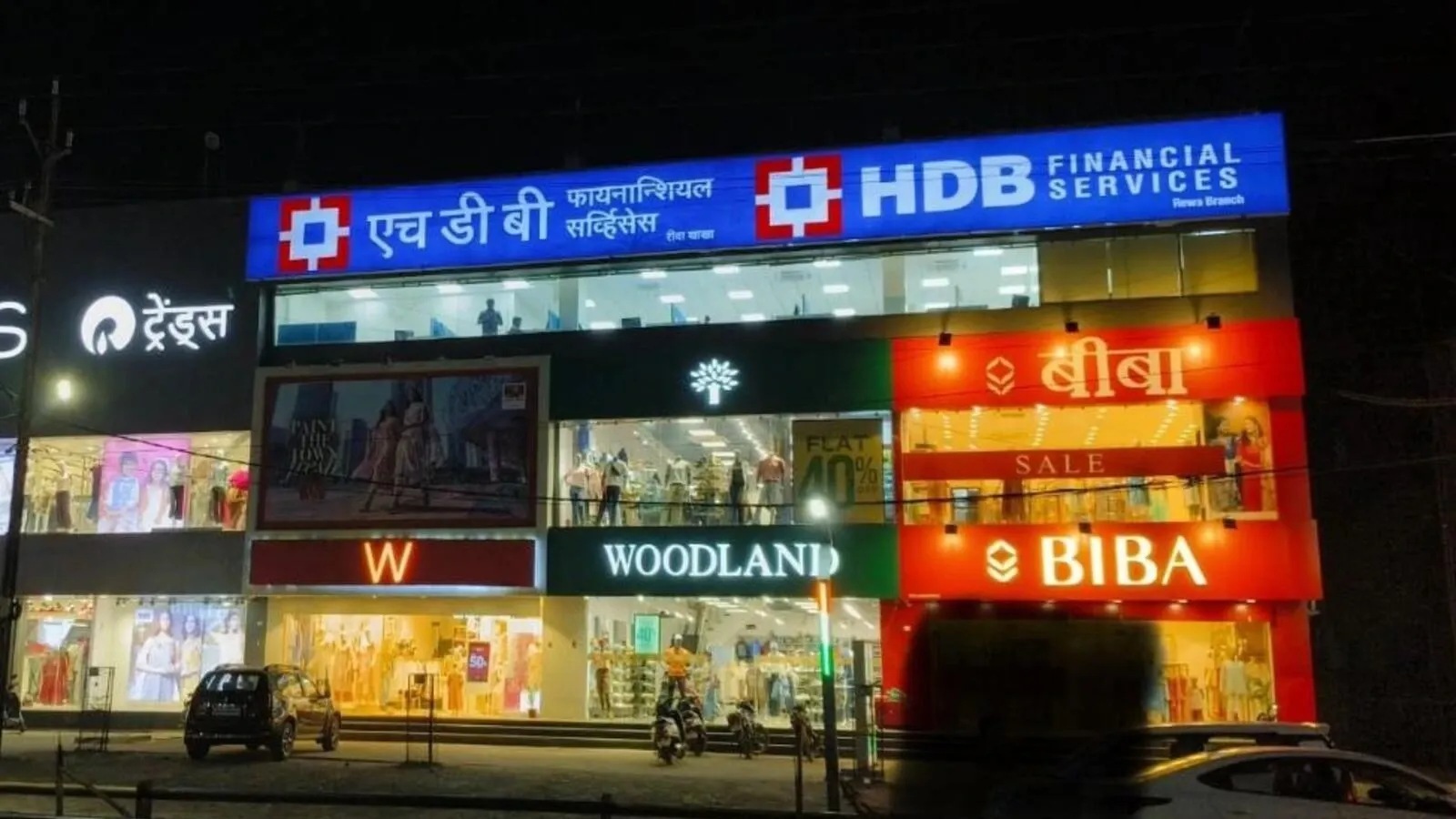
1. At a Glance
There are two kinds of NBFCs in India. The first type spends half its time convincing investors that everything is fine while gross NPAs quietly climb like an unattended gas cylinder leak. The second type has a giant parent, raises debt at AAA rates, lends to half the country, and still somehow gets treated like a mid-tier financier. HDB Financial Services belongs firmly in the second category.
This is an NBFC with a gross loan book of ₹1,18,493 crore, 22.9 million customers, 1,730 branches, and a parent in HDFC Bank sitting with 74.1% ownership. That is not “support.” That is effectively a giant financial oxygen cylinder attached to the company at all times.
Q4 FY26 numbers were strong. PAT came in at ₹751 crore, up 41.4% YoY. Net interest income jumped 21.6%. Net interest margins improved to 8.23%. Gross Stage 3 assets dropped to 2.44% from 2.81% in Q3. RoA improved to 2.48% and RoE touched 14.8%.
Yet the stock is trading at just around 21 times earnings and 2.77 times book value.
That sounds reasonable until you compare it with the rest of the NBFC universe where companies with weaker parentage, lower branch depth, and more aggressive asset quality assumptions are trading at much richer multiples.
The most interesting part is not even the earnings growth. It is the quiet shift happening inside the business.
Consumer finance is now becoming the main growth engine. Auto loans, two-wheeler loans, consumer durable finance, gold loans, and even small-ticket digital lending are all growing faster than the older secured segments. Management has also repeatedly said unsecured MSME stress is easing, early bucket collections are improving, and vehicle finance delinquencies are stabilizing.
In simple language: the messiest parts of the loan book are slowly getting less messy.
But do not assume this is some flawless machine.
Gross NPAs are still higher than FY24 levels. Debt stands at ₹99,230 crore. Borrowing approvals for FY27 are as high as ₹32,824 crore. BPO income has weakened over the last two years. RoE has slipped from FY24 highs. Cost of credit remains elevated at 2.5%.
So this is not a “perfect compounder” story.
This is a story of a very large NBFC trying to balance growth, collections, margins, asset quality and funding cost at the same time — while being shadowed by its much larger parent.
And that is exactly what makes it interesting.
2. Introduction
HDB Financial Services is one of those companies that has spent years being talked about more than being traded.
For years, it was the “HDFC Bank subsidiary that might list one day.” Then it listed. Then investors suddenly realized they were not buying a startup fintech story. They were buying a very large, very old-school lending machine.
The company was incorporated in 2007 and today operates across three main verticals:
- Enterprise lending
- Asset finance
- Consumer finance
Unlike pure-play gold financiers or vehicle financiers, HDB is diversified across multiple lending categories. That means when one segment struggles, another segment can compensate.
For example, during FY26, consumer finance was the star performer while certain parts of commercial vehicle finance and MSME unsecured lending remained under pressure.
The company’s biggest strength is its positioning in what management calls “aspirational India.” That is basically a fancy way of saying it lends to customers who are often outside the core target market of large banks.
These are underbanked households, small businesses, rural customers, semi-urban borrowers, vehicle operators, tractor buyers, and people taking loans for motorcycles, phones and consumer appliances.
Nearly 71% of branches are located in Tier 4 towns and beyond. More than 80% of branches are outside India’s 20 largest cities.
That matters because metro lending is crowded and brutally competitive. But in smaller towns, branch presence, local collections, dealer relationships and distribution become powerful competitive advantages.
And HDB has scale.
Its top 20 borrowers account for just 0.30% of the loan book. Average ticket size is around ₹1.66 lakh. That means this is a highly granular retail franchise rather than a concentrated wholesale book.
The business also gets indirect benefits from HDFC Bank. It shares the same logo, benefits from lower funding cost, gets business referrals, and receives strong confidence from lenders and rating agencies.
CRISIL has reaffirmed its AAA rating on HDB’s debt instruments and facilities, citing strategic importance to HDFC Bank, strong capitalisation and established retail franchise.
The only funny part is that HDB sometimes behaves like it wants to be seen as independent, but every second paragraph of every rating report eventually says the same thing: “Yes, the company is strong, but let us be honest, HDFC Bank is the real bodyguard here.”
3. Business Model – WTF Do They Even Do?
HDB is basically a lending supermarket.
The company lends to salaried people, self-employed people, truck buyers, tractor buyers, gold borrowers, people buying televisions, people buying motorcycles, and even people who want business loans.
The business is divided into three large buckets:
Enterprise Lending
This contributes around 38% of the gross loan book.
Products include:
- Loan against property
- Enterprise business loans
- Business loans
- Personal loans
- Gold loans
This is the segment where HDB deals with small businesses, traders, self-employed borrowers and property-backed loans.
Asset Finance
This also contributes around 38% of the loan book.
Products include:
- Commercial vehicle loans
- Construction equipment loans
- Tractor loans
This is a more cyclical segment because it depends heavily on transport demand, infrastructure activity, rural economy and construction cycles.
Consumer Finance
Consumer finance contributes around 24% of the loan book, but it is the fastest-growing segment.
Products include:
- Consumer durable loans
- Auto loans
- Two-wheeler loans
- Micro lending
- Small-ticket personal loans
This is the business where someone walks into a