01 — At a Glance
The Dairy Behemoth in Valuation Purgatory
- 52-Week High / Low₹1,179 / ₹731
- TTM Revenue₹9,441 Cr
- TTM PAT₹385 Cr
- Full-Year EPS (TTM)₹17.29
- Q3 FY26 EPS₹3.01
- Book Value₹83.5
- Price to Book11.0x
- Dividend Yield0.65%
- Debt / Equity1.08x
- CRISIL RatingAA/Stable (Jan 2026)
The Auditor’s Opening Note: Hatsun closed Q3 FY26 with ₹2,381 crore revenue (+10.5% YoY), ₹120 crore PAT, and a spectacular 14% operating margin. That’s double the sector. Milk Banks at 13,100. Farms tied to the collection system: 5 lakh. Processing plants: 22. CRISIL just upgraded to AA/Stable in Jan 2026. And yet P/E is 53.4x. This is what happens when a dairy company becomes a growth stock by accident — the market hasn’t decided if it’s a blue chip or a moonshot, so it priced both.
02 — Introduction
Meet India’s Largest Private Dairy, Now With PE Memes
Hatsun Agro is India’s largest private-sector dairy company — not “a leading player,” not “among the top three” — literally the largest. Founded by R.G. Chandramogan in 1986 (who is still 54.88% promoter), the company has spent four decades quietly building the most unglamorous, unsexy, but ruthlessly profitable business model in India’s food sector: milk powder, ice cream, curd, paneer, buttermilk, ghee, cattle feed, and chocolate.
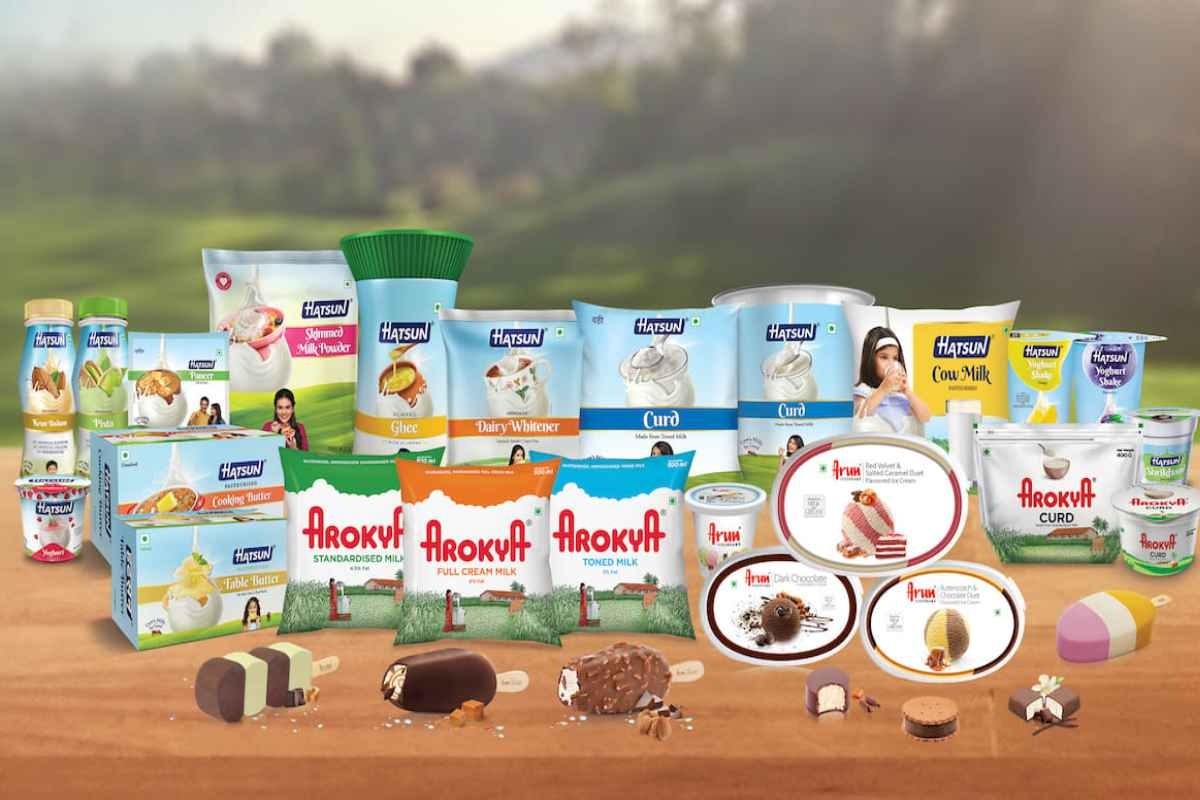
The brands read like a Tamil Nadu road trip: Arokya (milk), Arun (ice cream — south India’s #1), Ibaco (premium ice cream chain, 210+ outlets), HAP Daily (convenience stores, 3,850+ outlets), Hanobar & Havia (chocolates), and Santosa (cattle feed). Post Milk Mantra acquisition in March 2025 (₹233 crore), they also own Milky Moo in Odisha — merging this subsidiary with Hatsun in FY26.
Here’s the beautiful tragedy: the company has delivered 11% revenue CAGR over 5 years, 20% profit CAGR over the same period, maintains 13-14% operating margins, operates a negative working capital cycle, collects milk from 5 lakh farmers daily at 40 lakh litres, and has zero corporate governance scandals in its history. It’s also trading at 11x book value and 53x earnings — which is what happens when growth investors suddenly realize dairy companies aren’t dinosaurs.
Q3 FY26 results just landed. And the story got weirder: operating margins hit 14%, PAT grew 64% YoY (though aided by a softer base), and CRISIL upgraded to AA/Stable. The market shrugged. Let’s figure out why.
Milk Bank Intel: Hatsun operates 13,100 milk collection points covering ~10,000 villages across South India and Maharashtra. Farmers deposit milk. Company runs chilling centres. Direct bank transfer to farmers every 10 days. Zero intermediaries. This is what defensible moats look like when nobody’s watching.
03 — Business Model: Milk → Money → Margins
From Farmer’s Udder to Your Fridge (And Infinite Gross Margins)
The business model is deceptively simple and viciously efficient. Daily: Hatsun collects 40 lakh litres of milk from 5 lakh+ farmers across 13,100 Milk Banks. The milk hits chilling centres immediately. Testing happens (fat content, SNF — Solids Not Fat). Payment to farmer: direct bank transfer every 10 days. Zero middleman drama.
Manufacturing: The milk flows to 22 processing plants strategically located across Tamil Nadu, Andhra Pradesh, Karnataka, Telangana, Maharashtra, and Odisha (new via Milk Mantra). Here’s where the magic happens. The company processes milk into: (1) liquid milk under Arokya brand (~50% of revenue), (2) value-added products like curd, paneer, ghee, buttermilk (~10%), (3) skimmed milk powder — SMP — for export and domestic use (volatile, margin-friendly when global prices cooperate), (4) ice cream under Arun and premium Ibaco chain, (5) chocolates, and (6) industrial lubricants… wait, no, that’s Castrol. Let me re-read. No, Santosa cattle feed. That’s the full portfolio.
Distribution: 3,850+ HAP Daily stores, 210+ Ibaco outlets, 800+ sub-distributors, and traditional retail. The company has expanded aggressively out of Tamil Nadu (which was 67% of revenue 5 years ago, now ~55%). Karnataka, Andhra Pradesh, Telangana, Maharashtra — all growing fast. Odisha is the new frontier post-Milk Mantra.
The working capital cycle? Negative. Customers pay upfront or in 15 days. Farmers get paid every 10 days. Suppliers are managed on 15-20 day cycles. The cash conversion cycle runs at -30 days. The company literally earns interest on other people’s milk.
Daily Milk Processed40 Lakh LLPDFrom 5L+ Farmers
Milk Collection Points13,10013K+ Milk Banks
Processing Plants22Across 6 States
HAP Daily Outlets3,850+Growing Footprint
Capital Intensity: One of the most misunderstood metrics in Hatsun’s story. The company processes 40L LLPD, which requires massive refrigeration, chilling infrastructure, and processing capacity. But most assets are already built. Past 3 years: ₹2,000 crore in capex. FY26 capex is expected to be lighter. This is now a cash-harvesting machine, not a growth investment vehicle.
💬 Quick question: Do you think a negative working capital cycle (where you earn cash before paying suppliers) is sustainable long-term? Or does it create quality-of-life issues with milk suppliers during commodity crashes?
04 — Financials Overview: Q3 FY26 Deep Dive
The Numbers Everyone Missed
Result type: Quarterly Results | Q3 FY26 EPS: ₹3.01 | Annualised EPS (Q3×4): ₹12.04 | TTM EPS: ₹17.29
| Metric (₹ Cr) |
Q3 FY26
Dec 2025 |
Q3 FY25
Dec 2024 |
Q2 FY26
Sep 2025 |
YoY % |
QoQ % |
| Revenue | 2,315 | 2,010 | 2,381 | +15.2% | -2.8% |
| Operating Profit | 257 | 214 | 331 | +20.1% | -22.4% |
| OPM % | 11% | 11% | 14% | Flat | -300 bps |
| PAT | 67 | 41 | 120 | +64.0% | -44.2% |
| EPS (₹) | 3.01 | 1.84 | 5.40 | +63.6% | -44.3% |
The Volatility Story: Q3 FY26 saw a 44% QoQ drop in PAT because Q2 was a blowout quarter with exceptionally high margins (14% OPM). Q3 returned to normalized 11% margins — still healthy, but feels like a miss when you’re chasing growth. The 64% YoY profit growth looks dramatic until you note it’s coming off a weakish Q3 FY25 (₹41 cr PAT) and Q2 FY26 was genuinely exceptional. Operating leverage is real, but cyclical margin swings are part of the dairy volatility game.
EPS Re-Calculation & Annualisation: Q3 EPS of ₹3.01 × 4 = ₹12.04 annualised. TTM EPS (trailing twelve months) = ₹17.29. Why the gap? H1 (April-Sept 2025) was exceptional with ₹268 crore PAT. Q3 is softer. The market’s “normalized” P/E should use TTM EPS of ₹17.29, making the stock trade at 53.4x (922 ÷ 17.29). That’s higher than sector median of 26.2x — a 2x premium for what reason? Growth? Returns? Distribution? Jury’s still out.
05 — Valuation: What’s This Cow Worth?
Three Methods. One Uncomfortable Truth.
Join 10,000+ investors who read this every week.