1. At a Glance
Gujarat Pipavav Port Ltd (GPPL), India’s first private port, just dropped its Q2FY26 numbers, and boy, the ship’s sailing smooth. With quarterly revenue at ₹299 crore and profit after tax of ₹158 crore, this port is doing what most logistics startups only dream of — minting cash while distributing 100% of its profits as dividends. The company announced yet another interim dividend of ₹5.40 per share, making dividend hunters happier than a sailor at shore leave.
At a market cap of ₹7,869 crore and a P/E ratio of 18.3x, GPPL trades cheaper than its big brother Adani Ports (26x) and way more relaxed than JSW Infrastructure’s aggressive 38x. It’s nearly debt-free (Debt: ₹50.6 crore, D/E = 0.02), sits on a juicy ROCE of 24.9%, and boasts a dividend yield of 5.04% — the kind of combo that gives even seasoned investors FOMO.
The company reported 31.8% YoY growth in quarterly sales and 37.8% surge in profit, proving that while most ports drown in capex and debt, GPPL prefers chilling with free cash flow and fat margins. Operating Profit Margin (OPM)? 58%. PAT Margin? 40%. In a world of chaos, Pipavav is Gujarat’s Zen port.
2. Introduction
Welcome to Gujarat Pipavav Port Ltd — India’s first private port and arguably the calmest overachiever in logistics. While others shout about “port-led growth” and “multi-modal synergy” in investor decks, GPPL quietly moves cargo, earns fat margins, and mails dividend cheques like clockwork.
Born out of a partnership between Gujarat Maritime Board and APM Terminals (part of the mighty A.P. Moller-Maersk empire), Pipavav is strategically located near Bhavnagar, perfectly placed on the international maritime trade route that connects India with the US, Europe, Africa, the Middle East, and the Far East.
Its container volumes are rising again — 179,000 TEUs this quarter, up 33% QoQ — while dry bulk volumes are still recovering post-fertiliser slowdown and coal suspension. But unlike other ports that panic when a cyclone hits, Pipavav rebuilds, files the insurance claim, and gets back to work — literally what it did after Cyclone Tauktae in 2021.
So, what’s the secret sauce? Three words: Maersk, Efficiency, and Discipline. GPPL’s Danish parent brings in tech, systems, and cargo flows, while the management sticks to a “no debt, all cash” philosophy. Result? This ₹7,800 crore company has an Enterprise Value of ₹6,927 crore — meaning the market is practically paying you to take its cash flow.
3. Business Model – WTF Do They Even Do?
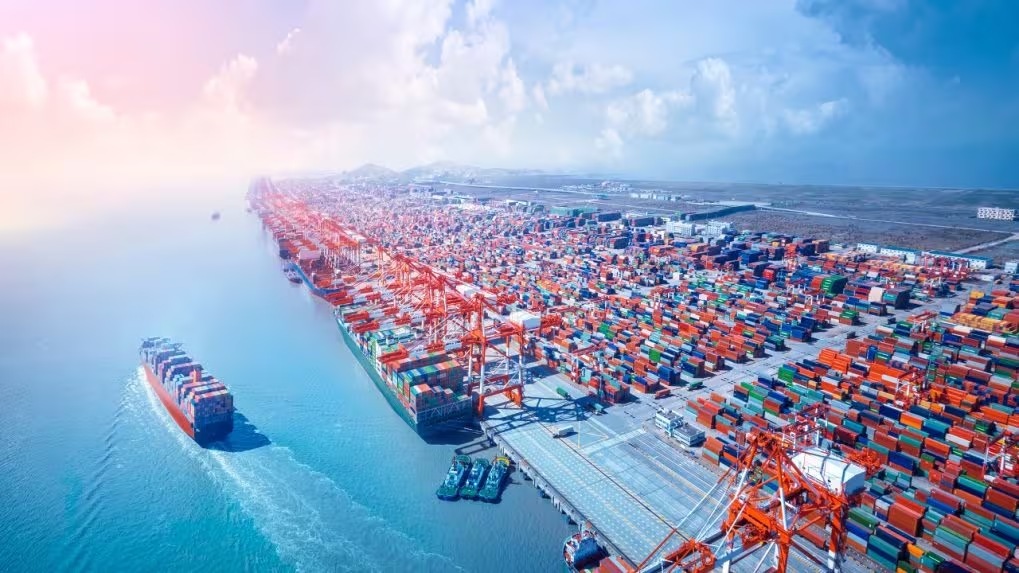
Think of GPPL as a toll booth for global trade, but instead of honking trucks, it handles container ships, bulk cargo, and car carriers.
Here’s the breakdown:
- Container Cargo (60–70% of revenue): The backbone of the business. Handles 1.35 million TEUs per year. Customers include Maersk Line — which alone contributes ~23% of total revenue.
- Dry Bulk: Handles fertilisers, coal, and minerals (capacity ~4–5 million MT). But the segment has seen turbulence, with coal handling temporarily suspended.
- Liquid Bulk: Capacity ~2 million MT. And soon to expand — a USD 90 million new liquid berth is under construction, expected completion by December 2025.
- RoRo (Roll-on/Roll-off): Cars, trucks, and other vehicles — handled using container berths.
Unlike PSU ports that rely on bureaucratic blessings, GPPL operates under a concession agreement with Gujarat Maritime Board until 2028, with ongoing discussions for extension.
The port’s AEO (Authorized