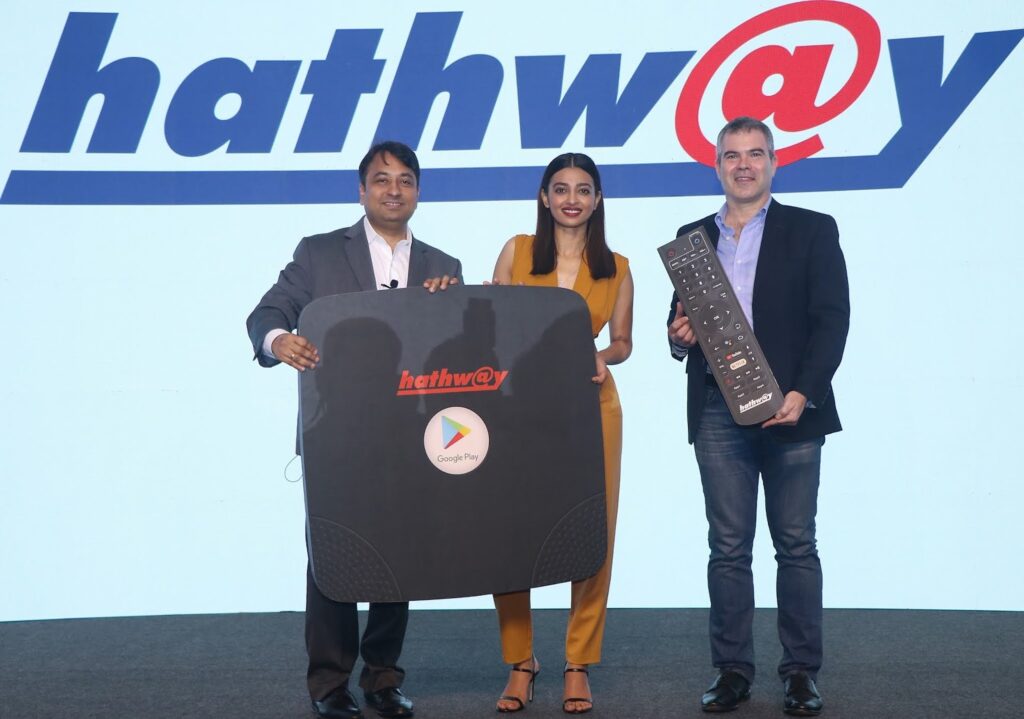
Ah, GTPL Hathway – the company that connects India’s living rooms better than most politicians connect with voters. Founded in 2006, this Gujarat-born cable giant is India’s largest Multi System Operator (MSO) and among the top private broadband providers. In Q2FY26, the company reported revenue of ₹959 crore (+12% YoY) and PAT of ₹7.4 crore (-28% QoQ), proving that while everyone’s watching OTT, GTPL’s still trying to change the channel manually.
At ₹105 per share and a market cap of ₹1,178 crore, the stock trades at 29x earnings — which is ironic for a company whose profit graph looks like a dropped signal bar. ROE at 4.1% and ROCE at 5.9% suggest management’s capital efficiency could use the same booster that their broadband customers are buying.
Still, it’s not all static. With 9.6 million active cable boxes, 1.05 million broadband subscribers, and an upcoming ₹400-crore HITS project (satellite-based content distribution), GTPL is gearing up for a new broadcast era — assuming the Department of Telecom doesn’t unplug them over that ₹975 crore AGR demand.
2. Introduction – When Cable Meets Karma
Imagine explaining to your Gen Z cousin that before Netflix, people watched serials through cables, not clouds. That’s GTPL Hathway — the unsung hero bringing “Sasural Simar Ka” to tier-3 towns while pretending to be the next digital disruptor.
In Gujarat, they’re legends. In West Bengal, they’re household names. In the rest of India, they’re that logo you see while scrolling channels you’ll never watch.
GTPL is like the Reliance Jio of 2010 — but for cables. They distribute 950+ channels (including 95+ HD ones) and run broadband with average monthly usage of 396 GB per user — more than most people use for entire Netflix subscriptions. But here’s the irony — even with millions of viewers and terabytes of traffic, profits are shrinking faster than YouTube ad-skips.
Why? Because the TV industry’s changing. Viewers are cutting cables, not subscribing to them. Broadband margins are under pressure from JioFiber and Airtel Xstream. And amidst all this, GTPL’s trying to reinvent itself with OTT bundles (“GTPL Buzz”, “GTPL Genie”) and an AI chatbot called “GIVA” that’s probably the only thing growing fast at this company.
3. Business Model – WTF Do They Even Do?
GTPL runs two main businesses — both stuck between nostalgia and Netflix.
(a) Digital Cable TV: The bread, butter, and increasingly stale jam of GTPL’s business. It controls 9.6 million set-top boxes, 8.9 million paying subscribers, and offers a buffet of 950+ channels. Revenue comes from subscription fees, placement/carriage income, and marketing incentives. It’s also innovating with OTT hybrid products like “GTPL Genie” — a single interface combining linear TV and streaming content, i.e., an attempt to keep grandma and grandson happy on the same screen.
(b) Broadband: The younger, slightly cooler sibling. With 1.05 million broadband subscribers and 5.95 million homes passed (75% FTTX-enabled), GTPL provides up to 200 Mbps unlimited plans. The average user consumes 396 GB/month — probably half of it on YouTube “funny fail” videos. GTPL’s expansion focus? Cross-sell broadband to cable customers, push rural fiber, and piggyback on Gujarat’s love for fast internet and slow driving.
Revenue Mix (FY25):
Cable TV subscription: 35.2%
Broadband ISP: 15.6%
Placement/Carriage/Marketing: 44.8%
Others: 4.1%
Essentially, they earn more from showing other channels’ ads than their own subscriptions. Now that’s what you call outsourcing profitability.
4. Financials Overview
Metric
Latest Qtr (Q2FY26)
YoY Qtr (Q2FY25)
Prev Qtr (Q1FY26)
YoY %
QoQ %
Revenue
₹959 Cr
₹855 Cr
₹904 Cr
+12.1%
+6.1%
EBITDA
₹104 Cr
₹107 Cr
₹107 Cr
-2.8%
-2.8%
PAT
₹7.4 Cr
₹13.7 Cr
₹7.3 Cr
-46%
+1.3%
EPS (₹)
0.82
1.14
0.94
-28%
-13%
Commentary: Revenue’s growing modestly, but profits are acting allergic to growth. Margins have slipped from 15% OPM a year ago to 10.9%. Costs from tech upgrades and customer acquisition are biting. And with broadband ARPUs flat, GTPL’s bottom line feels like a buffering screen.
5. Valuation Discussion – Fair Value Range Only
Method 1: P/E Approach
EPS (FY25): ₹3.61
Peer P/E range: 15x (Zee) to 63x (Sun TV)
Reasonable range: 18x–25x → Fair Value Range: ₹65 – ₹90