At a Glance
Grindwell Norton (GNO) is currently commanding a market capitalization of ₹19,885 crore, and if you think this is just another sleepy industrial stock, the latest numbers will wake you up. The company has reported a massive 28.3% YoY surge in quarterly PAT, reaching ₹119.34 crore. While the broader markets often fret over industrial slowdowns, GNO is busy widening its gap with competitors.
However, beneath the surface of these shiny profit numbers lies a valuation that might make even the most aggressive investors pause. Trading at a Price-to-Earnings (P/E) of 47.8 and a Price-to-Book (P/B) ratio of 7.86, the market is pricing this company for absolute perfection. Any slight miss in execution could lead to a painful re-rating.
The company’s working capital cycle has also seen a dramatic shift, with working capital days stretching from 62 days to 103 days. This suggests that while sales are growing, the company is finding it harder to squeeze cash out of its operations as quickly as it used to. Furthermore, despite being a market leader, its 5-year sales growth stands at a modest 13.4%, which barely outpaces nominal GDP.
Investors seem to be betting heavily on the “Saint-Gobain” parentage and the company’s shift toward high-margin Ceramics and IT services. But with a PEG ratio of 8.15, the stock is effectively screaming that it is overvalued relative to its growth rate. Is the premium justified for a “debt-free” status, or is the market ignoring the slowing top-line momentum in its core Abrasives business?
Introduction
Grindwell Norton is the Indian jewel in the crown of the French transnational giant, Compagnie de Saint-Gobain. Founded in 1950, it has evolved from a pure-play abrasive manufacturer into a diversified powerhouse spanning Ceramics, Plastics, and even high-end Digital IT services.
The company operates in a space where precision is everything. From the tiny bearings in your car to the massive steel structures in infrastructure projects, GNO’s products are the silent workers. Its recent performance in Q4 FY26 shows a company that is successfully navigating a volatile raw material environment while maintaining a dominant market share.
What makes GNO unique is its integrated business model. It doesn’t just sell “sandpaper”; it provides mission-critical grinding wheels and high-performance ceramics that are essential for the “Make in India” initiative. With four manufacturing sites for Abrasives and two for Ceramics, it has built a formidable supply chain that competitors struggle to match.
However, being part of a global giant comes with its own set of rules. The company is conservative, cash-rich, and rarely indulges in the kind of aggressive leverage that fuels rapid-fire expansion. For some, this is a safety net; for others, it’s a ceiling on growth.
Business Model – WTF Do They Even Do?
If you’ve ever touched a smooth surface on a piece of metal or seen a precision-cut glass, you’ve likely encountered GNO’s handiwork. They are essentially the “smoothers and shapers” of the industrial world.
1. Abrasives (40% of Revenue)
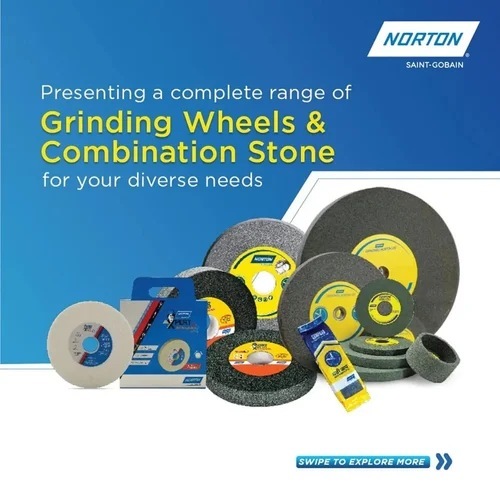
This is their bread and butter. They produce over 15,000 different products ranging from bonded abrasives (grinding wheels) to coated abrasives (sandpaper). If something needs to be sharpened, cut, or polished, GNO has a tool for it. They are the undisputed market leaders in India here.
2. Ceramics & Plastics (44% of Revenue)
This is where the high-margin “sexy” stuff happens. They make silicon carbide, performance plastics, and refractories that can withstand insane temperatures. This segment serves high-growth industries like Aerospace, Life Sciences, and Electric Vehicles (EVs). It’s less of a commodity and more of a specialized engineering solution.
3. Digital Services (19% of Revenue)
Wait, a sandpaper company doing IT? Yes. They run INDEC, which is the offshore IT development center for the entire global Saint-Gobain group. They manage IT infrastructure across 70 countries. It’s a