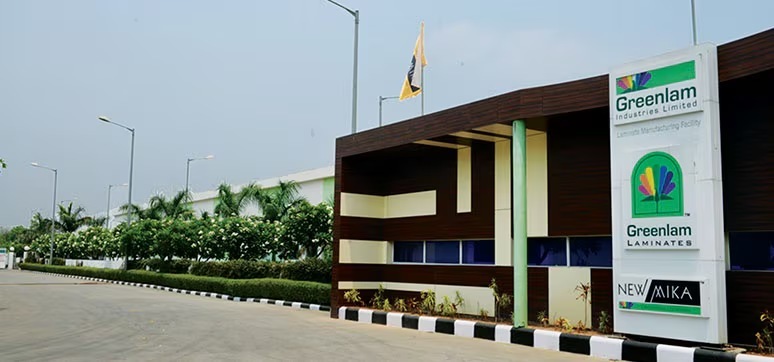
Greenlam Industries Ltd FY26: A ₹3,000 Crore Milestone Wrapped in a Tax Search
For a business whose primary product line is meticulously designed to cover up ugly structural plywood, Greenlam Industries spent the fiscal year ended March 31, 2026, finding out that some corporate realities are incredibly hard to laminate over.
On the surface, the headline figures look exactly like the kind of pitch deck management would happily present to a room full of yield-hungry institutions. For the first time in its corporate history, Greenlam crossed the psychological finish line of ₹3,000 crore in annual consolidated revenue, settling at a shiny ₹3,046.1 crore. Volume growth in its core laminates division held up nicely, and the company proudly retained its title as India’s largest laminate exporter for the sixteenth consecutive year.
But if you peel back the top decorative layer, the substrate underneath looks structurally compromised. Net profit for the full year trickled down to just ₹56.0 crore—a painful drop from the already uninspiring ₹68.3 crore recorded in FY25. Meanwhile, total debt remains stubbornly locked above the four-figure mark at ₹1,055.4 crore. This massive capital outlay over the last three years has triggered a wave of fixed depreciation and interest charges that are currently chewing through operational cash flow like termites through un-treated softwood.
Introduction
Greenlam Industries is essentially what happens when a legacy building materials business decides it wants to occupy every single square inch of your modern apartment’s interior. Originally demerged from the Century Ply lineage years ago, the company has grown into a global surfacing powerhouse. It operates five highly mechanised manufacturing facilities stretching from Nalagarh in Himachal Pradesh down to Naidupeta in Andhra Pradesh.
Lately, management has been on an aggressive capitalization spree. They have injected hundreds of crores into massive greenfield projects to expand beyond their bread-and-butter laminates into plywood, engineered doors, flooring, and massive chipboard plants. The strategic thesis is straightforward: become a one-stop-shop for India’s exploding modular kitchen and real estate markets. The execution reality, however, involves managing complex global supply chains while trying to appease local tax authorities who decided to drop by for an unannounced, multi-day audit right before the fiscal year closed.
Business Model: WTF Do They Even Do?
If you have ever touched a sleek kitchen cabinet, checked out a faux-wood office cubicle, or walked across an engineered floor that felt expensive but sounded slightly hollow, you have interacted with Greenlam’s portfolio.
The business model is divided into three buckets, but structurally it is an absolute monarchy disguised as a democracy:
Laminates & Allied Products: The absolute ruler of the P&L, commanding a massive 85.3% of overall corporate revenues. They turn paper and industrial resins into high-pressure sheets that survive hot coffee spills and toddler tantrums.
Veneers & Allied Products: The luxury niche (7.6% of revenue), dealing in fancy engineered wood, premium flooring, and pre-hung door sets for buyers who find standard plastic laminates a bit too pedestrian.
Plywood & Chipboard: The industrial volume plays (7.1% combined). These are the structural substrates—the heavy, dense particle boards and blockboards that actually hold the furniture together under the laminate skin.
The strategic joke here is that Greenlam has spent the last three years trying to convince the market that it is a balanced “integrated surfacing provider.” In reality, they are a phenomenal laminate company that has strapped a collection of highly capital-intensive, loss-making substrate start-ups to its back, hoping the core engine doesn’t overheat while dragging them to profitability.
Financials Overview
Figures are consolidated, in ₹ crore.
Metric
Latest Quarter (Q4 FY26)
YoY (%)
QoQ (%)
Revenue
₹857.7
+25.8%
+21.4%
EBITDA (without Forex)
₹107.4
+57.1%
+64.6%
PAT
₹40.5
+2,641.4%
—
Reported EPS
₹1.55
+962.5%
—
Did Management Walk the Talk?
During the early part of the fiscal year, management repeatedly assured the street that the massive operating deleverage hitting their newer plants would ease off as capacity utilization moved up. Looking at the Q4 sequential bounce, they have technically delivered a recovery. Q4 revenue surged past ₹850 crore as international buyers stopped delaying their shipments, which temporarily cleared out the logjam built up during a sluggish Q3.
However, looking at the full year, the narrative shifts from triumphant to defensive. Management called their Q4 gross margin of 51.5% “resilient,” yet it was a steep sequential drop from the 55.6% recorded in Q3, courtesy of an unhedged spike in chemical and imported paper costs. The company notes that it successfully passed on these entire raw material hikes to the market in April 2026. Accepting input cost pain for an entire quarter and promising that the customer will pay for it next quarter is an adventurous way to run a consumer brand.
Would you comfortably back a management team that prints double-digit top-line growth while its bottom line shrinks by 18% over the same twelve months?
Valuation Discussion: Fair Value Range Only
To find out where Greenlam sits on the value spectrum, we need to look at its core earnings capacity. For FY26, the company reported a full-year Net Profit of ₹56.0 crore against an outstanding share base of 25.5 crore shares. This gives us a full-year Reported EPS of ₹2.20.
At the current market price of ₹228, Greenlam trades at an astronomical trailing P/E of 103.6x.
1. P/E Multiple Method
The median P/E of the organised wood panel and laminate peer group (comprising Century Ply, Stylam, and Greenply) sits comfortably around 45.5x. If we apply this normalized industry multiple to Greenlam’s actual FY26 EPS of ₹2.20, the mathematical fair value lands at ₹100. Even if we grant them an aggressive premium for their export dominance and value the business at a structural luxury multiple of 65x, the upper bound of the value range tops out at ₹143.
2. EV/EBITDA Method
Greenlam’s FY26 consolidated EBITDA came in at ₹334.2 crore. With a Market Cap of ₹5,827 crore and Net Debt of ₹940.1 crore, its