Goyal Salt FY26: Operating Profit Doubled, Reported Profit Fell — Meet the Vanishing ₹7 Crore of Other Income
Spotted a factual error — a wrong number, date, or fact? Tell us and we will check the source.
General information and entertainment, not investment advice. The author is not a SEBI-registered adviser or research analyst. No recommendation, no promised returns. Markets carry risk including loss of capital. Figures may not be current. Consult a registered adviser before acting.
1 — At a Glance
Goyal Salt closed FY26 with revenue of ₹199.6 crore, a 54% jump over the prior year’s ₹129.9 crore. Operating profit doubled from ₹12 crore to ₹24 crore, and the operating margin climbed to 12% from 9%. By every line that describes the actual business of refining salt, the year was the strongest on record.
Then the reported profit after tax landed at ₹11.35 crore — down from ₹13.25 crore a year earlier.
Both facts are true at once, and the bridge between them is a single row: Other Income, which contributed ₹7.4 crore to FY25 and ₹0.2 crore to FY26. The headline profit that fell was leaning on non-operating gains that didn’t repeat; the operating engine that carried FY26 is the one that’s actually growing.
Underneath, borrowings rose from ₹21.44 crore to ₹44.37 crore in twelve months, funding a Gujarat plant and a fresh capex pipeline. A company that makes an everyday commodity is spending like it has bigger plans. Whether the balance sheet keeps pace with the ambition is the question the rest of this entry sits with.
2 — Introduction
Goyal Salt Ltd was incorporated in 2010 and reconstituted from a private limited company to a listed one in 2023, trading on the NSE SME platform. It refines raw salt drawn from sub-soil brine in Rajasthan, turning it into industrial and edible varieties for B2B and wholesale buyers.
The last two years have been a construction story. In April 2025 the company inaugurated a Gujarat plant at Chirai Moti, lifting installed capacity toward 660,000 MT per annum and stating a ₹300 crore turnover ambition. In November 2025 the board approved a further ₹40 crore, 700 MT/day plant at Bharuch, targeting a twelve-month build, while flagging that its Gandhidham facility was running at 1,500 MT/day. Order flow followed the capacity: a ₹78.36 crore Chhattisgarh contract for 75,000 MT of refined iodised salt in October 2025, and a ₹178.36 crore order referenced alongside the November capacity note.
The financials in this entry are consolidated where stated and drawn from the audited FY26 results. What they show is a business scaling fast on borrowed money, in a category where the product itself costs a few rupees a kilogram.
3 — Business Model: WTF Do They Even Do?
They make salt. Not the artisanal, pink-Himalayan, Instagram-caption kind — the workhorse kind, in bulk, for factories.
The range is broader than a salt shaker suggests: triple refined free-flow iodised salt, refined industrial salt, double fortified salt, and refined half-dry salt, sold under brands including Goyal Salt, Idea Salt, Fortuner, and Apollo Refined Industrial Salt. The customer list reads like an index of Indian industry — chemicals, dyes, textiles, detergents, leather, cattle feed, oil and gas, and food. Roughly 52% of FY24 revenue came from goods it manufactured and about 43% from goods it traded, which means nearly half the top line is buying and reselling rather than refining.
The integrated model — lease rights for raw salt extraction, plus refining, storage, and packaging under one roof — is the moat, such as it is. In a commodity where the finished product sells cheap, the only place to win is cost: sit close to the brine, refine efficiently, move volume. Goyal’s two Rajasthan and Gujarat locations exist for exactly that reason — raw material next door, transport bill trimmed.
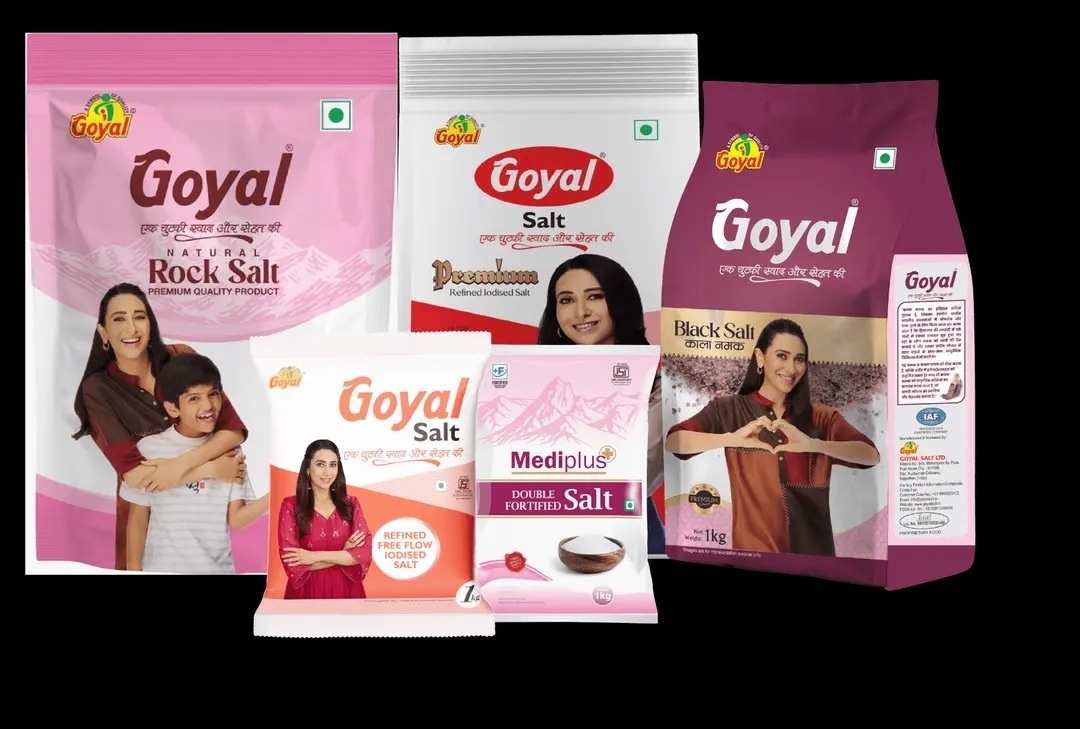
The stated ambition is to climb up the value chain into B2C table salt in small packs, complete with a Bollywood brand ambassador. That’s the pitch. The current reality is a wholesale salt refiner with a distributor network of 60-plus and a claimed 5,000 retail outlets. Does a brand ambassador change the economics of a ₹200-crore commodity business, or just the marketing budget? The volumes will tell before the advertising does.
4 — Financials Overview
Figures are consolidated, in ₹ crore.
Metric
Latest Half (H2 FY26)
YoY (H2 FY25)
Prev Half (H1 FY26)
Revenue
111.41
61.71
88.19
Operating Profit
12
5
12
PAT
4.97
3.92
6.38
EPS (₹)
2.78
2.19
3.56
The second-half top line grew about 81% year-on-year, and half-year operating profit more than doubled against H2 FY25. PAT rose 27% over the same half a year earlier. The sequential dip in profit from H1 to H2 tracks with a heavier interest and depreciation load in the closing half, as the new plant came onto the books.