General information and education, not investment advice. The author is not a SEBI-registered adviser or research analyst. No recommendation, no promised returns. Markets carry risk including loss of capital. Figures may not be current. Always consult a SEBI-registered adviser.
1. At a Glance
Goodricke Group grows tea, processes it, blends it and sells it. The company runs tea gardens and factories, and sells through auction, private sale and export. Revenue was ₹211.30 crore for the three months to June 2026. A year earlier it was ₹174.51 crore, a rise of 21.1%. Operating profit was ₹37.83 crore, against ₹2.91 crore a year earlier. Net profit was ₹40.87 crore, against ₹3.19 crore. Earnings per share for the quarter were ₹18.92, and the company has not annualised that figure. Tea does not grow in equal instalments.
The quarter carried an exceptional gain of ₹5.60 crore. It came from the sale of specified assets of a tea estate for ₹19 crore in May 2026. Other income was ₹10.35 crore. Finance costs for the three months were ₹0.65 crore. The company once carried borrowings of ₹125.5 crore, and that line has gone from shouting to muttering. Borrowings stood at ₹18.62 crore as at March 2026.
Own crop is the leaf picked from the company’s own gardens. Management states that own crop in the three months was 41% higher than in the same period a year earlier. That figure excludes the impact of own crop in tea estates sold. Management attributes the improvement in profitability to higher crop, better realisations, a focus on quality production and cost initiatives.
The board appointed Grant Thornton Bharat LLP as internal auditors for three financial years from FY2026-27. Members approved MSKA & Associates LLP as statutory auditors for five years from the 50th annual general meeting. The statutory auditors issued a qualified conclusion on the quarter’s results, on inventory valuation. Their predecessor qualified the same matter a year earlier.
2. Introduction
Goodricke Group Limited was incorporated in 1977. It has spent nearly five decades growing tea, processing tea, blending tea and selling tea. The name is older than the company. It belongs to the tea world’s long colonial hangover, where estates and brands outlive their owning entities by generations.
Camellia Plc, UK, is the ultimate holding company and holds 74% through its subsidiaries. The public holds the remaining 26%. That figure has not moved across any quarter from September 2023 to June 2026. Twelve consecutive filings have carried the number 74.00, which is either stability or the least eventful spreadsheet column in the market.
ICRA, a credit-rating agency, says in its October 2025 rationale that Goodricke is an established player in the bulk tea industry. ICRA consolidates the company with three group entities in arriving at its ratings. Those are Amgoorie India Limited, Stewart Holl (India) Limited and Koomber Tea Company Private Limited. ICRA reaffirmed its [ICRA]A (Stable) and [ICRA]A2+ ratings on ₹164 crore of facilities.
Recent years have involved a certain amount of estate arithmetic. An agreement for the sale of Chulsa Tea Estate was executed in March 2025. A non-binding memorandum of understanding for the sale of Leesh River Tea Estate followed in April 2025. In July 2025 the company sold specified assets of a tea estate for ₹26.50 crore. It booked an exceptional gain of ₹10.14 crore on that sale. April 2026 brought a non-binding memorandum for Chalouni Tea Estate at ₹19 crore. It was executed in May 2026, with possession transferred and leasehold approval pending. ICRA noted that the sale of two gardens fetching around ₹44 crore was expected to improve cash flows and lower the debt burden.
Leadership changed hands in September 2025. Shaibal Dutt was appointed Managing Director and Chief Executive Officer with effect from 6 September 2025. The results announcement of 27 May 2026 approved the audited results and a 20% dividend. It also set the annual general meeting for 29 July 2026 and named MSKA as statutory auditors. One further item sat in the same filing, with no ceremony whatsoever. It was the launch of a new dairy business.
US
Now live
US Stocks terminal is live
13,000+ US tickers · EDGAR fundamentals · screener and filings feed — the same terminal, for American markets.
Explore →
3. Business Model: WTF Do They Even Do?
The company grows leaves and then crushes them. The country dissolves those leaves in boiling water twice a day, without ever wondering who did the crushing.
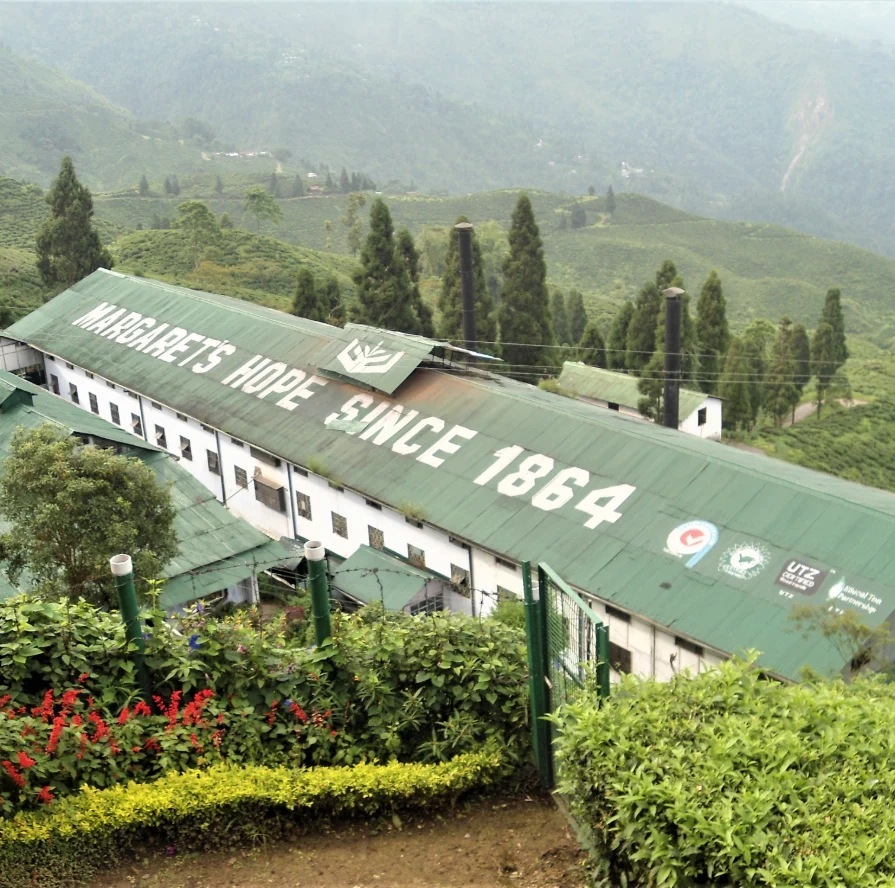
More precisely, Goodricke cultivates tea across 18 gardens and runs 22 factories. Those include a processing factory attached to each garden, tea-blending units and an instant tea plant. The gardens cover 10,311 hectares under cultivation, in West Bengal and Assam. Dooars holds 73% of that area and Darjeeling 9%. Assam accounts for the remaining 18%. The wider Group has 29 tea estates across 17,465 hectares, split roughly evenly between the two states.
The bulk range covers black, green and CTC teas, original and blended. CTC stands for crush, tear and curl, the machine method behind most everyday tea. It spans premium Darjeeling orthodox, fine Assam orthodox and CTC, and full-bodied Dooars CTC. Instant teas come in hot-water-soluble and cold-water-soluble form, including instant black, Darjeeling, green and oolong. The consumer range covers black, green, milk and organic teas. White and flush teas sit in the same range. Somebody at this company has genuinely considered the market for instant oolong.
Sales go out through auction, private sale and export. Per ICRA, a credit-rating agency, the packet tea division accounted for 27% of standalone sales in