Genus Paper & Boards Ltd — FY26: ₹940 Crore of Revenue, ₹14.6 Crore of Profit, and a Fire for Good Measure
Spotted a factual error — a wrong number, date, or fact? Tell us and we will check the source.
General information and entertainment, not investment advice. The author is not a SEBI-registered adviser or research analyst. No recommendation, no promised returns. Markets carry risk including loss of capital. Figures may not be current. Consult a registered adviser before acting.
1 — At a Glance
Genus Paper & Boards Ltd closed FY26 with standalone revenue of ₹940 crore — a 10.7% gain over FY25 — while PAT climbed to ₹14.6 crore, more than doubling from ₹8.1 crore the year before. On a trailing basis, EPS landed at ₹0.57.
The numbers that reward attention: ROCE at 6.17% and ROE at 2.95% — a three-year average ROE of 2%, on a business that has been borrowing at scale. Borrowings have compounded steadily, reaching ₹443 crore as of March 2026 against total equity of ₹507 crore, leaving a debt-to-equity ratio of 0.87. Interest costs of ₹41 crore consumed a meaningful share of an operating profit of ₹80 crore — interest coverage sits at 1.36x.
The company’s market capitalisation is ₹311 crore, which is roughly one-third of annual revenue. The market pays 21.3x trailing earnings, against an industry P/E of 18x, which is a notable premium for a business generating a PAT margin of 1.6%.
Two events from the period earn the bracket-in-red treatment: a fire at the Muzaffarnagar stock yard on May 24, 2026 (after the reporting period), and the disinvestment of wholly-owned subsidiary GPCL to a promoter entity in March 2026. Neither has been quantified yet in the P&L.
The central tension: revenue has grown at 27% CAGR over five years while PAT margin has spent most of that journey below 2%.
2 — Introduction
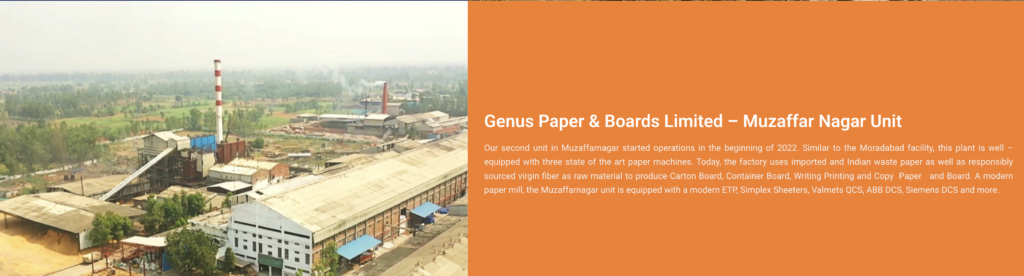
Genus Paper & Boards Limited was incorporated in 1996 and forms part of the Kailash Group of Companies. Its manufacturing roots lie in Uttar Pradesh — plants at Moradabad and Muzaffarnagar — and its products have served packaging supply chains feeding FMCG, consumer durables, pharmaceuticals, garments, and e-commerce companies.
The story of the last several years is partly a capacity story. In FY22, the company completed a ₹225 crore capital expenditure programme that included acquiring NS Papers Limited’s Muzaffarnagar plant and expanding capacity at both locations. By the current period, installed capacity stood at 2.84 lakh MTPA for kraft paper and 1 lakh MTPA for duplex paper, alongside a 12 MW co-generation captive power plant. That build-out was funded significantly by term debt, which explains the borrowings trajectory since FY22.
FY26 brought two material transactions. In March 2026, the company sold 100% of its equity in wholly-owned subsidiary Genus Paper and Coke Limited (GPCL) — a met coke manufacturer — to Hi-Print Electromack Private Limited, a promoter entity, for ₹11.86 crore. The filing flags this as an arm’s-length related-party transaction backed by a valuation report. In FY25, GPCL had contributed ₹14.24 crore in revenue (about 1.65% of group revenue) and ₹22.35 crore to net worth (4.34%).
After the reporting period closed, a fire broke out at the Muzaffarnagar stock yard on May 24, 2026, damaging raw material inventories. The filing states no casualty, no production disruption anticipated, and that affected inventories are adequately insured. The financial impact had not been ascertained at the time of reporting.
FY26 results are presented on a standalone basis. GPCL was disinvested effective March 6, 2026, and all comparative periods have been restated accordingly.
3 — Business Model: WTF Do They Even Do?
Genus Paper makes packaging paper. More specifically, it makes kraft paper and duplex paper — the kind of board that becomes a box that holds your courier delivery, your FMCG bottle, your garment. This is a commodity business with a well-established sense of humility about margins.
The product range spans carton board (multilayer cellulose), containerboard (the corrugated-case material), specialty kraft (higher-strength grades with reduced lignin content), and writing-printing paper. Grades run from 230 GSM to 450 GSM. The company distributes through a network of around 30–35 dealers spread across Uttar Pradesh, Uttarakhand, Rajasthan, Bihar, and neighbouring states.
The raw material is waste paper. This matters because waste paper pricing is a volume-sensitive input that the company does not control, and it is the single largest cost on the P&L — ₹654 crore of raw material costs in FY26 against ₹940 crore in revenue, or roughly 70 paise of every rupee of sales.
The business sits in two segments per the company’s own classification: the paper business (dominant, ₹940 crore segment revenue in FY26) and a strategic investments activity (₹36.4 crore segment revenue in FY26). The investment division holds a portfolio of shares and securities that occasionally generates gains and occasionally does not. In FY26, it generated ₹34.4 crore in segment result, which meaningfully supplemented a paper-business segment result of ₹1,424 crore — wait, that’s in lakhs: ₹14.24 crore from paper, ₹0.34 crore from investments, netting to a ₹14.75 crore PBT. Even in a good year, paper is the engine; investments are the side hustle.
The capacity base at 3.84 lakh MTPA (kraft + duplex combined) is large relative to historical output — in FY25, production was 1,14,343 MT, suggesting the Muzaffarnagar additions have not yet been fully digested.
The question that sits quietly in the background: can a commodity packaging board company with ₹41 crore in annual interest costs and a 1.6% PAT margin run hard enough on volume to make the capital structure work? A 2,700 bps move in operating margin from 4% in FY23 to 8.4% in FY26 — either operating leverage finally arriving or a cost-mix shift toward higher-margin grades, possibly both. The filings don’t settle which.
4 — Financials Overview
Figures are standalone, in ₹ crore. This is an annual result for FY26 (year ended March 31, 2026).
Metric
FY26
YoY Change
FY25
Revenue
₹939.97 Cr
+10.7%
₹849.15 Cr
EBITDA (PBT+Int+Dep)
₹79.6 Cr
+14.3%
₹69.7 Cr
PAT
₹14.58 Cr
+80.4%
₹8.08 Cr
EPS
₹0.57
+83.9%
₹0.31
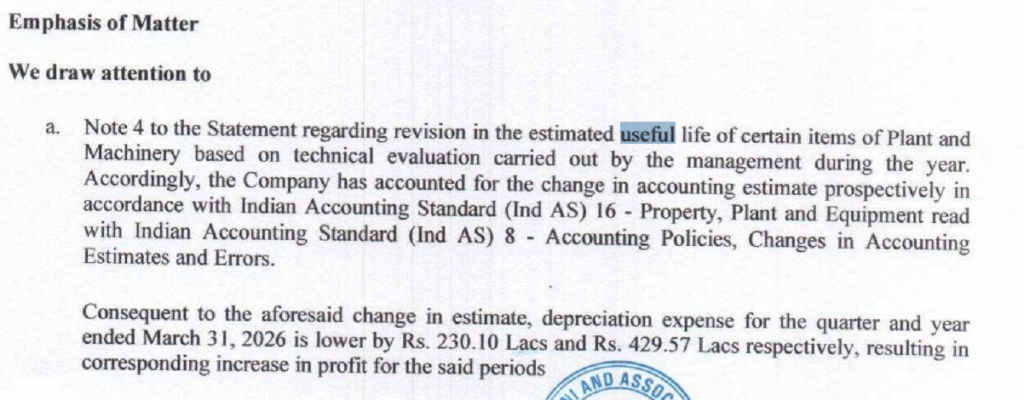
Operating profit margin held at 8.41% in FY26, essentially flat from 8.01% in FY25. The large PAT jump relative to EBITDA growth came primarily from two sources: the tax expense remained near-zero (deferred tax of ₹0.17 crore on a ₹14.75 crore PBT), and the auditor’s report flags that a reassessment of plant & machinery useful life — revised to 35–40 years based on an independent chartered engineer’s evaluation — reduced depreciation by ₹4.30 crore for the full year, per the filing. PAT margin for FY26 stands at 1.55%.
Revenue from the latest quarter (Q4 FY26) was ₹226.09 crore, up 0.67% year-on-year from ₹224.58 crore in Q4 FY25.
The filing notes that the company’s wholly-owned subsidiary GPCL was disinvested effective March 6, 2026, and results are presented on a standalone basis. Comparative period figures have been restated accordingly.