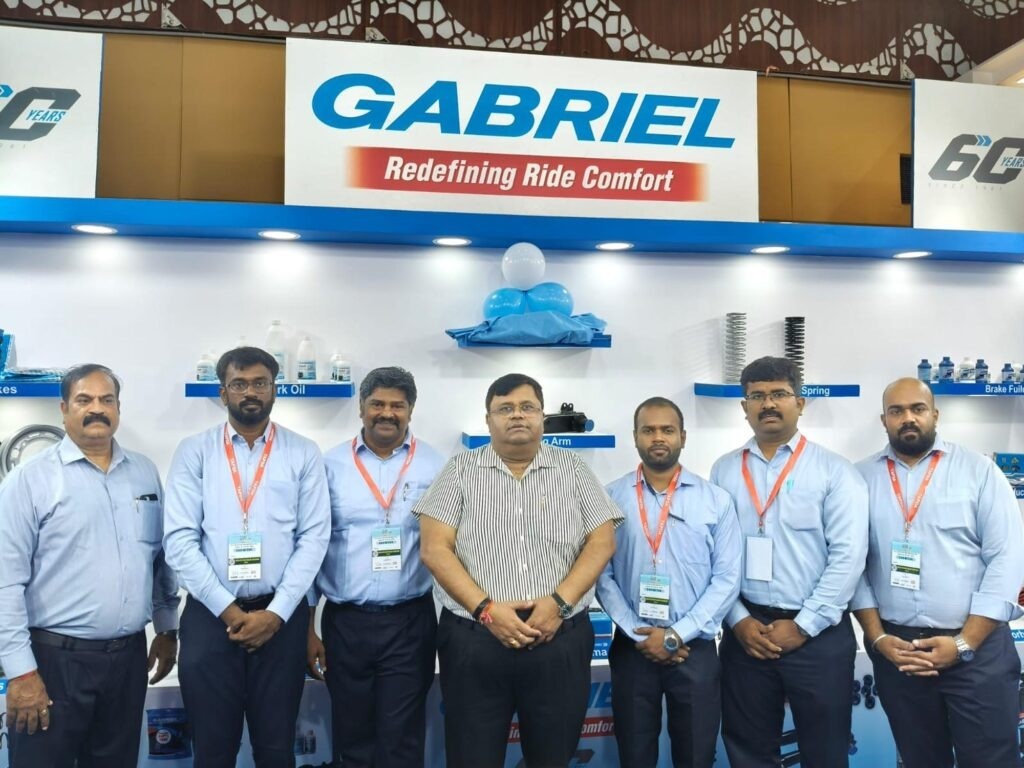
Gabriel India Q4 FY26: The Shock Absorber That Won’t Break
General information and entertainment, not investment advice. The author is not a SEBI-registered adviser or research analyst. No recommendation, no promised returns. Markets carry risk including loss of capital. Figures may not be current. Consult a registered adviser before acting.
1. At a Glance
Gabriel India reported ₹1,111 crore in Q4 FY26 revenue, up 19% year-on-year. Net profit for the quarter stood at ₹61 crore, a 13.8% uptick. The full year FY26 net profit reached ₹243 crore, a 14.8% increase over FY25’s ₹211.87 crore.
Operating margin expanded to 8.7% in FY26 from 7.3% in FY25—the company’s squeeze on costs is visible. The balance sheet remains nearly debt-free with borrowings at just ₹34 crore. Cash on hand climbed to ₹169 crore from ₹37 crore a year ago.
But the stock sits at 55.6x trailing earnings while peers cluster at 26.6x. The company is diversifying hard—a lubricants venture with SK Enmove, fasteners with Jinhap, sunroofs accelerating. The restructuring scheme (Project Rise) closed this month. Something is cooking.
2. Introduction
Gabriel India, established 1961, makes ride-control products—shock absorbers, struts, front forks, dampers. It is part of the Anand Group. The company manufactures over 500 models and serves two-wheelers, three-wheelers, passenger cars, commercial vehicles, railways, and aftermarket segments across six continents.
The company dominates the commercial vehicle segment with 88% market share. In two-wheelers it holds 32% market share. Passenger vehicles see 24% market share. The aftermarket accounts for 11% of revenue; OEM channels bring 89%.
On 22 May 2026, the composite scheme of arrangement (Project Rise) became effective. Anchemco India merged into Asia Investment Private Limited, whose automotive undertaking then demerged into Gabriel India. The result: Gabriel now holds stakes in Dana Anand (25.1%), Henkel Anand (49%), and Anand CY Myutec (76%). Promoter holding rises from 55% to 63.5%. This is a consolidation into the Gabriel brand—not yet a capital-intensive merger, but a structural reshaping.
3. Business Model: WTF Do They Even Do?
The core: suspension components for vehicles, broadly two channels.
OEM (89% of revenue): Direct sales to TVS, Honda, Yamaha, MSIL, M&M, Skoda, Volkswagen, Tata Motors. The two-wheeler base (Hero, TVS, HMSI, Yamaha) contributes 64% of segment revenue. Passenger vehicles (MSIL, M&M, Skoda, VW) bring 23%. Commercial vehicles and railways (TML, M&M, AL) add 12%. Trading accounts for 1%.
Top customer is 27% of revenues; top five are nearly 66% of revenues. Concentration risk is the price of being essential.
Aftermarket (11%): 700+ dealers, 25,000+ retail outlets, 10 CFA locations. The company’s “fit-and-forget” positioning is about genuine OEM-grade components that replacement buyers trust. Aftermarket has grown consistently year on year.
The new stuff: Sunroof business (via IGSSPL, fully owned) hit ₹434 crore in FY26, up from negligible. Penetration around 24-25% of models. Margins at 15.1% EBITDA. Five new models coming; the order book is robust. SK Enmove JV (lubricants and e-fluids, 49% Gabriel) has started sales; two OEM wins already. Jinhap fasteners JV (51% Gabriel) plant under construction; September completion expected. Solar dampers in development across Europe, Americas, Asia. Bicycle component innovation won an award at Eurobike.
The business is no longer just shocks. It is becoming a mobility-solutions play—still weighted to suspensions, but drifting.
4. Financials Overview
Figures are consolidated, in ₹ crore, quarterly basis.
Metric
Q4 FY26
YoY Change
Q3 FY26
Revenue
1,111
+19.3%
1,073
Operating Profit
97
—
92
Net Profit
61
+13.8%
66
EPS (₹)
4.26
—
4.57
Full year FY26 revenue was ₹4,233 crore, +16% YoY. Net profit reached ₹243 crore, up 14.8% from FY25. EBITDA margin (standalone) improved to 9% from 8.7% in the prior year.
Operating performance:
Management highlighted broad-based volume recovery in domestic segments. Two-wheeler production +21% YoY in Q4; passenger vehicles +11%; commercial vehicles +19.5%. The company outpaced underlying industry growth across all three segments. Sunroof ramp-up contributed to consolidated revenue growth (consolidated saw 15% YoY growth to ₹4,667 crore in FY26).
Q4 gross margin faced pressure from supply-chain stress, commodity inflation (aluminum, gas shortages in March), and a deliberate shift to prioritize OEM production over aftermarket. Aftermarket and export volumes took a backseat; management called it a “calculated allocation.” Commodity pass-through to customers is now on a monthly settlement basis, adding volatility. Yet, management reiterated customer willingness to pay recovery and cited “most important is to ensure recovery”—a signal that pricing power remains intact.
5. Valuation Discussion: Fair Value Range (Educational Only)
What follows is a walkthrough of how three valuation methods work, using this company’s numbers as the example — not a target, not a forecast, not advice.
Method 1 (P/E Multiples): Annualised FY26 net profit is ₹243 crore ÷ 14.36 crore shares = ₹16.93 EPS. Peer median P/E is 26.6x. At peer median: 16.93 × 26.6 = ₹450. At peer band (13x–55x, the range of the peer table): 16.93 × 13 to 16.93 × 55 yields ₹220–₹931.