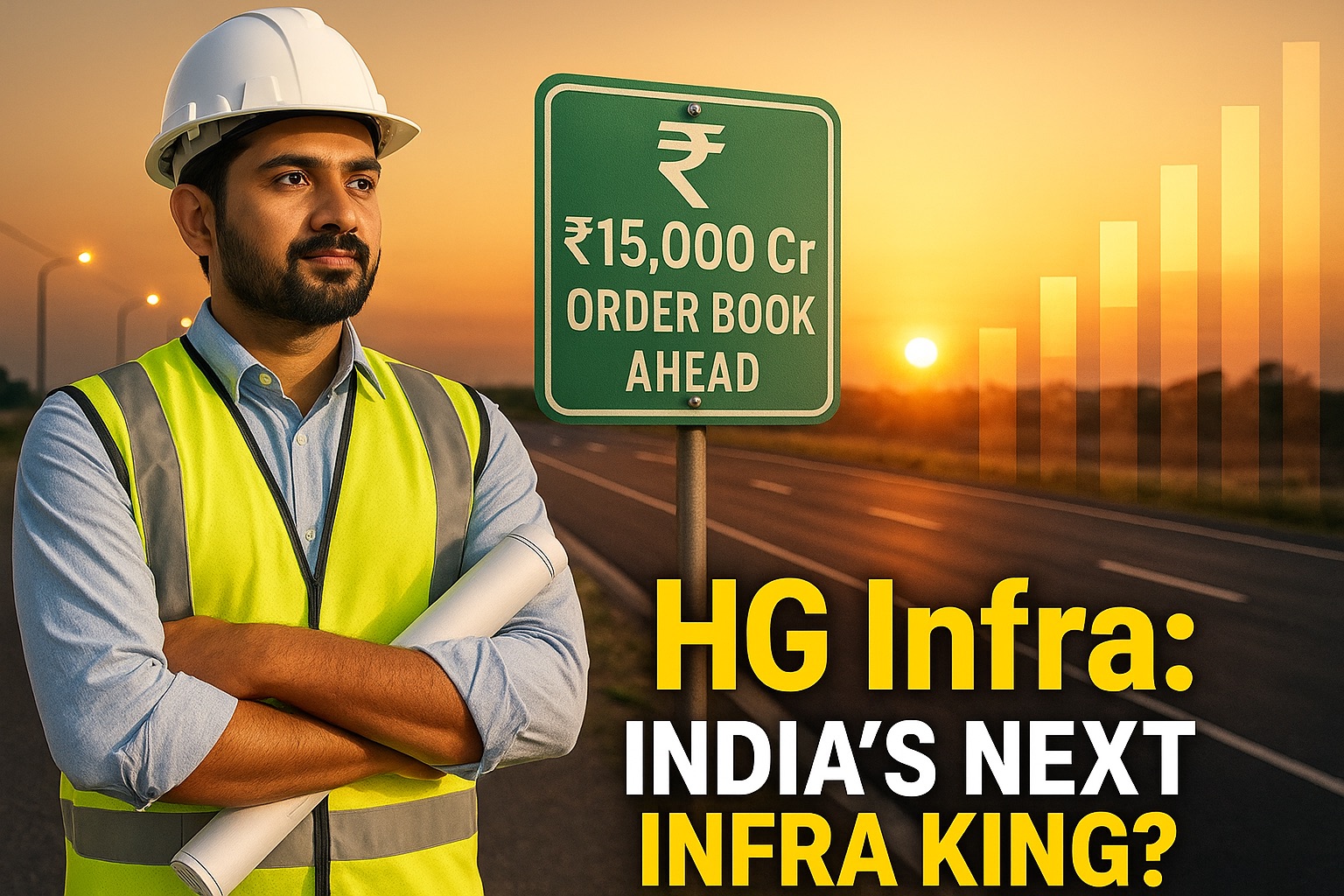
From Bonus Miles to Battery Storage — Is This the Most Underrated Infra Giant in India?
📜 Disclaimer (Read This Before You YOLO)
This EduInvesting Premium Report is not a stock tip, not a buy/sell/hold call, and definitely not your financial planner’s cousin’s advice.
We’re a financial content platform — not SEBI-registered investment advisors. This research is for educational and informational purposes only.
We use public data, company filings, and meme-grade analysis to highlight interesting businesses. We may express strong views, but they’re just that — views, not recommendations.
Stock markets involve risk. Past performance means jack about the future. DYOR = Do Your Own Research. Invest responsibly, or don’t. But don’t blame us if your SIP cries.
If you make gains — tell your friends. If you make losses — tell your therapist, not us.
“Consult a SEBI-registered adviser before acting.”
Page 1 — Why This Stock?
H.G. Infra Engineering Ltd (HGIEL) has quietly become a rising star in India’s infrastructure arena. In an industry known for delays and debt traps, HGIEL has bucked the trend by delivering projects ahead of schedule and growing at breakneck speed. In fact, it was recognized as the 2nd Fastest Growing Construction Company (Medium Category) in 2023hginfra.com. Over the past decade, the company’s revenues have exploded more than 10x (from ₹471 crore in FY2014 to ₹5,056 crore in FY2025)screener.in – a CAGR north of 30%. Earnings have followed suit, climbing from a measly ₹17 crore to over ₹500 crore in the same periodscreener.in. Few construction firms can boast such a consistent upward trajectory.
What makes HGIEL stand out? For starters, it’s not just a one-trick pony building highways. The company is diversifying into railway projects, metro lines, water pipelines, and even solar power farmsreuters.comhginfra.com. Its order book – the value of projects in hand – hit ₹15,281 crore as of March 2025hginfra.com, roughly 3 times its FY25 revenue. That kind of backlog provides solid revenue visibility for the next 2-3 years. Importantly, HGIEL has a reputation for execution excellence – completing projects like the Delhi Urban Extension Road (UER) ahead of time and earning bonus payouts (a rarity in this sector!). Management’s focus on on-time delivery has helped it win repeat orders and new bids, even against larger rivals.
Yet, despite these strengths, the stock trades at a modest valuation of ~14 times trailing earningsreuters.com. After a euphoric rally last year, the share price has pulled back from a 52-week high of ₹1,799 to around ₹1,100 nowreuters.comreuters.com. In other words, the market seems to be offering HGIEL at a discount, just as its growth engines rev up. With India’s government pumping billions into infrastructure (think roads, railways, and renewable energy projects) and an ambitious target to become a $5 trillion economy, companies like HGIEL stand to benefit hugely.
So why this stock? Because HGIEL gives investors a front-row seat to India’s infrastructure boom – with a company that actually knows how to execute. It’s rare to find an EPC contractor that grows fast and (mostly) keeps its books in order. If the idea of a construction firm that’s as efficient at laying asphalt as it is at minting profits appeals to you, HGIEL demands a closer look. In the following pages, we’ll dig into what makes this company tick and whether it can keep paving the road to riches for its shareholders.
Key numbers at a glance: HGIEL delivered a 5-year revenue CAGR of ~22% and PAT CAGR of ~28% through FY20–FY25hginfra.comhginfra.com. Its order book of ₹15,281 crore spans highways (68% of backlog), rail/metro (20%), and emerging segments like solar & battery storage (~12%)hginfra.com. The company’s EBITDA margins ~15-16% are among the best in industry, yet it trades at only ~1.4× salesreuters.com – a potential bargain if growth continues. Time to find out if HGIEL can walk the talk (or rather, build the road) in the coming years.
Page 2 — Management Mic Drop (Concall)
If you want straight talk and bold claims, HGIEL’s management did not disappoint in the latest earnings call. In a sector where CEOs often blame everything from monsoons to “market conditions” for poor results, HGIEL’s team dropped some mike-worthy moments that grabbed analysts’ attention.
First, Managing Director Mr. Harendra Singh practically thumped the table with confidence about future growth. He projected over ₹7,000 crore in revenue for FY26, asserting “we are confident that we will be doing more than ₹7,000 crores for the year FY26”hginfra.com. For context, that implies ~16-20% growth over FY25 – not a modest target, but delivered with a casual “we got this” flair. It’s not often you hear management openly guide to double-digit growth in a challenging environment, but Singh’s conviction came through loud and clear.
He also addressed the odd drop in consolidated FY25 revenue and profit (more on that accounting quirk later) head-on. In what can only be described as an “accounting magic” reveal, the CFO explained that ~₹1,300 crore worth of solar project revenues were removed in consolidation due to intercompany sales, which in turn caused about a ₹200–300 crore hit to reported profithginfra.com. The key message? Don’t worry, it’s just an accounting technicality. Management assured that as soon as those solar assets start generating power (which they have begun), the consolidated numbers will “be corrected in the coming quarters”hginfra.com. In other words, “nothing to see here, folks – margins will bounce back.” A bold claim, but delivered with mic-drop confidence that suggests they really believe it.
Another highlight was the discussion on new opportunities. The company isn’t content building just roads and highways; management is gung-ho about tapping airports, ropeways, and power distribution projects toohginfra.com. Mr. Singh confirmed HGIEL is actively bidding in these areas (yes, even airports – apparently building runways isn’t a stretch for a road specialist). He sounded optimistic that diversification will “support long-term growth and margin improvement” and reduce reliance on the ultra-competitive road sectorhginfra.com. When asked if these new ventures will bear fruit, the response was essentially: “We’re qualified, we’re bidding – watch this space.”
Perhaps the most reassuring (and somewhat sarcastic) remark came regarding working capital and debt. One analyst gently probed the sharp rise in debt and receivables in FY25. The CFO’s response: we had to borrow short-term to buy a ton of solar panels up-front (to lock in good prices), but “the debt will mellow down by Q2FY26 and further cool down by year-end”hginfra.com. In other words: chill out, we know we maxed the credit card for a bit, but we’ll pay it off soon.
All told, the management’s tone in the call was confident, transparent, and refreshingly growth-oriented. Key takeaways from the Q4 FY25 concall include:
No more margin “magic” tricks: The one-time revenue elimination that hit FY25 results should reverse, implying consolidated margins will normalize. As Mr. Singh put it, “the consol number will be corrected in coming quarters”hginfra.com. In fact, they emphasized that standalone results (which exclude that quirk) already show healthy growth and margins (more on that later).
Guidance is full throttle: They reiterated revenue growth guidance of ~18% for FY26 and maintaining EBITDA margins around 15-16%hginfra.com. This is on top of an ambitious order inflow target of ₹11,000 crore for FY26hginfra.com. Management basically said “bring it on” to the upcoming project bids.
Focused on cash and debt: Acknowledging investor concerns, the CFO highlighted that the surge in debt (to ₹1,086 cr standalone) was temporary, used to “secure competitive prices” by bulk-buying solar moduleshginfra.com. With project completion and government payments, they expect to pare down debt significantly by FY26. (One could almost hear the clink of optimism in his voice while saying this.)
Sarcasm served smartly: When quizzed about intense competition in road tenders (some low-cost contractors underbidding), Mr. Singh quipped that it’s indeed “crowded” but HGIEL’s pre-qualification and track record give it an edgehginfra.comhginfra.com. Essentially, “we’ll let our execution do the talking, while others race to the bottom.” A subtle but smart jibe at competitors.
If this call is any indication, HGIEL’s top brass exudes a mix of confidence and candor that is frankly rare in infrastructure companies. They acknowledged challenges (debt spike, new sector learning curves) but also flexed their successes and plans with a quiet swagger. It was the kind of performance where you could almost imagine the CEO at the end saying, “That’s all – Obama out.” (Mic drop).
Page 3 — Business Model
How does H.G. Infra make money? In simple terms, by building the stuff that keeps India moving. The company’s core business is EPC (Engineering, Procurement & Construction) contracts for infrastructure projects. That means HGIEL takes on projects end-to-end – from designing and engineering, to sourcing materials, to actual construction – delivering a finished asset to the client (usually a government authority like NHAI or a state PWD).
Historically, road and highway projects have been HGIEL’s bread and butter, contributing the bulk of revenue. The company built its reputation paving national highways, city bypasses, and expressways across 13 statesreuters.com. It operates through a single segment (in financial reporting) – the EPC infrastructure business – but within that, it’s multi-faceted. Let’s break down the key components of HGIEL’s business model:
EPC Contracts (Fixed-Price): Most of HGIEL’s projects are pure EPC where the government pays a fixed contract value and HGIEL delivers the road/bridge/etc. on time. There’s no long-term ownership or toll collection – once built, it’s handed over. HGIEL has excelled here by tightly controlling costs and timelines. It owns a fleet of 3,000+ modern construction equipmentscreener.in (from pavers to excavators), which allows it to execute projects in-house rather than over-relying on subcontractors. This not only ensures quality control but also helps in maintaining industry-leading operating margins (more on margins in the financials section). Essentially, HGIEL has productized road construction – a repeatable process using its machinery and experienced crews.
HAM Projects (Hybrid Annuity Model): About 36% of HGIEL’s current order book is under HAM modehginfra.com. Under HAM, HGIEL partly invests in the project and the government repays it via annuities over ~15-20 years. Think of HAM as a mix of EPC and BOT (Build-Operate-Transfer): the government pays 40% of the project cost during construction and the remaining 60% is paid as fixed annuities (plus interest) after completionshankariasparliament.comshankariasparliament.com. HGIEL likes HAM projects because they ensure long-term revenue (annuity payments) without taking traffic risk (the govt, not HGIEL, bears toll risksshankariasparliament.com). However, HAM requires HGIEL to put up initial capital (equity in the project SPV) and carry project debt until payback. This means higher working capital needs and debt on the balance sheet. HGIEL’s strategy: build the HAM project, then monetize it by selling the project SPV to an investor (often an infrastructure investment trust) once it’s operational. In FY25, HGIEL did exactly this – it sold stakes in four completed HAM projects to an InvIT, raking in ₹803 crore of cash and offloading the associated debt. This “build, monetize, repeat” model helps recycle capital so HGIEL can take on new projects without bloating its balance sheet.
Diversification into New Segments: Recognizing that roads can be a crowded field, HGIEL has expanded into railways, metro rail, and water infrastructure in recent years. It is executing railway track-laying and station works (e.g., an RVNL joint venture for new rail lines) and city metro contracts (like portions of the Delhi Metro). These segments form ~20% of the order bookhginfra.com. The company is also foraying into solar power EPC – a big step beyond concrete and asphalt. Under the KUSUM scheme for solarizing agriculture feeders, HGIEL is setting up ~183 solar power plants (aggregate ~638 MW DC) in Rajasthanhginfra.combusiness-standard.com. It has even bagged a 51.8 MW solar project in Jodhpur (₹220 crore value) in consortium with a partnerbusiness-standard.com. In renewable energy, HGIEL provides design-to-commissioning services (just like building a road, but here it’s solar farms). The company didn’t stop at solar – it ventured into BESS (Battery Energy Storage Systems) by winning a first-of-its-kind 300 MW/600 MWh battery storage project in Gujarat in 2025 (Letter of Intent received) to be executed over 2 yearsthemachinemaker.com. This places HGIEL on the cutting edge of new infra opportunities like grid storage, which the government is pushing heavily for a renewable-ready grid. While these new segments are small in current revenue, they represent huge growth avenues (and management is clearly eager to capture them).
O&M and Maintenance: Post-construction maintenance is not a major revenue driver yet (the company focuses on building, not operating roads long-term). However, under HAM and some EPC contracts, HGIEL has maintenance obligations for a few years. These are usually built into the contract value or annuity payments. HGIEL’s skillset in maintenance is likely solid (roads they built generally stay in good shape), but as of now, O&M forms a minor part of the business mix.
To sum up the model: get big contracts, execute them efficiently, keep a tight lid on costs, and use equipment and engineering prowess to edge out competitors. HGIEL’s integrated approach (doing everything from earthwork to laying bitumen in-house) gives it an advantage on quality and timing. The company’s business model is also evolving – from pure EPC toward a portfolio that includes development projects (HAM) and new infra verticals. The ultimate goal is to leverage its project execution DNA across multiple infrastructure segments.
It’s worth noting that HGIEL’s revenues are almost entirely from government or public-sector clients. This means low counterparty risk (the government isn’t going bankrupt anytime soon), but it also means dealing with bureaucratic tendering and payment cycles. The company mitigates this by geographic spread (projects across many states, so it’s not reliant on one state’s finances) and by winning projects funded by central agencies like NHAI, which have more reliable payment records.
One aspect of HGIEL’s business model that investors appreciate is its focus on core competence. Unlike some peers that dabbled in real estate or unrelated businesses during boom times, HGIEL sticks to infrastructure contracting. It doesn’t take traffic risk via toll projects (no Build-Operate-Transfer toll roads on its books) – if it did, the recent toll inflation and traffic volatility could hurt. Instead, HGIEL’s HAM projects are annuity-based, giving fixed returns. This discipline in business model has kept the company out of trouble that befell others (remember the era when many infra firms went bust chasing BOT toll roads? HGIEL sidestepped that).
In summary, HGIEL’s business model can be thought of as “Infrastructure-as-a-Service.” It builds critical assets for a fee, uses a scalable in-house execution platform, and is now extending that platform to adjacent infrastructure types. It’s like a reliable contractor that the government repeatedly hires – and now it’s getting invited to more parties (rail, solar, etc.) due to its proven skill. The challenge ahead will be managing this growth and diversification without losing the plot on execution quality or over-stretching its capital – but so far, management has navigated that balance adeptly.
Page 4 — Big Numbers (Financials)
Time to crunch the numbers – and H.G. Infra’s numbers are as solid as the concrete in its highways (with just a few potholes along the way). Let’s start with the growth story. Over FY2014 to FY2025, HGIEL’s consolidated revenue zoomed from ₹471 crore to ₹5,056 crorescreener.in, and net profit rose from ₹17 crore to ₹505 crorescreener.in. The chart below illustrates this meteoric rise:
Figure: HGIEL’s Revenue and Net Profit trend (FY2014–FY2025). The company scaled up rapidly, with a slight dip in FY2025 profit due to one-off adjustments.screener.inscreener.in
Top-line: Despite a minor dip in FY25, the 5-year revenue CAGR is ~22%hginfra.com, thanks to a string of project wins and timely execution. Even more impressively, standalone revenue (which reflects the core construction business excluding subsidiaries) actually grew ~18% in FY25 to ₹6,052 crore from ₹5,122 crore in FY24hginfra.com. The dip in consolidated revenue to ₹5,056 crore (from ₹5,378 crore in FY24) was entirely due to that solar segment intercompany elimination – effectively an accounting quirk. Excluding that, the underlying business continued its growth. In plain English, HGIEL kept building more and earning more, but the books show a dip only because of internal sales cancellation (the finance department giveth and taketh away).
Bottom-line: HGIEL has been consistently profitable, with net profit margins improving from ~3-4% a decade ago to ~10% in recent yearshginfra.com. In FY2024, it achieved a standalone PAT margin of 10.7%, which eased to 9.5% in FY2025 (again due to that one-off tax effect on consolidated accounts)hginfra.com. Standalone net profit actually increased in FY25 to ₹577 crore (from ₹545 crore in FY24, +6% YoY), but consolidated PAT reported was ₹805 crore vs ₹859 crore (a 6% decline). The good news is management expects this gap to vanish next year – meaning reported profits should realign with actual operational profits. Over the last 5 years, PAT has grown at ~24% CAGRscreener.in, reflecting both revenue growth and margin expansion.
Order Book and Execution: Financials in construction can be lumpy, so it’s useful to also look at execution metrics. HGIEL’s order book stood at ₹15,281 crore as of Mar 2025hginfra.com. The book-to-bill ratio is about 2.5–3.0x, meaning it has roughly 2.5-3 years worth of revenue in hand – a healthy buffer. Importantly, HGIEL converts orders to revenue efficiently. In FY25, it executed ~₹6,050 crore (standalone) out of a ₹15k cr backlog, a comfortable pace. The order book mix also de-risks revenue: 64% EPC (direct pay) and 36% HAM (deferred pay)hginfra.com, so cash flows are staggered but backed by sovereign payments.
Profitability: HGIEL boasts industry-leading EBITDA margins around 15-16% on standalone projectshginfra.com. In fact, its EBITDA margin has been steady despite inflation. For FY25, standalone EBITDA margin was ~15.7%hginfra.com and consolidated was 20.9% (the consolidated percent looks higher because the elimination removed low-margin revenue, making the ratio look juicier). Historically, EBITDA margin improved from ~11-12% in FY14 to ~19-20% by FY23screener.inscreener.in, thanks to operating leverage and cost control. Net margins have held around ~10% recentlyhginfra.com, which is solid for an EPC company. To put in perspective, many peers operate at 6-8% net margin. HGIEL’s superior margin is partly due to owning equipment (less rental cost), efficient project management, and perhaps some higher-margin projects (like some state EPC contracts) in its mix.
Return Ratios: High growth and decent margins translate to robust returns. Return on Equity (ROE) was ~18-20% in recent yearsscreener.in. FY2024 ROE was ~18% (down a bit from >20% earlier, as equity base expanded)screener.in. Return on Capital Employed (ROCE) stands around 16-17% (or mid-20% if you exclude the surplus cash and consider core business)screener.in. These are healthy double-digit returns, indicating HGIEL creates value above its cost of capital. Notably, the ROCE did dip in FY22-FY23 when a lot of capital got tied in ongoing HAM/solar projects (work-in-progress yields lower immediate returns), but management expects improvement as those projects monetize.
Dividend: Token – ₹2 per share in FY25 (~0.2% yield)screener.in, basically peanuts as the company prefers reinvestment.
In short, the big numbers tell a story of high growth, steady margins, and respectable returns. Even the slight blemish of FY25’s consolidated dip is an artifact rather than a fundamental issue. The underlying trajectory is intact – revenues marching upward and profits tagging along happily.
One more thing to appreciate: HGIEL has shown discipline in managing growth. It has not over-extended via debt-fueled acquisitions or exotic ventures. The financials reflect a company largely growing organically, funded by internal accruals and prudent borrowing when needed. The IPO in 2018 bolstered equity (share capital jumped from ₹18 cr to ₹65 cr in FY2016, indicating the pre-IPO split and issue)screener.inscreener.in, and since then no significant dilution – promoters still hold ~72% equity, showing skin in the gamescreener.in. So the financial foundation is strong.
Finally, how does the stock’s valuation stack up to these numbers? At current market cap ~₹7,200 cr, HGIEL trades around 14x FY25 earnings and 1.3x FY25 salesreuters.comreuters.com. For a company with ~20% historical growth and 18% ROE, that valuation is not demanding. The PEG ratio (Price/Earnings to Growth) is ~0.6, which is a hint at undervaluation if growth is sustained. Of course, the market may be cautious due to the recent working capital blowout (addressed next in balance sheet/cash flow). But purely on big financial metrics, HGIEL looks like a growth stock at a reasonable price. The upcoming pages will delve into scenario analysis and valuation to see what that could mean in terms of fair value.
Page 5 — What’s This Stock Worth?
When it comes to valuation, H.G. Infra Engineering isn’t your frothy, story-stock unicorn – it’s a solid earnings compounder in a cyclical industry. That means we’ll value it by crunching earnings and cash flows rather than, say, “eyeballs” or “clicks.” So, what’s a fair value (FV) range for HGIEL? Let’s break it down.
Earnings Power: In FY25, HGIEL (consolidated) earned about ₹805 crore in net profit, which is roughly ₹77 per share in EPSscreener.in. However, as we’ve noted, that was after a one-time hit. The normalized earnings power is a bit higher – if we add back the eliminated solar profits and corresponding tax, true EPS might be closer to ₹85-90. Looking forward, management’s guidance and the order book suggest earnings will grow in the mid-teens at least for the next couple of years. The company itself is “confident” of >₹7,000 cr revenue in FY26hginfra.com and maintaining 10%+ PAT margin, implying FY26 PAT could be ~₹900 cr (our estimate). That would be about ₹90 per share in EPS. Sell-side analysts (13 analysts cover the stock) seem to agree – the stock’s forward P/E is ~11.5reuters.com, which implies consensus FY26 EPS ~₹96 (i.e. ~24% growth).
Valuation Multiples: Construction/EPC companies in India typically trade in the range of 10–15× earnings (unless growth is extraordinary or balance sheet is debt-laden). HGIEL, given its superior margins and diversification, arguably deserves to be on the upper end of that band, especially if it delivers on growth. Peers like KNR Constructions or PNC Infratech trade around 12–14× forward earnings; larger diversified players (L&T, etc.) in mid-teens. HGIEL currently is ~14× TTM and ~11–12× one-year forward – so some growth expectation is priced in, but not a whole lot.
Let’s consider three scenarios for fair value, based on earnings multiples:
Base Case: Assume HGIEL achieves ~15% CAGR in earnings for the next 2-3 years. By FY27, EPS would be ~₹115-120. If the market values it at a middle-of-the-pack P/E of 12× (taking a cautious view due to infra cyclicality), the stock would be around ₹1,380 (12 × 115) in a couple of years. In present value terms, discounting back, that might justify a current fair value around ₹1,200–1,250. This is close to the current market price, suggesting the market is roughly pricing in this moderate growth scenario.
Bull Case: Here we assume HGIEL fires on all cylinders – revenue growth 20%+ (winning new orders hand over fist, maybe some margin expansion if interest costs drop and execution efficiencies kick in). In this scenario, FY27 EPS could approach ₹140+. Additionally, with such growth, the market might reward HGIEL with a higher multiple, say 15× (reflecting confidence in sustained growth). That yields a future price of 15 × 140 = ₹2,100. Discounting that back a bit (or looking one year out), a bullish fair value today might be in the ₹1,500–1,600 range. Essentially, if you believe HGIEL can consistently grow ~20% and manage its balance sheet, the stock could have ~40-50% upside from current levels in a year or two.
Bear Case: Let’s get pessimistic. Suppose order inflows slow (perhaps the government caps spending, or competition snatches projects) and HGIEL’s revenue growth falters to single digits. Maybe margins also take a hit from rising input costs or higher interest burden (worst case PAT growth <10%). In such a scenario, FY27 EPS might only be ~₹90-100. The market might also de-rate the stock to 8-10× P/E (as growth fades and perceptions align it with slower peers). That would imply a price of maybe ₹800–₹900. In present terms, a conservative fair value could be around ₹950 or lower, about 15-20% below current price. This is the downside risk scenario where things don’t go as planned (more on these risks in SWOT).
Pulling it together, we can triangulate a Fair Value range for HGIEL roughly between ₹1,200 and ₹1,500 per share. This range encapsulates a reasonable base case and an optimistic scenario, without venturing into pie-in-the-sky territory. Notably, even the high end of this range (₹1,500) would only value HGIEL at about 15× one-year forward earnings – not exactly bubbly for a company of this caliber.
Another method: DCF (Discounted Cash Flow). However, EPC firms have volatile cash flows due to working capital swings, making DCF tricky. But as a sanity check, if HGIEL can generate ~₹800-900 cr of free cash flow annually within a few years (once growth stabilizes) and we assume a cost of capital ~12%, the DCF would likely align with the above range. For instance, ₹850 cr growing at 5% terminal and discounted at 12% yields an EV of ~₹10,000 cr. After adjusting debt, equity value ~₹8,000 cr, which per share is ~₹1,230. If we assume higher growth period or better cash conversion, that DCF equity value moves up toward ₹10,000 cr (per share ~₹1,500). So DCF isn’t contradicting our multiple-based range – in fact, it nicely corroborates ₹1.2k–₹1.5k as a fair value zone.
One must remember that valuation is an art as much as science, especially for a company straddling growth and cyclicality. HGIEL’s value will ultimately hinge on two things: execution (hitting those profit targets) and balance sheet discipline (turning profits into actual free cash). The market is likely to reward it with a higher multiple if it sees consistent cash generation and reduction in debt. Conversely, if working capital remains a sinkhole, even high reported profits might not elevate the stock’s worth in Mr. Market’s eyes.
At the current price around ₹1,100, the stock appears to be trading near the lower bound of our fair value range, suggesting a favorable risk-reward skew (more upside potential than downside, assuming the company delivers). However, it’s not a screaming deep-value steal – rather, it’s a growth-at-reasonable-price (GARP) situation. Investors buying here are essentially betting that HGIEL will continue its winning streak of project execution and earnings growth, in which case the valuation will grow into that bull case.
In summary, our FV range for HGIEL is roughly ₹1,300 ± ₹200 (i.e. ₹1,100 on the low side to ₹1,500 on the high side). Think of ₹1,300 as the mid-point of where this stock should gravitate as things normalize (that would be ~13-14× forward earnings, perfectly reasonable)reuters.com. If the company outperforms, ₹1,500+ is on the cards; if it stumbles, sub-₹1,000 could reappear. As we’ll explore next in the “What-If” scenarios, there are various roads this stock can travel – some smooth, some bumpy – and each leads to a different destination in terms of valuation.
(No buy/sell verdict here – just the valuation GPS coordinates. Now, fasten your seatbelt as we take a ride through best-case and worst-case scenarios for HGIEL.)
Page 6 — What-If Scenarios
Scenario analysis is like a choose-your-own-adventure for stocks. In HGIEL’s case, the future could play out in multiple ways depending on execution and external factors. Let’s sketch out the major scenarios:
1. Bull Case: HGIEL the Highway Hero 🏋️♂️ In this rosy scenario, everything goes right. The government continues its infrastructure spending spree unabated (election year or not, roads and rail get budget love). HGIEL capitalizes on this big time by winning new