Force Motors Q4 FY26: ₹9,057 Cr Sales, ₹1,212 Cr Profit, Zero Debt, 36% ROCE — Is This Van Maker Quietly Becoming a Cash Machine?
Date of Publishing -
Spotted a factual error — a wrong number, date, or fact? Tell us and we will check the source.
1. At a Glance
Force Motors is not the kind of company that screams for attention every morning. It does not arrive with glossy electric SUV launches every second week. It does not flood television screens with celebrity ads. It does not try to look like a tech startup wearing an automobile badge.
And yet, in FY26, the numbers are difficult to ignore.
The company reported consolidated sales of ₹9,057 crore, operating profit of ₹1,483 crore, and net profit of ₹1,212 crore. The balance sheet now shows borrowings at exactly ₹0 crore. ROCE stands at 36%. ROE is 29.2%. The stock trades at a P/E of around 24.8 based on the current market price of ₹19,904 and FY26 EPS of ₹919.55.
This is where the detective work begins.
Because Force Motors is not a simple “vehicle company.” It is a layered automobile business hiding in plain sight. One side sells Traveller vans, ambulances, school buses, Urbania, Trax and Gurkha. Another side manufactures engines and axles for luxury car players like Mercedes-Benz India and BMW India. Another side runs Force MTU Power Systems, a joint venture with Rolls-Royce Power Systems, manufacturing Series 1600 engines and generator sets.
That is not exactly a regular smallcap auto story. It is more like a garage with three doors: one opens into commercial vehicles, one into premium automotive components, and one into industrial power systems. The risk is that all three doors still open into the same broad auto-industrial cycle. The reward is that the company is no longer dependent on just one noisy road.
The latest annual numbers show a business that has moved from recovery mode into serious profitability. FY23 sales were ₹5,029 crore. FY24 sales rose to ₹6,992 crore. FY25 sales rose again to ₹8,072 crore. FY26 sales reached ₹9,057 crore. In three years, the company has added more than ₹4,000 crore of annual revenue.
Profit has moved even faster. Net profit increased from ₹134 crore in FY23 to ₹388 crore in FY24, ₹801 crore in FY25, and ₹1,212 crore in FY26. That is not a mild improvement. That is the financial equivalent of a Traveller van suddenly overtaking a sports car on an empty expressway.
But investors should not get hypnotised by growth alone. This business operates in a cyclical industry. Vans, ambulances, school buses, utility vehicles and commercial mobility products depend on economic activity, institutional buying, replacement cycles, fleet demand, and government or defence orders. Luxury engine and axle assembly depends on OEM relationships. Margins can look heroic during operating leverage and product mix improvement, and then behave like an intern in a crisis when the cycle turns.
The company also had certain important events in FY26. It approved audited results for the quarter and year ended March 31, 2026, recommended a ₹50 dividend, and acquired Veera Tanneries for ₹16,196 lakh. Earlier, in March 2025, it secured an order for 2,978 vehicles from Defence. In January 2025, it received an order for 2,429 BSVI diesel ambulances. The tractor business had already been discontinued effective March 31, 2024.
So the broad story is this: Force Motors has exited a weak segment, reduced debt to zero, scaled revenue, improved margins, delivered strong cash flow, retained leadership in niche LCV passenger applications, and continues to build its premium component and power systems legs.
The question is not whether FY26 was strong. It clearly was.
The real question is whether this is a structurally better Force Motors — or simply a very good cyclical upturn wearing a clean balance sheet and a new suit.
That is the investigation.
2. Introduction
Force Motors was established in 1958 and is the flagship company of the Abhay Firodia group. Older investors may remember it as Bajaj Tempo, the name it carried till 2005. The company has been connected with India’s commercial mobility ecosystem for decades, especially in the small and light commercial vehicle space.
Its products include light commercial vehicles, multi-utility vehicles, small commercial vehicles, special vehicles and, historically, agricultural tractors. The tractor business is now discontinued, effective March 31, 2024. That matters because exiting a low-scale, intensely competitive segment can sometimes improve capital discipline. It can also mean admitting defeat gracefully, which is rare in corporate India. Usually, companies prefer calling it “strategic restructuring” while the numbers sit in the corner crying.
Force Motors today is better understood through three engines of business.
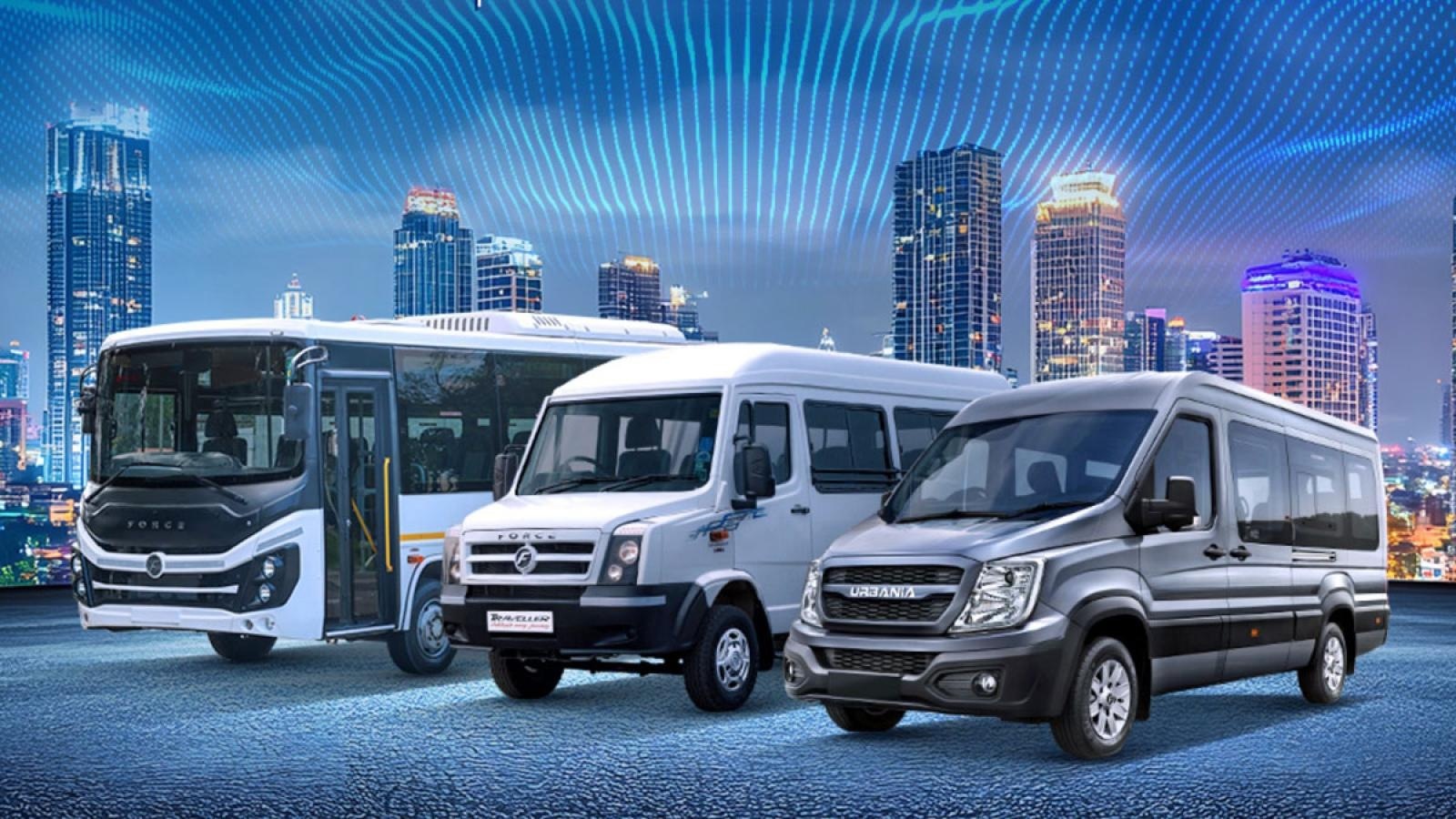
First, the vehicle business. This includes Traveller, Urbania, Trax, Gurkha, monobuses, ambulances, school buses, delivery vans and defence or special application vehicles. The company has a strong position in the LCV passenger segment and is described as having around 70% market share in LCV school buses and ambulances, with the investor presentation also describing leadership of over 70% market share in the segment.
Second, the high-tech aggregate business. Force Motors manufactures engines and axles for Mercedes-Benz India and engines and cooling modules for BMW India. The company says it has supplied over 150,000 engines and over 140,000 axles for Mercedes-Benz India, and over 70,000 engines to BMW. This is the part of the business where Force quietly does serious industrial work while other companies fight for headline space.
Third, the Force MTU Power Systems joint venture. Force Motors holds 51% in this JV with Rolls-Royce Power Systems. The JV manufactures Series 1600 engines and generator sets. In the Q3 FY26 investor presentation, the company stated that the Force MTU facility in Chakan is the only manufacturing plant in the world producing Series 1600 engines and supplying to global markets.
The business also has export presence in 25+ countries and a sales and service network of 300+ locations and growing. Its major facilities include Pithampur, Akurdi, Chakan, Chennai and the Force MTU facility at Chakan.
The latest financial year has made the company more interesting. FY26 revenue stood at ₹9,057 crore. Operating profit stood at ₹1,483 crore. Net profit stood at ₹1,212 crore. Borrowings were reduced to zero. Cash from operations was ₹1,297 crore. Free cash flow was ₹761 crore.
This combination — growth, margin expansion, debt reduction and cash flow — is not common. It deserves attention. But attention is not the same as blind admiration. The auto industry remains cyclical. The company’s niche positioning is both strength and limitation. It dominates in selected segments, but does not have the broad mass-market scale of Maruti, Mahindra or Tata Motors.
So the investor’s job is not to clap. The investor’s job is to ask: what part of this performance is repeatable?
3. Business Model – WTF Do They Even Do?
Force Motors makes vehicles and vehicle-related aggregates. That sounds simple until one opens the bonnet.
The company’s vehicle portfolio includes Traveller, Urbania, Trax, Gurkha, monobuses, ambulances, school buses, delivery vans, troop carriers and special application vehicles. Traveller is the legacy workhorse. Urbania is the newer premium shared mobility platform. Trax serves utility and institutional applications. Gurkha is the rugged off-road product that looks like it was designed for terrain where Google Maps gives up and starts praying.
The business model has three practical revenue streams.
The first is manufacturing and selling vehicles. This includes LCVs, MUVs, special vehicles and related applications. According to the provided revenue bifurcation, manufacturing of commercial vehicles contributes around 48% of revenue. This is the visible business — the vans, buses, ambulances and utility vehicles one can actually see on roads.
The second is motor vehicle engines, contributing around 36% of revenue. This is the more sophisticated side. Force Motors manufactures engines and axles for Mercedes-Benz India and engines for BMW India. These relationships indicate manufacturing credibility. Luxury car OEMs do not usually hand over engine and axle work to a company whose shopfloor runs on hope and duct tape.
The third includes parts and accessories at around 7%, and historically tractors at around 3%. The tractor business has now been discontinued, which should simplify the story going forward.
The company also operates through subsidiaries and a joint venture. Tempo Finance (West) is involved in financial services. Force MTU Power Systems, where Force holds 51%, manufactures engines and generator sets through a JV with Rolls-Royce Power Systems.
There is also a serious manufacturing backbone. The Pithampur plant is described as a 300+ acre fully integrated mother plant handling stamping, body welding, painting, final assembly and in-house production of engines, gearboxes and axles. Chennai handles BMW engine assembly. Chakan handles Mercedes-Benz engines and axles. Force MTU at Chakan manufactures Series 1600 MTU engines.
In simple words, Force Motors is not just bending sheet metal and hoping for the best. It is vertically integrated, OEM-linked, and positioned in specific mobility niches.
The roast is this: the company’s products are not exactly glamour machines. Nobody is making reels titled “My Traveller van changed my personality.” But schools, hospitals, institutions, defence, fleet operators and shared mobility users care about reliability, cost and application fit. That is where Force plays.
And when a boring product starts producing exciting cash flows, the boring part suddenly becomes fashionable.
Reader question: Is Force Motors finally getting rewarded for boring execution, or is the market simply excited because FY26 looked unusually clean?
4. Financials Overview
The latest official result heading after the peer comparison is “Quarterly Results.” Therefore, the EPS treatment is locked as quarterly for the latest quarter. Since the latest quarter is March 2026, the correct EPS reference for valuation is full-year FY26 EPS, not Q4 EPS annualised. For March quarter results, annualisation of a single quarter is not appropriate because full-year EPS is already available.
The latest consolidated quarter is Mar 2026. The comparable same quarter last year is Mar 2025. The previous quarter is Dec 2025.
Metric
Latest Quarter: Mar 2026
Same Quarter Last Year: Mar 2025
Previous Quarter: Dec 2025
Revenue
₹2,550 crore
₹2,356 crore
₹2,129 crore
EBITDA / Operating Profit
₹414 crore
₹329 crore
₹374 crore
PAT
₹279 crore
₹435 crore
₹406 crore
EPS
₹211.38
₹329.92
₹308.21
The sales picture is healthy. Revenue rose from ₹2,356 crore in Mar 2025 to ₹2,550 crore in Mar 2026, an increase of around 8.2% year-on-year. Sequentially, revenue rose from ₹2,129 crore in Dec 2025 to ₹2,550 crore in Mar 2026, which is a sharp QoQ improvement.
Operating profit also improved. It rose from ₹329 crore in Mar 2025 to ₹414 crore in Mar 2026. Sequentially, operating profit improved from ₹374 crore to ₹414 crore. This suggests the operating business remained strong.
But PAT tells a more complicated story. Net profit declined from ₹435 crore in Mar 2025 to ₹279 crore in Mar 2026. It also declined from ₹406 crore in Dec 2025 to ₹279 crore in Mar 2026. The detective notices the clue: other income was ₹418 crore in Mar 2025 and ₹241 crore in Dec 2025, but only ₹39 crore in Mar 2026. So the operating engine improved, while reported PAT cooled because the non-operating booster rocket was smaller.
This is why investors should not only stare at PAT like it is the final truth delivered from a mountain. Operating profit tells one story. Other income tells another. The tax line tells another. The final number is a family argument written in accounting format.
For FY26, however, the full-year picture is strong.