General information and entertainment, not investment advice. The author is not a SEBI-registered adviser or research analyst. No recommendation, no promised returns. Markets carry risk including loss of capital. Figures may not be current. Consult a registered adviser before acting.
1. At a Glance
A mango pulp processor walks into a war zone.
The company’s FY26 revenue fell 12.5% to ₹868 crore, a collapse framed as inevitable: cheaper mango procurement courtesy of Middle East export disruptions, a failing tomato harvest, and inventory piling up with no customer sign-off. Adjusted for the cost-plus model, the real story is volumes—down 3.7% to 880 MT across FY25–FY26, while carrying costs spiraled. Operating profit dropped 13% to ₹100 crore. Net profit fell 35% to ₹28 crore.
The balance sheet reads like a season of delayed checkouts: inventory ballooned to ₹640 crore (up 31% YoY), borrowings held steady at ₹432 crore (up from ₹440 crore, a marginal win), and working capital days stretched to 334 (from 208 last year). The rating agency flagged this as “adequate” liquidity, but the footnote stings: 95% of stock is order-backed and zero margin for surprise.
The green flags: frozen foods grew 28% YoY to ₹92 crore (up from ₹71 crore), the Pectin JV began commercial production, and Tetra Recart orders sit at ₹8 crore. The question: can these three segments—currently ₹117 crore combined, or 13% of revenue—absorb enough fixed overhead to unwind the mango-pulp dependency and the seasonality trap? Management targets ₹300–400 crore from non-mango categories in 3–4 years without shrinking mango. The math says ₹868 crore × 40% upside would be ₹1,214 crore. The track record says 12.5% contraction.
2. Introduction
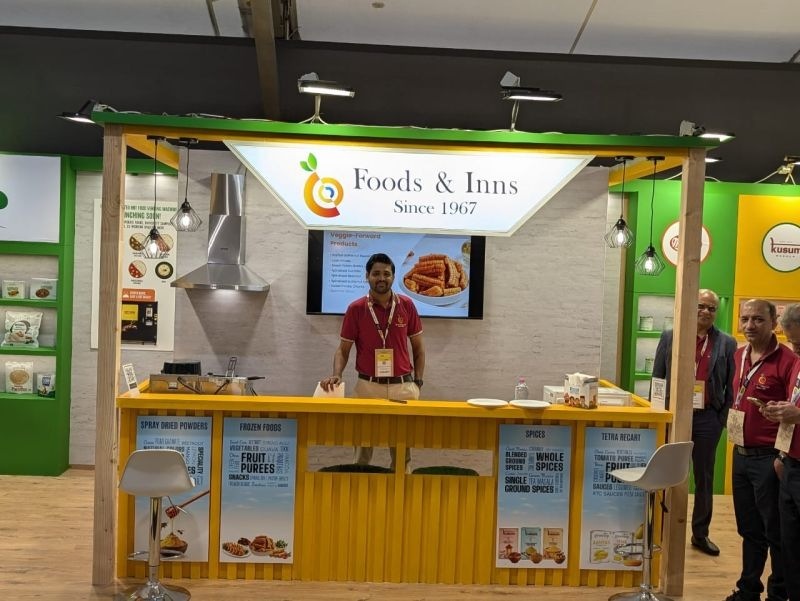
Foods & Inns has been pulping mangoes for over 50 years, beginning as a Coca-Cola canning operation in 1970 and pivoting into aseptic fruit processing in the 1980s. Today it is one of India’s largest mango pulp exporters and also claims leadership in frozen goods, spray-drying, spices, and—newly—pectin-from-waste.
The structure is clean: seven owned plants across Maharashtra, Gujarat, and Andhra Pradesh, plus a joint venture (Beyond Mango, 50% stake) manufacturing pectin in Chittoor. The company operates under a cost-plus contract model with marquee customers like Coca-Cola and PepsiCo, meaning raw material price swings are passed through with a negotiated markup every 15 months. Pricing power exists, but volume is king.
FY26 opened with inherited challenges. The Middle East conflict in March 2026 redirected table mangoes (normally earmarked for fresh export) into processing, flooding the input market with cheaper fruit. Simultaneously, unseasonal rains in Maharashtra and Karnataka spoiled the tomato harvest—the secondary pulp segment. Exports to the Middle East froze in Q4. Airline capacity constraints diverted more table fruit to local processors, compressing realizations. By June 2026, the CFO, Anand Krishnan, resigned, effective June 30.
The business remains resilient on the B2B side (Coca-Cola, PepsiCo hold contracted volume), but the seasonality trap is now the company’s public enemy no. 1.
3. Business Model: WTF Do They Even Do?
The core business is fruit and vegetable pulping.
Mango Pulp: The flagship. The company processes three varieties—Alphonso, Kesar, Totapuri—into aseptic pulp for mango-based beverages and dairy products. It procures ~200,000 MT of raw mango each season (April–August) from its farmer network in Maharashtra and Karnataka, the leading growing regions. Sales concentrate in December–June (60–65% of domestic volume), with export dispatch running from August through the following May. Carry-forward inventory each year is ~45% of season production. FY26 revenue from mango: ₹695 crore, or 80% of total.
Tomato Pulp & Paste: The off-season play. Tomato procurement runs September–December. FY26 volume tanked due to quality issues and unseasonal rain; management expects near-term guidance to remain uncertain.
Spray-Dried Powders: Converts liquids into shelf-stable powder (shelf life ~24 months). Dairy, fruit, vegetable, and natural color powders. Capacity expanded from 500 MTPA to 1,050 MTPA (doubled in FY24–FY25). FY26 revenue: ₹19 crore. Gas supply disruptions in March–April 2026 halted production for ~45 days; costs rose.
Frozen Vegetables & Snacks: Fruits (mango, papaya, pineapple), vegetables (peas, carrots, corn, okra), and snacks (samosas, spring rolls, flatbreads). Sold to modern retail, HORECA, and e-commerce channels under the “Green Top” brand. Volume grew ~28% YoY in FY26 to 99,453 MT (up from 98,399 MT in FY25—actually down 1% on tonnage, but revenue up to ₹92 crore from ₹71 crore due to value-added mix). The segment is being branded as the growth engine.
Spices & Masala: Kusum Spices (acquired FY19) sells 70+ ground, blended, and whole spice products to 12 countries. FDA-approved. Exports to US, UK, Oman, UAE. FY26 revenue: ₹19 crore.
Tetra Recart Packaging: A sustainable carton alternative to cans. Shelf life up to 2 years without preservatives. The Vankal plant (commissioned March 2023) has capacity of 3 MT/hr. FY26 revenue: ₹3 crore. Confirmed orders: ₹8 crore (400 MT). Management guided FY27 revenue at ₹20 crore. Adoption friction remains real: Tetra Recart is 25% more efficient to ship than cans but premium-priced; Indian consumers prefer cheaper retort pouches.
Pectin (Beyond Mango JV): Mango pulping wastes ~50% of fruit weight (skins, kernels). The JV converts this waste into natural pectin (gelling agent) for food, pharma, cosmetics. Commercial production started June 2026 (post–year end). India imports 95% of its pectin from Brazil, China, Mexico. The company claims 50% capacity utilization could yield ₹7–8 crore revenue; 70% gross margin. Key customers targeted: Coke, Pepsi, Unilever, Dabur. Import substitution play.
The model is B2B-heavy (60% of revenue to 10 customers, per management) but geographically diversified: 68% from exports (50+ countries) with Europe and US at ~20% of total, Middle East at 11%, and India at 31% (down from historical 40%, reflecting export growth).
4. Financials Overview
Figures are consolidated, in ₹ crore.
| Metric | FY26 | FY25 | YoY Change |
|---|---|---|---|
| Revenue | 868 | 992 | -12.5% |
| EBITDA | 112 | 129 | -13.2% |
| PAT | 28 | 42 | -33.3% |
| EPS | 3.77 | 5.71 | -34.0% |
The contraction reflects the pass-through model at work: cheap mangoes → lower realizations → same (or lower) volumes → fixed costs unabsorbed. Management reiterated on the concall that EBITDA margin % guidance is withheld because pricing is a pure pass-through; the business is volume-driven, not margin-driven.
From the concall (June 2026):
- “Challenging operating environment” in FY26 driven by “pass-through of lower raw material costs.”
- “Temporary disruptions in export markets”—Middle East exposure ~USD 2 million; management expects pent-up demand as conditions stabilize.
- FY27 volume growth guidance: ~18% across the entire basket, anchored on frozen foods (30% CAGR last 3 years) and Tetra Recart ramp-up.
- Mango/tomato realizations to remain suppressed into FY27–FY28 because “low cost season product” inventory will be sold.
5. Market Expectations & Historical Multiples
This section describes how the market is currently pricing the company and how that compares with its own history and peer group. It is descriptive, not predictive.

| Metric | Current | Historical Average (FY17–FY26) | Peer Median |
|---|---|---|---|
| P/E | 14.9x | 28.1x | 51.5x |
| EV/EBITDA | 7.4x | 8.2x | 13.8x |
| ROE | 5.0% | 7.6% | 28.4% |
| ROCE | 8.9% | 11.8% | 22.1% |
The market currently pays 14.9x earnings at ₹55.5 per share (referenced June 22, 2026), well below its own historical average of 28x and a fraction of the peer band (Britannia at 49.7x, Nestle at 78.4x).
What is the market pricing in? Three overlapping narratives:
Narrative 1—Volume Stall: Mango volumes grew at a 10-year CAGR of 10%, but the last three years saw -3%, -1%, and -3.7% respectively. If the market perceives a structural slowdown in the pulp segment (e.g., shift to direct juice, private-label saturation), a sub-25x multiple is rational.
Narrative 2—Leverage Stress: Borrowings increased from ₹342 crore (FY24) to ₹432 crore (FY26, +26%), while working capital days ballooned from 212 (FY24) to 334 (FY26). Interest coverage fell to 1.86x (from 2.6x in FY24). A rating agency flagged “high leverage limits financial flexibility.” Debt-to-equity stands at 0.76x, and the company has ruled out further borrowings and buybacks.
Narrative 3—Execution Risk on Pivot: Frozen foods, Pectin, and Tetra Recart combined for ₹117 crore in FY26. To hit the management target of ₹300–400 crore (without shrinking mango), these three segments need to compound at ~45% CAGR over 3–4 years. Frozen foods grew 28% YoY, a strong start, but Tetra Recart is stuck at ₹3 crore after three years, and Pectin just began commercial production.
The market appears to be discounting the mango core as stagnant and the growth segments as unproven.
6. What’s Cooking
- Pectin Commercial Production Ramp: Beyond Mango JV commenced commercial production in June 2026 after resolving “teething problems.” The process innovation (using wet and dry mango peel flexibly) improves capacity utilization. Management targets ₹7–8 crore revenue at 50% utilization in FY27. Gross margin ~70% (waste-based input). Pending customer approvals from Coke, Pepsi, Unilever, Dabur.
- Frozen Foods Capacity Constraints: FY26 volume surge (~28%) has nearly saturated existing capacity. Management is evaluating satellite production units and eyeing US market expansion (Costco, Walmart identified as channels). Strategic ambition: ₹100 crore (FY26) → ₹300–400 crore in 3–4 years. Capex clarity pending tie-up with NHB (National Horticulture Board) cluster program.
- Tetra Recart Order Pipeline: Confirmed orders stand at ₹8 crore (400 MT); FY27 pipeline expected to reach ₹20 crore. Repeat business from Finland, Germany, US, Canada flagged as encouraging. Adoption in India slower due to packaging cost economics; education on preservative-free claim remains a barrier.
- Tomato Paste Stock Clearance: FY26 inventory held ~9,000 MT of tomato stock (all backed by orders), representing ~₹70 crore embedded revenue expected to dispatch fully. Future season guidance deferred (quality/yield volatility).
- Spray-Drying Expansion: 120 MTPA capex (~₹2.5 crore) underway to meet growing demand for dairy and fruit powders. Energy disruption in March–April 2026 (gas unavailability for 45 days) has normalized, but cost pressures linger.
- Solar Installation: Post–year-end (not yet capitalized), 1,300 kWp at Vankal and 1,350 kWp additional at Gonde (total 1,850 kWp). Payback claimed at <3 years. Expected energy cost savings.
- CFO Resignation: Anand Krishnan (CFO, Chartered Accountant, 15+ years experience) resigned effective June 30, 2026. Likely planned transition per MD commentary on “additions” to promoter ranks.
7. Balance Sheet
| Item | FY24 | FY25 | FY26 |
|---|---|---|---|
| Total Assets | 1,027 | 1,290 | 1,301 |
| Total Liabilities | 1,027 | 1,290 | 1,301 |
| Equity | 399 | 539 | 566 |
| Borrowings | 469 | 440 | 432 |
| Inventory | 384 | 490 | 640 |
The balance sheet balances. Equity grew from ₹539 crore (FY25) to ₹566 crore (FY26), driven by retained earnings. Borrowings edged down from ₹440 crore to ₹432 crore (a marginal ₹8 crore reduction), a tiny nod to deleveraging ambition, while inventory surged 31% to ₹640 crore. The working capital cycle elongated to 334 days (from 208 days in FY24), a red flag.
Three bullets:
- Inventory is the beast: At ₹640 crore, it represents 74% of equity. The rating agency confirmed 95% is order-backed, but the 334-day cycle implies the company is funding multi-month customer holding periods on the seller’s balance sheet—a subsidy to blue-chip buyers.
- Debt is flat, not falling: Despite deleveraging rhetoric, borrowings barely budged. The company’s ability to reduce leverage hinges on working capital cycle compression, which requires customers to advance cash or reduce hold periods—unlikely in a commoditized market.
- Fixed assets grew 14% to ₹335 crore (from ₹301 crore in FY25), reflecting capex for spray-drying, solar, and Tetra Recart machinery. The depreciation charge jumped to ₹25 crore (from ₹21 crore), compressing operating profit further.
8. Cash Flow: Sab Number Game Hai
| Year | Operating | Investing | Financing |
|---|---|---|---|
| FY24 | -22 | -95 | 60 |
| FY25 | 15 | -30 | 2 |
| FY26 | 132 | -72 | -38 |
FY26 operating cash flow swung sharply to positive ₹132 crore (from ₹15 crore in FY25), a recovery. However, this was lifted by a ₹33.86 crore PLI (Production-Linked Incentive) payment recognized in Q4. Strip that out, and the underlying operating cash generation remains weak—the improvement is partly accounting timing (invoice discounting reducing debtor days from 89 to 61).
Investing outflow of ₹72 crore reflects capex on spray-drying, solar, and equipment. Financing saw a ₹38 crore net repayment (a positive signal on debt reduction intent, though the absolute leverage level remains high). Free cash flow turned positive at ₹94 crore (operating ₹132 minus investing ₹72 minus finance costs), but sustainability hinges on the PLI stream and working capital compression.
One wisdom line: Government subsidies (PLI) are temporary and volatile; internal cash generation from operations must stabilize if the company is to fund growth capex without leverage creep.
9. Ratios: Sexy or Stressy?
| Ratio | Value | Comment |
|---|---|---|
| ROE | 5.0% | Equity is earning less than a savings account. Three-year average of 7.6% shows recent deterioration. |
| ROCE | 8.9% | Capital employed is returning sub-cost-of-capital, a sign that capex is not yet accretive. |
| P/E | 14.9x | The market is paying ₹14.9 per rupee of current earnings. Historical P/E is 28x. |
| PAT Margin | 3.1% | Net profit as a % of sales: compressed from 4.2% in FY25. Cost of capital (interest + tax) is eating margin. |
| D/E | 0.76x | Debt-to-equity is moderate by industrial standards but high relative to leverage headroom in a volume-driven, commoditized business. |
A closer read: ROE of 5% is alarming. The company is earning a 5% return on ₹566 crore of shareholder capital while servicing ₹432 crore of debt at 10–11% effective interest rates. The spread is negative. Only scale (volume growth) or margin expansion (premium products, mix shift) will turn this equation. Neither is happening visibly.
10. P&L Breakdown: Show Me the Money
| Year | Revenue | EBITDA | PAT |
|---|---|---|---|
| FY24 | 1,020 | 123 | 37 |
| FY25 | 992 | 129 | 42 |
| FY26 | 868 | 112 | 28 |
The trajectory: declining revenue, declining EBITDA, and sharply declining net profit (profit margin compressed from 4.2% to 3.1% as a % of sales). EBITDA margin held relatively stable at 12.7% (FY26) vs. 12.9% (FY25), masking the fact that absolute EBITDA fell due to lower sales. PAT, however, got hammered: ₹42 crore → ₹28 crore, a 33% drop. The culprit: interest expense stayed high at ₹47 crore (down only marginally from ₹62 crore in FY25, partly offset by PLI gains), and the company faced a tax provision of ₹13 crore.
The business is mature (EBITDA margin stable, no operational improvement signals), shrinking (revenue down 12.5%), and burdened by financial charges it cannot yet outgrow.
11. Peer Comparison
| Company | Revenue | PAT | P/E |
|---|---|---|---|
| Nestle India | 6,748 | 1,114 | 78.4x |
| Britannia | 4,719 | 680 | 49.7x |
| Zydus Wellness | 1,485 | 162 | 73.6x |
| Foods & Inns | 289 | 19.5 | 14.9x |
| Peer Median (25 co.) | 162 | 5.3 | 51.5x |
Foods & Inns reports Q4 FY26 revenue of ₹289 crore (down 27% YoY) and PAT of ₹19.5 crore (down 16% YoY). The Q4 contraction is acute: volumes fell due to “geopolitical situation in March,” particularly in the Middle East. Realizations were suppressed because “inventory produced from the lower cost 2025 crop season” was being cleared.
Peer comparison reveals the size and margin gap. Nestle’s quarterly profit (₹1,114 crore) is 57x Foods & Inns’ full-year profit (₹28 crore). Britannia’s P/E (49.7x) is 3.3x Foods & Inns (14.9x), reflecting brand strength, volume predictability, and margin durability. Foods & Inns trades at a steep discount because it is a contract processor (lower pricing power), seasonal (high working capital drag), and dependent on a single category (mango pulp, 80% of revenue) that is not re-rating upward.
12. Miscellaneous: Shareholding & Promoters
| Holder | Stake |
|---|---|
| Promoters | 25.4% |
| FIIs | 0.1% |
| DIIs | 1.1% |
| Public | 73.4% |
Promoter holding has collapsed from 29% (FY23) to 25.4% (FY26), a loss of 13.4% of the original stake over three years. The founding Dalal family (Milan, Bhupendra, Rekha, and others) collectively hold ~15%, while Raymond Simkins (external investor, now reclassified as promoter per April 2024 open offer) holds ~8.7%. The open offer in July 2024 (initiated by Acquirers, a fund entity) sought to acquire 1.9 crore shares; pro forma pro-forma it appears Simkins converted to promoter status post-acquisition.
Promoter activities flagged: Bhupendra Champaklal Dalal was involved in a 2018 incident (noted in rating report); Milan Dalal, now MD, affirmed on the concall that inter-promoter “additions” are ongoing (“I’ve added a bit… you should see more of these disclosures coming up”), implying buyouts or pledged share transactions are in motion.
The family’s hold is fraying, signaling either internal wealth rebalancing or declining confidence in the business cycle.
13. Corporate Governance: Angels or Devils?
Auditor: Deloitte Haskins & Sells (Big 4, no red flags in audit reports reviewed).
Board: Nine directors, including two independent directors (Maneck Davar, Hormazdiyaar Vakil, Karishma Bhalla, A.V. Seshadrinathan, Sanjay Naik). Chairman is Milan Dalal (non-executive, non-independent). CEO is Moloy Saha (Cost Accountant, 20+ years experience).
Pledges: Promoter shareholding had 9.26% pledged (as of report date, per regulatory data). Pledges indicate leverage at the holding company level or interim liquidity arrangements—common in family businesses but a minor risk flag.
Related-Party Transactions: Minor—no large capex or equity infusions flagged. Beyond Mango JV is 50%-owned; no related-party subsidy evident.
Resignations & SEBI Actions: Anand Krishnan (CFO) resigned effective June 30, 2026. Separately, in March 2025, SEBI imposed penalties on the MD and CEO for compliance delays (Regulation 30 late disclosures). No material findings; governance frictions noted but not systemically damaging.
Red Flags as Facts:
- Working capital days spiraled to 334 (from 208 in FY24), indicating liquidity stress if customer payment terms tighten.
- Pledges on promoter shares signal family-level liquidity pressure.
- CFO departure in the middle of capex cycles (spray-drying, Pectin, solar) creates near-term execution risk.
- SEBI penalties hint at disclosure laxity, not fraud, but underscore need for process discipline during transitions.
14. Industry Roast & Macro Context
The fruit and vegetable processing industry in India is fragmented, low-margin, and held hostage by seasonality and commodity input prices.
The Roast:
Pricing Power: Contract processors like Foods & Inns operate as margin-neutral pass-throughs. Coca-Cola and PepsiCo dictate terms: cost-plus mark-up, quarterly renegotiations, volume take-or-pay clauses. When raw material prices fall (as they did in FY26 due to Middle East redirections), realizations collapse alongside revenue. The processor absorbs the margin hit on existing inventory, a structural tax on commodity price drops.
Seasonality Trap: Mango procurement is a 120-day window (April–August). Customers dispatch over 12 months. This forces the processor to finance 240+ days of inventory on the customer’s behalf, bloating working capital and leverage. The rating agency dryly noted: “elongated net cash conversion cycle, leading to liquidity risk.” FY26 exemplified it: inventory ballooned to ₹640 crore (34% YoY swing), the company borrowed more (despite deleveraging goals), and interest costs spiked.
Regulatory & Trade Dynamics: USDA and FDA certifications are table-stakes for exports; SEBI compliance, labor codes, and sustainability (increasingly, CDP and ESG disclosures) are mandatory. Large customers like Coca-Cola demand farmer certification programs (Rainforest Alliance, SAI). Foods & Inns has invested in farmer training and soil rejuvenation partnerships with French firms (Biospheres, AXA Climate), but costs are real and scale benefits are long-term.
Category Shifts: Modern retail and e-commerce are fragmenting private-label demand (positive for contract processors), but direct juice and plant-based alternatives are eating into mango-beverage growth. Frozen foods face logistics headwinds (cold-chain cost ~10x ambient), but margin upside is real (50% gross margin vs. 33–39% in pulp).
Macro Tailwind—Dubious: Government PLI subsidies (₹33.86 crore in FY25, ₹25.08 crore in FY24) are supporting reported cash flow and capital deployment, but these are tied to export thresholds and are not guaranteed beyond FY28. If the scheme lapses or threshold tightens, the company loses ₹25–35 crore annually in support.
15. EduInvesting Verdict
| Strengths | Weaknesses |
|---|---|
| Market leadership in mango pulp processing in India | Mango segment (80% of revenue) is stagnant—3 of last 4 years saw volume decline |
| Diversified customer base (Coca-Cola, PepsiCo) and geographies (50+ countries, 68% exports) | Working capital cycle at 334 days; leverage at 0.76x D/E still high relative to cash generation |
| Installed capacity for growth (spray-drying doubled to 1,050 MTPA, Tetra Recart, Pectin) | New segments (Frozen, Pectin, Tetra Recart) are ₹117 crore combined; need 45% CAGR to reach ₹300–400 crore target |
| Cost-plus model shields from raw material inflation | Cost-plus model also compresses realizations when inputs cheapen (FY26 case study) |
| PLI subsidies supporting capex and free cash flow | PLI subsidies are temporary and not guaranteed beyond FY28 |
| Opportunities | Threats |
|---|---|
| Frozen foods: ₹92 crore growing 28% YoY, targeting US market (Costco, Walmart) | Commodity price shocks: a tomato crop failure or mango glut can flip cash generation and inventory dynamics overnight |
| Pectin import substitution: India imports 95% of pectin; commercial production just started at 50% utilization; target customers are global giants | Private label saturation in developed markets; shift to direct juice, plant-based alternatives eroding mango-beverage growth |
| Capacity utilization upside: existing investments (spray-drying, frozen, Tetra Recart) are underutilized; fixed-cost absorption could improve margin and ROCE | Geopolitical disruptions (Middle East conflicts, shipping bottlenecks) are becoming structural risks, not one-time shocks |
| Deleveraging target: management has deprioritized buybacks, reinforcing debt reduction intent | Working capital intensity may not compress unless customers advance cash or shorten payment terms—structural to the business |
Closing Observation:
A balance sheet with ₹640 crore trapped in seasonal inventory, a leverage multiple that hasn’t budged despite deleveraging promises, a 5% ROE that screams capital-impairment risk, and a growth pivot that is barely 13% of revenue and unproven. The company is a textbook case of a commodity processor caught between a shrinking core business and an execution challenge on new verticals, each of which demands scale and supply-chain discipline to achieve acceptable returns. The title of this report asked: can mango-core stagnation be offset by frozen, Pectin, and Tetra growth without shrinking the pulp business? Three years in, the answer is: not yet, and maybe not at all if realizations stay suppressed and working capital doesn’t compress.
The company is not insane; management can see the wall. The PLI support and new capex are genuine hedges against total decline. But hedges are not growth, and growth is what the market is waiting to price in.