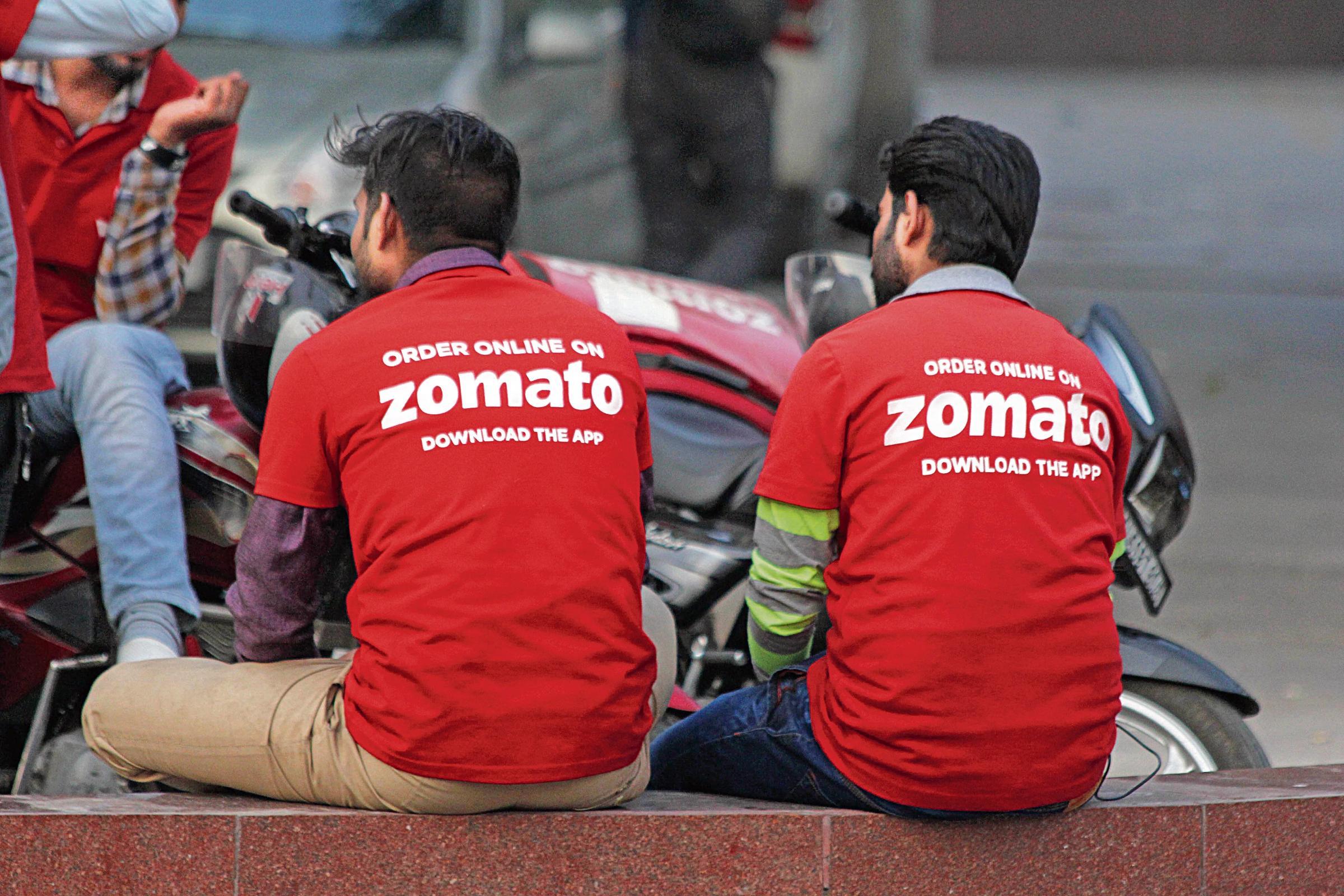
Eternal Ltd Q4 FY26: Revenue explodes 196% YoY to ₹17,292 crore, PAT jumps 346%, but P/E at 680 asks investors to believe in tomorrow before breakfast
Date of Publishing -
Spotted a factual error — a wrong number, date, or fact? Tell us and we will check the source.
1. At a Glance
Eternal Ltd has delivered the kind of Q4 FY26 headline that makes a market screen look like it has been edited by someone with a caffeine problem. Consolidated revenue from operations stood at ₹17,292 crore in Q4 FY26, compared with ₹5,833 crore in Q4 FY25 and ₹16,315 crore in Q3 FY26. That is 196% year-on-year growth and 6% sequential growth. Net profit came in at ₹174 crore, up from ₹39 crore in Q4 FY25 and ₹102 crore in Q3 FY26.
On the surface, this looks like the perfect internet economy fantasy: food delivery maturing, Blinkit scaling like a rocket, Hyperpure still supplying the back-end kitchen economy, and Going-out trying to become the app where India books movies, events, restaurants, sports and probably one day emotional damage also.
But Eternal is not a simple story. It is not a normal consumer company where revenue grows, margins expand, profit follows, and valuation politely sits in a sensible chair. This is a company where the operating profit for Q4 was ₹486 crore, other income was ₹342 crore, finance cost was ₹132 crore, depreciation was ₹468 crore, and the final PAT was ₹174 crore. In short, the business is scaling, but the profit bridge still has more moving parts than a food delivery rider navigating Koramangala traffic during rain.
The market is valuing Eternal at a market capitalisation of about ₹2,48,883 crore at a price of ₹258. The reported stock P/E is around 680. On FY26 EPS of ₹0.38, that valuation is not whispering optimism. It is shouting it from a rooftop, wearing a Blinkit yellow jacket.
Consolidated FY26 diluted EPS stood at ₹0.39, while annual screener EPS is ₹0.38.
The segment picture is fascinating. In Q4 FY26, Quick Commerce generated ₹13,232 crore revenue, dwarfing India food ordering and delivery revenue of ₹2,737 crore. Hyperpure stood at ₹978 crore, Going-out at ₹277 crore, and residual segments at ₹68 crore. Eternal has quietly transformed from a food delivery company into a quick commerce beast with a restaurant app attached. The rebranding from Zomato to Eternal now looks less cosmetic and more like a legal name catching up with business reality.
The bigger detective question is this: did management walk the talk from the Jan 2026 concall?
In that call, management said Blinkit had reached breakeven, but warned that competition was volatile and margin trajectories would not be linear. Q4 FY26 confirms both sides of that statement. Quick Commerce segment result improved to ₹265 crore in Q4 FY26 from ₹202 crore in Q3 FY26 and a loss of ₹82 crore in Q4 FY25. So yes, operationally, the business walked the talk. But the same result also shows that the company is still spending heavily on delivery charges, warehousing, employee cost, depreciation and expansion. The walk is real, but the shoes are expensive.
Management had also said Going-out losses should decline sequentially after the District Pass-led spike. Q4 shows Going-out segment loss at ₹73 crore versus ₹114 crore in Q3 FY26. That is a clear sequential improvement. Not a victory parade yet, but at least the fire alarm is less loud.
Eternal’s Q4 FY26 is therefore not a boring “good quarter.” It is a complicated quarter. Revenue growth is spectacular. Profitability is improving. Quick commerce is scaling. But the valuation already prices in a very long runway, strong execution, and the assumption that competition will not burn the entire grocery basket just to win market share.
That is where the story becomes interesting.
2. Introduction
Eternal Ltd, formerly Zomato Ltd, is one of India’s most visible consumer internet companies. It began as a food discovery and delivery platform and has evolved into a multi-segment digital commerce company.
The company now operates across India food ordering and delivery, Hyperpure B2B supplies, Quick Commerce through Blinkit, Going-out through dining and ticketing, and smaller residual businesses.
Q4 FY26 gives investors a clean view of what Eternal is becoming. Food delivery is no longer the only hero. Blinkit is now the financial heavyweight. In Q4 FY26, Quick Commerce revenue of ₹13,232 crore was nearly five times the India food ordering and delivery revenue of ₹2,737 crore.
That one fact changes the entire investment debate.
Earlier, Eternal was judged on whether food delivery could become profitable. Now the debate is whether Blinkit can scale profitably while competitors throw discounts, delivery-fee cuts, lower minimum order values, and marketing cash into the battlefield.
The company’s Q4 result also came with corporate action. The board approved transfer of the District platform technology stack and identified employees to Wasteland Entertainment Private Limited, a wholly owned subsidiary, for ₹24.19 crore. The stated reason was organisational efficiency and unlocking further business opportunities.
There was also a major leadership transition. Deepinder Goyal resigned as Managing Director and CEO effective February 1, 2026. Albinder Singh Dhindsa, the Blinkit CEO, was appointed CEO of the company from the same date. Deepinder later became Vice Chairman and Non-Executive Director after shareholder approval.
This is not a small symbolic change. When the Blinkit leader becomes the CEO of Eternal, the message is clear: the quick commerce engine is now central to the group’s future.
But investors should not mistake scale for automatic shareholder returns. A company can grow revenue at high speed and still struggle to justify valuation if margins, cash flows and return ratios do not catch up.
In FY26, Eternal reported consolidated revenue of ₹54,364 crore, operating profit of ₹1,208 crore, and PAT of ₹366 crore. The business has clearly crossed the stage of “will it ever make money?” But at a market capitalisation of nearly ₹2.49 lakh crore, the question is sharper: how much future profit is already embedded in the price?
That is the real audit.
Not whether Eternal is a great app. It is.
Not whether Blinkit is growing. It is.
The question is whether the economics can mature fast enough to support the market’s expectations. Because at 680 times earnings, even small disappointments can become expensive lessons.
So let us investigate the numbers like adults, but with mild sarcasm because Indian internet valuations demand emotional support.
3. Business Model – WTF Do They Even Do?
Eternal is now a multi-engine consumer internet company.
The old mental model was simple: users order food, restaurants prepare it, delivery partners bring it, and Zomato earns platform fees, delivery-related revenue, advertising and other service income.
That still exists. India food ordering and delivery remains an important business. In Q4 FY26, it generated ₹2,737 crore external revenue and ₹549 crore segment result. It is the mature engine: high brand recall, large user base, restaurant network, delivery partner supply, and improving profitability.
Hyperpure is the B2B supply chain business. It supplies food ingredients and other products to restaurants and B2B buyers. In Q4 FY26, Hyperpure generated ₹978 crore external revenue and ₹13 crore segment result. It is less glamorous than Blinkit, but it sits inside the same food ecosystem. Think of it as the backstage kitchen supplier while the app gets all the Instagram attention.
Quick Commerce is Blinkit. This is now the monster engine. It lets customers order groceries, daily essentials, electronics, beauty products, home items and other categories for fast delivery. In Q4 FY26, Quick Commerce revenue was ₹13,232 crore and segment result was ₹265 crore. The business moved further into an inventory-led model in FY26, which means revenue now includes direct sales to customers and not just marketplace commission.
That accounting change is important. Revenue growth looks much larger because the company is now recording more of the transaction value as revenue in the inventory-led model. This does not make the growth fake, but it does mean investors must be careful while comparing FY26 with earlier years. Revenue is not just a scoreboard; sometimes it is also an accounting mirror.
Going-out covers dining-out and entertainment ticketing. Eternal acquired Orbgen Technologies and Wasteland Entertainment from One 97 Communications in FY25, bringing movies and events into the platform. In Q4 FY26, Going-out revenue was ₹277 crore, but the segment reported a loss of ₹73 crore. The company is trying to build a broader discovery and transaction platform for offline leisure spending.
In plain English, Eternal wants to own three consumer habits: eating at home, ordering essentials at home, and going out of home.
That is powerful. It is also expensive.
The business model is not a single profit pool. It is a portfolio of consumer behaviours, each with different margins, competitive intensity, capital requirements and execution risk.
The lazy investor sees “Zomato app.”
The serious investor sees: food delivery cash generation, Blinkit scale economics, Hyperpure working capital discipline, Going-out optionality, GST disputes, lease liabilities, inventory risk, ESOP costs, depreciation, and a market valuation that has already opened the champagne.
Which part of Eternal do you think deserves the highest valuation multiple: food delivery, Blinkit, or Going-out?
4. Financials Overview
The latest official result is for the quarter and financial year ended March 31, 2026. Since this is Q4 FY26, full-year EPS is used for valuation instead of annualising the March quarter EPS. Consolidated FY26 diluted EPS was ₹0.39, while screener shows annual EPS of ₹0.38.
Q4 FY26 comparison table
Metric
Latest Quarter Q4 FY26
Same Quarter Last Year Q4 FY25
Previous Quarter Q3 FY26
Revenue from operations
₹17,292 crore
₹5,833 crore
₹16,315 crore
EBITDA / Operating Profit
₹486 crore
₹72 crore
₹368 crore
PAT
₹174 crore
₹39 crore
₹102 crore
EPS
₹0.19
₹0.04
₹0.11
Revenue grew 196% YoY and 6% QoQ. PAT grew 346% YoY and 71% QoQ. Operating profit improved from ₹72 crore in Q4 FY25 to ₹486 crore in Q4 FY26.
That is the good news.
The more serious point is that operating profit margin remains modest at around 3% in Q4 FY26. This is still a scale business looking for mature margins, not a mature profit machine printing cash at leisure.
Management commentary from Jan 2026 deserves credit. They said Blinkit had reached breakeven and margin expansion was being driven by operating leverage and cost efficiencies below gross profit. Q4 FY26 supports that. Quick Commerce segment result improved to ₹265 crore from ₹202 crore sequentially and from a ₹82 crore loss in Q4 FY25.
They also warned that competition could affect margins, top-line growth and store expansion plans. That caution remains relevant.