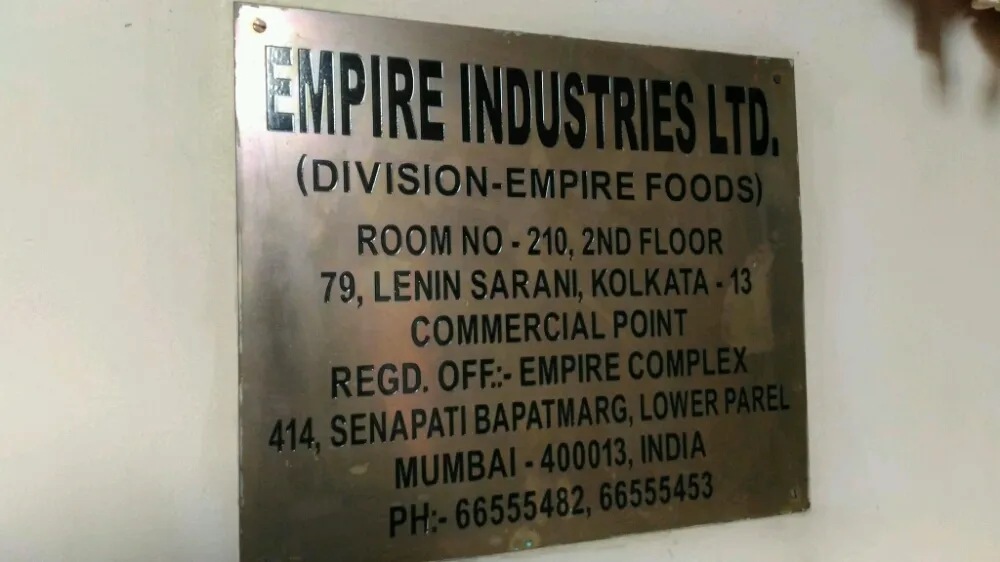
₹731.2 Cr revenue. ₹52.4 Cr net profit. ₹85.92 EPS. A P/E of 11.7x. Empire Industries — the 126-year-old Mumbai conglomerate — just posted numbers that suggest a company in equilibrium. Not growth. Not decline. Just flat, steady, respectable equilibrium. The kind of equilibrium that makes professional investors yawn and promoters quietly issue ₹50 per share in special dividends.
But before you scroll past: there’s something genuinely odd here. A company that once dominated container glass, now diversified across glass, frozen foods, machine tools, real estate, and office leasing, shouldn’t be this quiet. The quarterly results show a last quarter that finally woke up—₹195 Cr in sales, ₹19 Cr in profit—but the full-year tells a different story: growth that barely outpaced inflation, margins that wobble, and a balance sheet that looks less like a growth company and more like a family office managing legacy assets.
The stock trades at 11.7x earnings on a 15.6% ROE. The sector median is 15.2x on an 11.9% ROE. On paper, Empire is cheaper and more profitable. In practice, it trades like a value trap. The question isn’t whether the numbers are accurate. They are. The question is whether this business can ever matter again.
Wisdom drop: A company’s cheapness relative to the sector is often a price paid for invisibility, not opportunity. Empire’s modest valuation reflects not underappreciation but genuine lack of momentum.
Section 2: Introduction
Empire Industries Limited was founded in 1900—the same year Gillette invented the safety razor and Planck introduced quantum theory. For most of the 20th century, it was a name that mattered in Mumbai’s industrial circles: glass bottles for pharma, machine tools for factories, a sprawling real estate play. The Malhotra family, which controls 72.6% of the company, has kept it intact through independence, globalisation, and the rise of private capital.
Today, it survives as a holding company disguised as an operating business. Glass manufacturing still exists. Food trading still happens. Leasing of office space in Lower Parel and Vikhroli continues. But momentum? That left sometime in the previous decade.
FY26 was a year of consolidation, not transformation. Revenues grew 8%, net profit actually declined 1.5% (to ₹52.4 Cr from ₹54 Cr in FY25), yet somehow the dividend recommendation doubled. The dividend story — ₹50 per share, comprising ₹25 final and ₹25 special — is the loudest message management sent all year. Cash-rich, growth-quiet.
Section 3: Business Model: WTF Do They Even Do?
Empire’s business model reads like a company in slow-motion fragmentation. The glass division manufactures 1.9 million amber bottles daily — sold mostly to beverage makers (60%) and pharmaceutical companies (40%). The change in customer mix is deliberate: beverages carry better margins. High capacity utilisation at 95% masks the fact that utilisation, once at 100%, has stayed soft. The glass division contributes ~35% of revenue.
Trading and indenting — a euphemism for importing machine tools and frozen foods — accounts for ~43% of revenue. Frozen foods have seen 20% growth (per the CARE rating), but margins are thin and forex volatility is a constant headache. Machine tools? Government capex cycles rule its fate.
Then there’s the real estate division. The company owns 35 acres in Ambernath, mostly undeveloped. Three residential phases are under construction (20-45% complete), with 81% of units sold. The division is currently loss-making, but management banks on the upcoming Chikoli railway station to drive future appreciation. A classic real estate play: customer-funded, execution-dependent, long-duration risk.
Finally, the leave-and-license leasing business. Two office properties in Lower Parel and Vikhroli, both now fully occupied after previous slack. ₹11 Cr of annual rental income. Sticky, low-growth, but profitable.
The verdict: This is not a business. It’s a portfolio. The question is whether any of these assets justify the ₹604 Cr market cap, or whether that’s just the cost of holding them until they grow up — or sell.
Section 4: Financials Overview
Figures are consolidated, in ₹ crore.
Metric
Q4 FY26
YoY
FY26
FY25
Change
Revenue
195.4
+4.8%
731.2
677.0
+8.0%
Operating Profit
32.9
+159%
87
70
+24.3%
Net Profit
19.2
+332%
52.4
54.0
-1.5%
EPS (₹)
31.98
—
85.92
89.94
-4.5%
The story: Q4 was a breakout quarter—sales accelerated, margins expanded sharply (operating profit jumped 159% YoY). But the full year tells a more nuanced tale. Operating profit grew 24% (a genuine achievement in a slow-growth environment), yet net profit declined 1.5%. Why? Exceptional items. The Labour Code impact (₹40.88 Cr provision for enhanced gratuity and leave benefits) hit the quarter and shifted profit into loss territory for the full year.
Remove the Labour Code provision, and FY26 PAT would have been closer to ₹61 Cr—a 13% growth story. Management’s framing emphasizes this. It’s not wrong. But it’s also classic earnings management: exceptional items are always “non-recurring” until they recur. The company faces real provision for a Gabon receivable (₹52.9 Cr outstanding for 3+ years, ₹12.47 Cr provision taken in FY26). That’s not theoretical. That’s loss-making business that hasn’t been written off yet.
On the concall: Management emphasized “steady performance driven by diversified business profile” and noted the glass division now sells 60% to beverages vs. 40% pharma—a deliberate mix shift toward higher margins. The leasing business is now fully occupied (both properties) after previous slack. These are real positives, but they’re neither new nor material enough to justify re-rating the stock.
Section 5: Valuation Discussion: Fair Value Range
Methodology 1: P/E Multiple Method
FY26 EPS: ₹85.92 (reported) Peer P/E band: 11x–18x (sector median 15.2x; Empire’s small-cap diversified status justifies below-median multiple) Fair value range: ₹945 to ₹1,546 per share
Methodology 2: EV/EBITDA Method
FY26 EBITDA: ₹131.6 Cr (PBT ₹60.1 Cr + Interest ₹28.26 Cr + Depreciation ₹16.4 Cr – Labour Code exception, it’s already netted) EV/EBITDA multiple range: 6x–8x (peer range 6.2x–24x; smaller companies trade at lower multiples) Enterprise Value: ₹790 to ₹1,053 Cr Less: Net Debt of ₹52.4 Cr (Borrowings ₹172 Cr – Cash ₹119.6 Cr) Equity Value: ₹738 to ₹1,001 Cr Per share (0.6 Cr shares): ₹1,230 to ₹1,668
Methodology 3: DCF (Simplified)
Assumptions:
Revenue CAGR next 5 years: 8% (historical 5-year CAGR: 8.3%)
EBIT margin stabilizing: 12% (FY26: 11.9%)
Tax rate: 14% (FY26: 14%)
Terminal growth: 3%
WACC: 9%
Implied fair value per share: ₹1,100–₹1,200
Fair Value Range: ₹1,050 to ₹1,400 per share
Current price (₹1,007) sits at the lower end. Upside to midpoint: ~18%. Downside risk if revenue growth slows below 5% or margins compress further: ~15%.
Fair Value Disclaimer (Mandatory): This fair value range is for educational purposes only and is not investment advice.
Section 6: What’s Cooking: News, Triggers, Drama
1. Labour Code Impact (₹40.88 Cr provision): The Government of India’s new Labour Codes (effective November 2025) trigger increased gratuity and leave liability. Empire took a one-time provision for past service costs. It’s non-recurring in theory but sets a higher baseline for future years. This is not a red flag—it’s a fact of life for labour-heavy manufacturers. But it does trim reported earnings artificially.