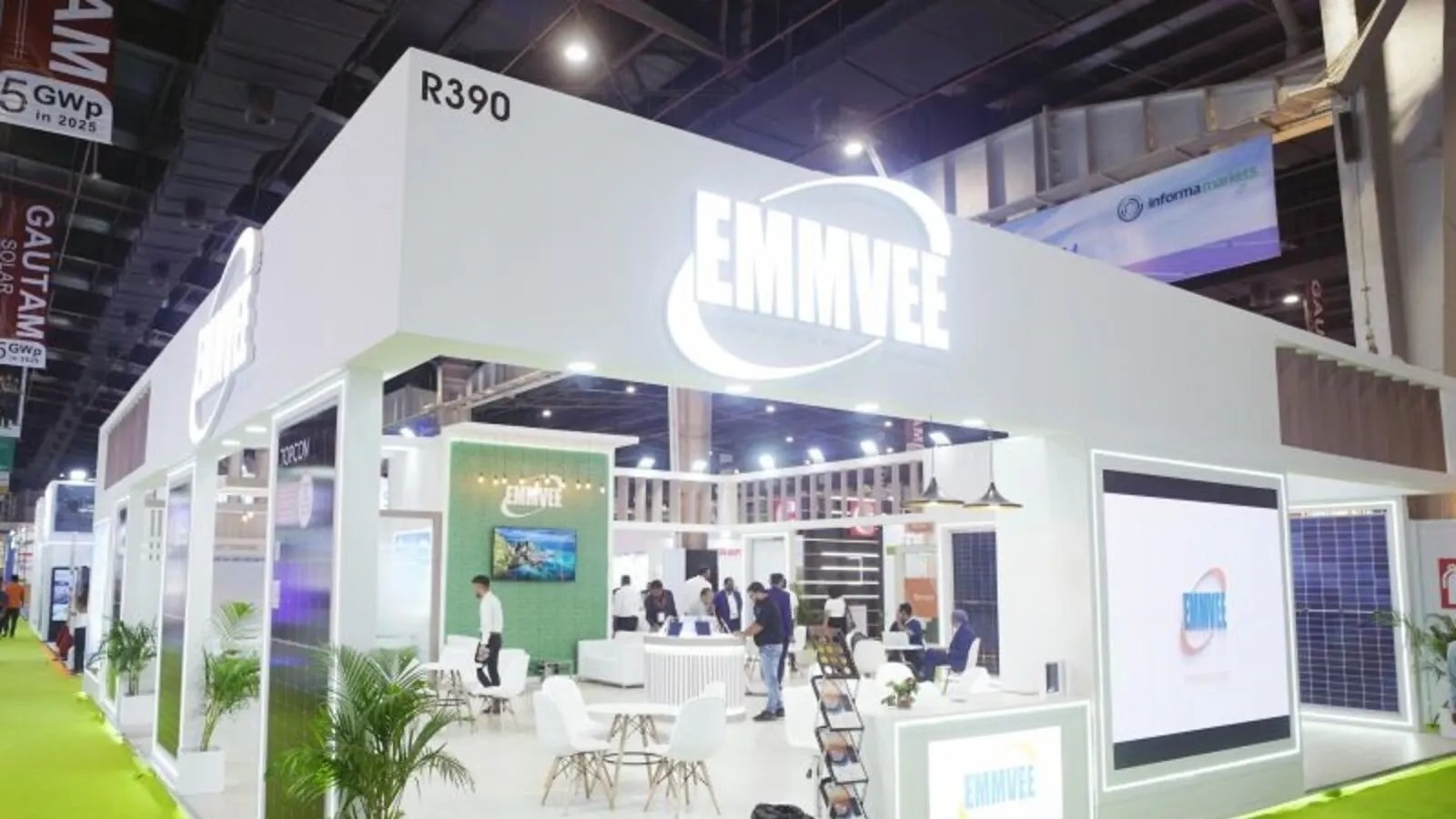
Emmvee Photovoltaic:
₹264 Cr PAT. 166% Profit
Growth. IPO Money Pays Off. Now What?
Just listed in November 2025, raised ₹2,900 crore, paid back ₹1,621 crore in debt. Revenue up 118%. Profit up 166%. And they’re acting like it’s just a normal Tuesday at the solar panel factory.
The Solar Company That Makes You Squint At Your Phone Screen Reading Growth Numbers
- 52-Week High / Low₹248 / ₹172
- Q3 FY26 Revenue₹1,152 Cr
- Q3 FY26 PAT₹264 Cr
- Q3 FY26 EPS (₹)3.81
- Annualised EPS (Q3×4)₹15.24
- Book Value₹13.8
- Price to Book (Current)15.0x
- Dividend Yield0.00%
- Debt / Equity (Post-IPO)2.15x
- IPO Proceeds Deployed₹1,621 Cr (Debt Repay)
They Make Solar Panels. You Need Them. They Know It. We Know It. Awkward.
Emmvee Photovoltaic Power Limited: incorporated March 2007, making solar cells and modules in Karnataka since forever, and just fresh off an IPO that valued them at ₹14,401 crore. Not a typo. That’s their current market cap.
For context: they are India’s second pure-play integrated cell-and-module manufacturer by capacity. First place is Waaree Energies (MCap ₹78,799 crore — yes, really). Emmvee sits comfortably in the no. 2 spot with 10.3 GW of installed module capacity and 2.94 GW of cell capacity as of December 2025.
The business model is delightfully straightforward: India needs to hit 500 GW of solar by 2030. The government wants those panels made domestically — hence the “Domestic Content Requirement” (DCR) framework that pays a 5–7 cent premium. Emmvee makes those panels. Revenue went from ₹952 crore in FY25 to annualised run rate of ~₹4,650 crore in Q3 FY26. That’s a 388% increase year-on-year if you annualise one quarter. No, that’s not sustainable. Yes, they know that. No, they’re not pretending it is.
And now, fresh IPO capital in hand, they’re building a 6 GW integrated facility at Devanahalli to capture more of the supply chain, reduce costs, and own more of the Bill of Materials (BOM). If they execute, they’ll be unstoppable. If they don’t, they’ll be just another solar company in an increasingly crowded field.
Silicon Wafers + Some Alchemy = Solar Panels That Talk To Your Roof
Emmvee buys silicon wafers, dopes them with boron and phosphorus (making them TOPCon cells — a next-gen efficiency tech), solders them into panels, and ships them to Indian IPPs (Independent Power Producers) and EPC contractors. The supply chain is: wafer → cell manufacturing → module assembly → quality test → customer delivery.
They own the cell and module piece. They don’t make wafers yet — that’s the backlog for the Devanahalli facility. They also don’t make glass, frames, or junction boxes, but management is exploring backward integration into those too. Right now, they’re buying wafers globally, processing them, and selling finished modules to developers who feed India’s renewable energy machine.
Revenue mix: 99.4% domestic, 0.6% exports (almost irrelevant). Customer concentration is brutal: top 1 customer = 36% of revenue, top 5 = 75%, top 10 = 85%. If Clean Max Enviro, KPI Green, or Ayana Renewable Power take a strategic pause, Emmvee feels it.
Q3 FY26: The Numbers That Made Analysts Recalculate Their Models
Result type: Quarterly Results (Q3 FY26, Oct-Dec 2025) | Q3 FY26 EPS: ₹3.81 | Annualised EPS (Q3×4): ₹15.24 | FY25 Full Year EPS: ₹68.39 (but FY25 was a 9-month year, effectively)
Source table
| Metric (₹ Cr) | Q3 FY26 Dec 2025 |
Q3 FY25 Dec 2024 |
Q2 FY26 Sep 2025 |
YoY % | QoQ % |
|---|---|---|---|---|---|
| Revenue | 1,152 | 528 | 1,131 | +118% | +1.9% |
| EBITDA | 413 | 202 | 399 | +105% | +3.5% |
| EBITDA Margin % | 36% | 38% | 35% | -200 bps | +100 bps |
| PAT | 264 | 99 | 238 | +166% | +10.9% |
| EPS (₹) | 3.81 | 1.58 | 3.40 | +141% | +12.1% |
Is ₹208 Reasonable or Frothy?
Method 1: P/E Based
Annualised Q3 FY26 EPS = ₹15.24 (Q3 EPS ₹3.81 × 4). Solar panel makers are typically valued at 20x–30x for growth stories, but the sector has high cyclicality. Emmvee’s justified band: 22x–28x given DCR support and execution risk.
Range: ₹335 – ₹427
Method 2: EV/EBITDA Based
Q3 annualised EBITDA = ₹1,652 Cr (₹413 Cr × 4). Current EV = ₹16,282 Cr. Implied EV/EBITDA = 9.8x. Solar manufacturers with integrated backward integration trade at 10x–15x EBITDA. Conservative band: 10x–12x given capex intensity ahead.
EV range (10x–12x): ₹16,520 Cr – ₹19,824 Cr → Per share (after debt):
Range: ₹244 – ₹292
Method 3: DCF Based (Simplified)
Base EBITDA: ₹1,652 Cr (Q3 annualised). Growth assumption: 25% CAGR for 5 years (moderating to 12% by year 5). Terminal growth: 4%. WACC: 10%.
→ Terminal Value (4% growth / 6% cap rate): ~₹38,480 Cr
→ Total EV: ~₹48,680 Cr (assumes low capex after FY28)
→ Per share (post-debt, ~₹2,056 Cr): ₹650+
Range: ₹240 – ₹650 (wide range reflects capex execution uncertainty)
IPO Hype, Capacity Ramps, And The Elephant In The Room Called “Overcapacity”
🟢 The Big One: IPO + Debt Payoff = Balance Sheet Turnaround
November 18, 2025: Emmvee raised ₹2,900 crore in the IPO. Fresh issue ₹2,144 crore, OFS ₹756 crore. First action: paid back ₹1,621 crore in term loans (out of the fresh proceeds). Debt/equity fell from 2.8x (FY25) to 2.15x (now), and projected to 0.2x by end FY26. ICRA upgraded long-term rating to A (Stable) from A- (Stable). Interest coverage jumped from 6.9x (FY25) to 8.2x (9M FY26), expected 8–9x for full FY26. Translation: balance sheet is now fortress-like heading into the ₹5,510 crore Devanahalli capex.
⚠️ Capacity War Coming
- • Emmvee: 10.3 GW modules (now), 16.3 GW by H1 FY28
- • Waaree: 10+ GW modules, expanding aggressively
- • Sunwatta, JinkoSolar, and others setting up plants
- • Announced capacity >> actual operational capacity (12–15% never commissioned)
- • Price deflation: DCR modules at 24–24.5 cents/Wp; non-DCR trending lower
✅ Order Book & Revenue Visibility
- • Order book: 9.3 GW as of Dec 31, 2025 (up from 5.36 GW mid-FY26)
- • Includes 4.5 GW multi-year TOPCon cell order (5-year contract, production starting soon)
- • DCR mix: ~50% in order book, ~40% in execution
- • Execution discipline: Management targets 6.3 GW per 12–18 months to avoid overcommitment
- • Spot orders adding on top of booked pipeline
⚠️ Silver Paste: The Hidden Cost Squeeze
- • Silver paste is ~13% of cell price, ~8–9% of module price
- • Emmvee has reduced consumption by ~50–60% in 3–4 months (verified on concall)
- • Further roadmap: another 40% reduction possible (seen in China, not yet achieved)
- • If silver prices double and pass-through fails = margin compression
- • Most orders have pass-through clauses, but risk remains
✅ Regulatory Tailwinds
- • ALMM (Approved List of Models and Manufacturers) expanding; Emmvee already on list for cells + modules
- • ALMM List-II (cells) implementation June 2026 — no timeline change yet
- • Government planning ALMM for wafers next — more localization ahead
- • 500 GW target by 2030 = sustained DCR demand for years
Post-IPO Fortress Mode: From Leveraged Growth to Deleveraging Sprint
Source table
| Item (₹ Cr) | Mar 2024 | Mar 2025 | Sep 2025 (Latest Qtr) |
|---|---|---|---|
| Total Assets | 2,173 | 3,914 | 4,449 |
| Net Worth (Eq + Reserves) | 169 | 537 | 957 |
| Borrowings | 1,447 | 2,065 | 2,056 |
| Other Liabilities | 558 | 1,312 | 1,437 |
| Total Liabilities | 2,173 | 3,914 | 4,449 |
Equity jumped from ₹169 Cr (Mar 2024) to ₹957 Cr (Sep 2025) because of IPO fresh issue ₹2,144 Cr. They’re building the equity cushion needed for the ₹5,510 Cr Devanahalli capex.
Borrowings stayed near ₹2,056 Cr despite capex ramp. IPO proceeds paid down old loans faster than new project loans were drawn. Shows strong capital management discipline.
The KIADB land payment (₹211.58 Cr, December 2025) and upcoming project work will inflate capex spend in FY27. Debt will rise, but the IREDA facility (₹3,306 Cr sanctioned) will fund most of it.
Operating Cash Generates. Capex Consumes. What’s Left Over? Creditors Get It.
Source table
| Cash Flow (₹ Cr) | Mar 2023 | Mar 2024 | Mar 2025 |
|---|---|---|---|
| Operating CF | +59 | +234 | +614 |
| Investing CF | -131 | -1,000 | -986 |
| Financing CF | +80 | +894 | +408 |
| Net Cash Flow | +8 | +129 | +36 |
What The Numbers Say (And What They Whisper)
Annual Trends — FY23 to FY25, Then Q3 Surprise
Source table
| Metric (₹ Cr) | FY23 | FY24 | FY25 | 9M FY26 (Annualised) |
|---|---|---|---|---|
| Revenue | 618 | 952 | 2,336 | 4,415 |
| EBITDA | 56 | 120 | 722 | 1,551 |
| EBITDA Margin % | 9% | 13% | 31% | 35% |
| PAT | 9 | 29 | 369 | 919 |
| EPS (₹) | 8.28 | 26.78 | 68.39 | ~135 |
FY25 was only 9 months (post-listing Nov 2025, so full year FY26 starts April 2026). The annualised 9M FY26 figure is conservative — actual run rate could be higher once Sulibele ramp stabilises. This is not a boring, linear story — it’s a hypergrowth inflection point being observed in real time.
Emmvee vs The Solar Giants (And a Few Pretenders)
Source table
| Company | Qtr Revenue (₹ Cr) | Qtr PAT (₹ Cr) | P/E | ROCE % | Debt/Eq |
|---|---|---|---|---|---|
| Emmvee Photovol. | 1,152 | 264 | 27.1x | 28.0% | 2.15x |
| Waaree Energies | 7,565 | 1,271 | 22.7x | 34.9% | 0.50x |
| Premier Energies | 1,936 | 392 | 26.8x | 41.1% | 0.30x |
| Apar Industries | 5,480 | 227 | 38.3x | 32.7% | 0.80x |
| Waaree Renewab. | 851 | 120 | 20.9x | 82.3% | -0.13x (cash) |
Emmvee’s P/E (27.1x) is mid-pack vs peers. Its leverage (2.15x) is the highest, but post-Devanahalli capex it will spike to 3.5–4x before falling again. Waaree trades cheaper (22.7x) because it’s 5x larger and has lower execution risk. Premier and Waaree Renewables trade higher because they have ROCE in the 40–82% range. Emmvee’s 28% ROCE will improve post-Devanahalli as backward integration kicks in.
Who Owns The Solar Dreams?
- Promoters (Donthi Family)80.03%
- DIIs (Mutual Funds, Insurance)12.50%
- FIIs3.97%
- Government0.07%
- Public3.43%
Pledge: 0.00%. Promoters own it lock, stock, and silicon wafer. No corners being carved out for external shareholders — yet. Post-Devanahalli capex, expect equity dilution or secondary offerings.
The Donthi Family: India’s Solar Bootstrappers
Manjunatha Donthi Venkatarathnaiah (38.46%), Shubha Manjunatha Donthi (38.46%), and two sons control 77.48% directly. Incorporated Emmvee in 2007, built it from zero to ₹14,401 crore market cap without a single strategic investor. Went public in Nov 2025 to fund the Devanahalli expansion. Traditional family promoter with execution credibility — they’ve been making panels since 2007.
Concentration Risk Alert 🚨
80% promoter ownership means every market move is a Donthi family wealth move. If they decide to diversify into something else — say, solar parks or EV batteries — capital allocation clarity becomes murky. Also: succession planning is not yet public. When does the next generation take over? These are conversations your edge will want to track.
Fresh-Listed Company With Old Family Money: Sounds Normal
✅ The Green Flags
- ✓ Listed Nov 18, 2025 → Fresh SEBI oversight and quarterly disclosures
- ✓ Debt/equity post-IPO is disciplined; capex is sanctioned and tracked
- ✓ ICRA rating upgraded (Jan 2026) based on independent credit assessment
- ✓ CARE monitoring agency validates IPO fund utilization (₹2,143.86 Cr deployed)
- ✓ No history of litigation, pledges, or audit qualifications (as of listing)
- ✓ GST discrepancy closed (Feb 2026) — no liability remaining
⚠️ The Watch List
- ⚠ 80% promoter ownership = minority shareholders have no exit leverage
- ⚠ Board structure unknown to public (typical for fresh IPOs; disclosure will come)
- ⚠ Related-party transactions in supply chain possible (Emmvee subsidiaries, family trusts)
- ⚠ Devanahalli capex (₹5,510 Cr) is the single biggest execution risk — delays = leverage spike
- ⚠ ALMM/ALCM regulatory changes could compress margins if DCR is reduced or scrapped
- ⚠ No dividend policy yet = all profits are reinvested (fine for growth, zero income for yield seekers)
Solar Manufacturing: The Government’s Favourite Pinata (And Biggest Capex Bet)
India’s solar ambitions are unambiguous: 500 GW by 2030. Current installed capacity is ~70 GW. Need to add ~60 GW annually for 7 years. That requires module supplies of ~60,000 MW/year. Global solar demand is ~300 GW/year. India’s 60 GW/year is significant but not game-changing in global terms — China alone makes 400+ GW/year. However, in India’s domestic supply ecosystem, 60 GW/year demand = massive capex opportunity.
🟢 The Tailwind: Government Backing DCR
Domestic Content Requirement (DCR) is not a rumour — it’s enshrined in tender conditions. Modules made with Indian cells get a 5–7 cent/Wp premium. That’s structural economics, not a subsidy. Companies like Emmvee, Waaree, and Premier Energies built their margins on DCR. Government is doubling down on localization across cells, wafers, and glass. ALMM is expanding. ALMM for wafers is coming. This is real industrial policy support, not fleeting sentiment.
🔴 The Headwind: Overcapacity Incoming
Waaree announced +5 GW capacity. Emmvee planning +6 GW. Sunwatta setting up 5 GW. JinkoSolar exploring India. And about 12–15% of announced capacities globally never get commissioned or remain idle — that’s a known phenomenon. But if 60–70% of announced capacities (across India) come online by 2028, the market will have 25+ GW of annual supply chasing 60 GW annual demand. Price deflation becomes inevitable. Non-DCR modules are already at 18–20 cents/Wp. DCR modules at 24–24.5 cents/Wp. If that delta compresses to 2–3 cents, profitability flattens.
🔵 The Opacity: Regulatory Changes
ALMM List-II (cells) is scheduled for June 2026. Nobody knows exactly what that means for current manufacturers. If it mandates ONLY Indian cells in domestic tenders, integrated players like Emmvee win big. If it allows imported cells with a small duty, then players like Waaree (who are also backward integrating) have optionality. Policy clarity is non-existent. This is a material unknowable — and the market is pricing it in via a 27x P/E (vs. historical 15–18x range).
⚡ The Inflation: Wafer Shortage + Price Volatility
Wafer supply is bottlenecked globally (China controls ~80% of capacity). If wafer prices spike 20–30%, Emmvee’s ability to pass through costs depends on contract terms. Management says “most orders have pass-through clauses,” but enforcement and timing matter. A 3–4 month gap between cost inflation and price realisation = margin compression. Devanahalli’s in-house wafer production (FY28+) solves this, but execution is paramount.
Competitive dynamics: India’s solar manufacturing is bifurcated. Integrated players (cell + module) like Emmvee, Waaree, Premier, and eventually Sunwatta command pricing power. Module-only companies (who import cells) are margin-squeezed. Emmvee is in the right segment, but so are three others with similar or larger scale. The 500 GW target is large enough for all of them — the question is how much margin they defend as capacity expands.
Macro tailwinds: Renewable energy is no longer niche — it’s now the primary growth engine for electricity generation in India. Corporate PPAs are accelerating (C&I segment). Government projects (Kusum, Suryaghar) are ongoing. Rural 1 MW-3 MW projects are emerging. Demand is sticky. The issue is price, not volume. That’s a margin story, not a demand story.
The Solar Spotlight Moment
Emmvee Photovoltaic is a company in the right place at the right time — India’s renewable energy transition is real, structured, and capital-backed. But timing and execution are everything. A ₹5,510 crore Devanahalli capex is immense for a ₹14,401 crore market-cap company. If they build on budget and schedule, they’re a ₹30,000+ crore company by FY28. If they slip, they’re a leveraged borrow who bet the house on government policy not changing.
Q3 FY26 Execution: Highest ever quarterly revenue (₹1,152 Cr). Highest ever quarterly PAT (₹264 Cr). Commissioning of the 2.5 GW Sulibele line (Dec 20, 2025). ICRA rating upgrade post-IPO debt paydown. Order book at 9.3 GW with 50% DCR. Management’s discipline on booking (6.3 GW execution per 12–18 months) shows restraint. The operational story is clean.
The IPO & Deleveraging: Nov 2025 IPO was timely. ₹2,900 crore raised, ₹1,621 crore paid down old debt immediately. Debt/equity fell from 2.8x to 2.15x. Interest coverage jumped from 5.47x to 8.2x. This is professional capital management. The balance sheet is fortress-like for *right now*. But Devanahalli capex will re-lever it to 3.5–4x in FY27. The question is whether operating cash flow growth (which should be substantial) can deleverage it back below 2.5x by FY28 exit.
Historical context: Emmvee was a pre-IPO family business that scaled from ₹618 Cr revenue (FY23) to ₹2,336 Cr (FY25). That’s a 92% CAGR. No market dislocation, no acquisition bump — organic scaling. But FY26 annualised (~₹4,415 Cr) is 89% growth again, which is not sustainable. Management understands this. Devanahalli is the next-level capex to justify the growth and expand margin via backward integration.
Valuation Reality: At ₹208, Emmvee trades at 27.1x annualised EPS (₹15.24). That’s a 35–40% premium to peers like Waaree (22.7x). The premium is justified *if* (a) Devanahalli executes flawlessly, (b) DCR policy remains stable, and (c) wafer backward integration delivers cost savings. If any one of these fails, the premium compresses fast. Fair value range of ₹240–₹427 reflects optimistic to conservative scenarios. CMP ₹208 sits below the conservative end — small margin of safety, but not a screaming bargain.
✓ Strengths
- Integrated cell + module player (rare in India, valuable)
- TOPCon technology adopted early; 100% of FY26 sales are TOPCon
- Order book: 9.3 GW with 50% DCR provides medium-term visibility
- Management discipline on capacity utilization (6.3 GW/12–18 months)
- Post-IPO balance sheet: fortress-like, debt paydown completed
- Government policy tailwind (ALMM expansion, DCR framework)
- Silver paste consumption reduction: 50% already achieved, 40% more runway
✗ Weaknesses
- Revenue heavily dependent on DCR tenders (50%+ of order book)
- Customer concentration: top 1 = 36%, top 5 = 75%
- Wafer sourcing: still dependent on imports (until Devanahalli)
- Module capacity underutilized: ~43% utilization vs 60–65% potential
- High P/E (27.1x) vs sector (23.6x) — limited upside margin
- Promoter holding 80% — no meaningful dividend expected
- Silver paste price volatility = cost inflation risk despite pass-through clauses
→ Opportunities
- Devanahalli facility (6 GW integrated): wafer + cell backward integration by H1 FY28
- Wafer list (ALMM for wafers): if adopted, further localization tailwind
- Module utilization ramp: 43% today → 70%+ over 12–18 months (low capex)
- Utility-scale DCR demand: expected to accelerate 9–12 months from now
- Geographic expansion: exports still 0.6%; potential to grow (but lower margin)
- Non-DCR premium products: positioning as cost leader in global market
⚡ Threats
- DCR policy reversal or dilution: tenders shift to open bidding = margin collapse
- Global overcapacity: new players + China competition = price deflation inevitable
- Devanahalli capex execution risk: delays = leverage spiral
- Wafer price inflation: pass-through clauses may not cover 100% or 100% timing
- ALMM List-II (June 2026): ambiguity on what it actually mandates
- Regulatory changes: government flip on policy priorities (less likely, but possible)
- Succession planning: Donthi family controls 80%; next generation clarity lacking
Emmvee Photovoltaic is a well-timed capex play dressed up as a momentum growth stock.
The core business (module and cell manufacturing) is solid, the capital allocation discipline is evident, and the regulatory environment is supportive *for now*. But the valuation assumes Devanahalli executes flawlessly and DCR policy remains stable. The P/E multiple offers modest margin of safety at ₹208. Investors betting on India’s renewable energy transition will find value here — but execution risk is material, and DCR policy is a binary switch nobody can predict.
Not a screaming buy. Not a screaming avoid. A *calculated risk* on India’s green energy ambition, with clear upside if execution is perfect and clear downside if any component breaks.