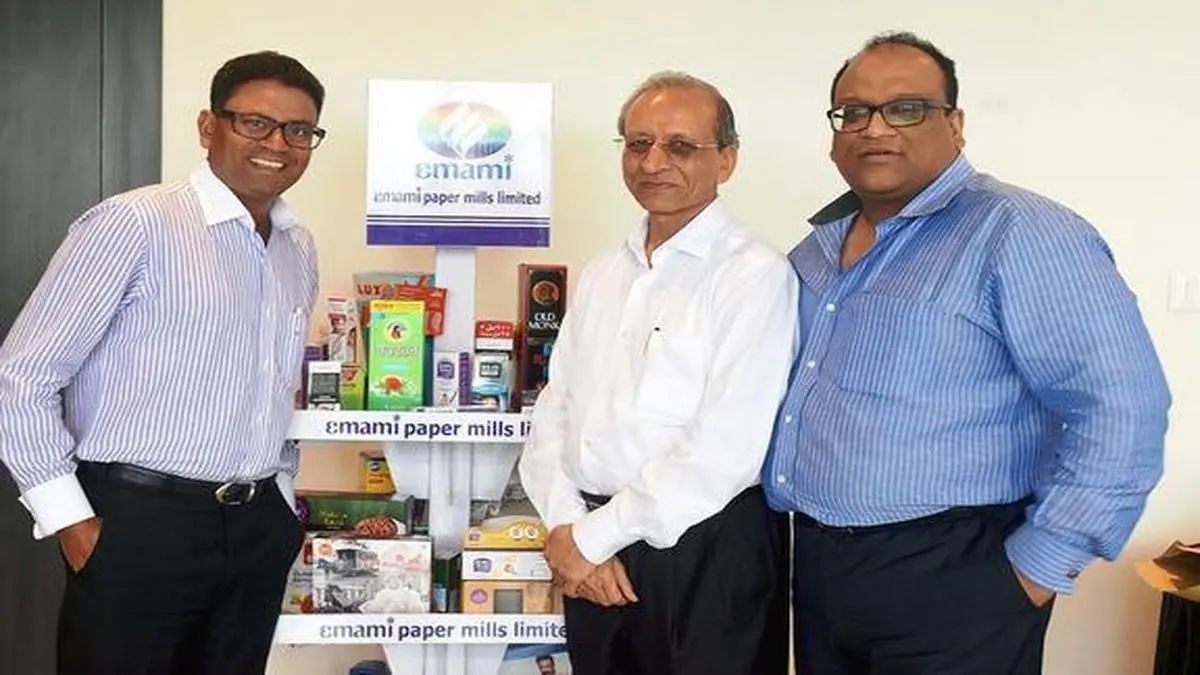
Emami Paper Mills FY26: PAT Surges to ₹61.4 Cr, but the Math Whispers Elsewhere
General information and entertainment, not investment advice. The author is not a SEBI-registered adviser or research analyst. No recommendation, no promised returns. Markets carry risk including loss of capital. Figures may not be current. Consult a registered adviser before acting.
1. At a Glance
Emami Paper Mills (EPML) reported FY26 PAT of ₹61.4 crore, up 136% from FY25’s ₹26.0 crore.
The bounce looks large. Operating profit rose 3.6% to ₹62.2 crore while sales fell 1.1% to ₹1,907 crore.
The tax rate dropped to 22% (from 23% prior year), pulling profit higher than operations alone would suggest.
Cash from operations recovered to ₹197 crore after a weak FY25 at ₹43.8 crore, a sign the business is moving money again.
On the other side, borrowings shrank to ₹817 crore from ₹941 crore—deleveraging in motion. Total debt-to-equity stands at 1.42x; the company still carries leverage, though India Ratings affirmed the A−/Stable rating in March 2026, signalling credit stability.
The core question: Is a company printing recovery real, or is the market pricing in more than the numbers support?
2. Introduction
Emami Paper Mills operates in a sector that sounds sleepy—paper, newsprint, packaging boards—until imports arrive and prices collapse.
The company was incorporated in 1981 and has been through boom and bust cycles. It sits inside the Emami group, a diversified Kolkata-based conglomerate with interests in FMCG, real estate, oils, and healthcare. That parentage provides financial flexibility and a safety net, a point India Ratings explicitly factors into its rating.
FY25 was brutal. PAT fell to ₹26.0 crore. Realisations (the prices EPML could charge) declined 5% year-on-year. Imports pressured the domestic market. The company’s own volumes were flat.
FY26 turned the corner—slightly. Prices bottomed. Costs eased. The company implemented efficiency measures and tightened its supply chain. The result: EBITDA margins improved to 9.5% in the nine-month period ending December 2025 (from 7.4% in FY25). Not a roar; a wheeze in the right direction.
Management shuffled in December 2025 when Vivek Chawla (former Whole-time Director) stepped down and Sushil Kumar Khetan took over as CEO, then as Whole-time Director. Manish Goenka, a scion of the Goenka family who leads much of the Emami clan, was re-appointed for three years from July 2026.
3. Business Model: WTF Do They Even Do?
EPML makes three things: newsprint, writing and printing paper (WPP), and multilayer coated packaging boards.
Newsprint: India’s largest newsprint producer. Capacity of 140,000 metric tonnes per annum (mtpa). The segment is in structural decline—digital news displacement is real and permanent. Pricing is weak. The company has made its newsprint machines fully flexible so they can swing to WPP or Kraft paper when realisations suit.
Writing & Printing Paper: A stable segment serving print media, education, retail. Low single-digit growth. No moat; commoditised pricing. EPML has a pan-India presence and some regional pricing power in the east.
Packaging Boards: The growth bet. 200,000 mtpa capacity (virgin and recycled grades combined). Demand is driven by e-commerce, FMCG, and fast-food delivery platforms—sectors moving volumes. Margins are thinner than they were, but volume resilience is higher. The company added virgin fibre capacity, which commands better realisations.
Geography: NP operations are in the east (Balasore, Odisha and Dakshineswar, West Bengal). Packaging boards are in the north and west. Exports are 8% of sales (Bangladesh, Vietnam, Middle East, Thailand) and remain subdued due to competition.
The model’s curse: EPML is a price taker. Raw material (waste paper and pulp) is 60–65% of total cost. Two-thirds of waste paper is imported; pulp is 100% imported. When global prices spike, EPML cannot pass it all on. When prices fall, domestic competition springs up and realisations stay pinned. The company has hedged forex exposure, which is prudent given pulp import risk.
4. Financials Overview
Figures are consolidated, in ₹ crore, annual basis.
Metric
FY24
FY25
FY26
Revenue
1,993.8
1,928.0
1,907.2
Operating Profit
236.4
142.1
196.0
EBITDA
295.6
194.1
248.5
PAT
84.3
26.0
61.4
EPS (annualised)
13.9
4.3
10.15
Latest quarter (Q4 FY26): Sales ₹496.4 crore, PAT ₹31.5 crore (annualising to ₹126 crore). That’s a Q4 bounce, and it reflects the seasonal recovery in demand.
Operating profit trajectory: FY24 opened with ₹236 crore. FY25 fell to ₹142 crore (a 40% cliff). FY26 recovered to ₹196 crore. The trend is up, but not yet back to the 2024 level. Margins compressed from 11.9% (FY24) to 7.4% (FY25), then to 10.3% (FY26). Partial healing.
Cash generation: Operating cash flow in FY26 was ₹197 crore, rebounding from ₹43.8 crore. The company spent ₹25.5 crore on capex, leaving free cash flow of ₹168 crore. That’s solid. Capex discipline is tight—India Ratings confirmed no major capex plans near-term.
Tax: The effective tax rate in FY26 was 34%, up from 22% in FY25. Over time, expect a blended 25–30% rate depending on profits and loss-carry-forward utilisation.
5. Valuation Discussion: Fair Value Range (Educational Only)
What follows is a walkthrough of how three valuation methods work, using this company’s numbers as the example — not a target, not a forecast, not advice.
Method 1 (P/E): Annualised EPS for FY26 is ₹10.15 (already a full year). Peer band for paper companies runs 17.6x (industry median) to 22–30x for mid-tier players. At 8.27x today, the market pays 8.27x on ₹10.15, producing a current price check of ₹84.0. Peer band multiples (17.6x to 25x) on FY26 EPS of ₹10.15 produce a range of ₹179–₹254.
Method 2 (EV/EBITDA): FY26 EBITDA is ₹248.5 crore. Enterprise value (market cap ₹514.4 + net debt ₹803.3) is ₹1,318 crore, yielding 5.3x. Paper industry median is 6.3x (per Screener data). Peer median sits around 6–7x. Applying 6.3x to ₹248.5 crore EBITDA produces ₹1,563 crore EV, which back-solves to ₹155–₹180 per share depending on net debt assumptions.
Method 3 (Simplified DCF): Assume operating profit stabilises at ₹196 crore (FY26 level), tax at 25%, and capex at ₹30 crore annually. Free cash flow to equity would be roughly ₹130–₹140 crore per year. At a 10% discount rate and 3% perpetual growth, this produces a value in the ₹1,300–₹1,500 crore range, or ₹215–₹247 per share. If growth assumptions tighten (2%