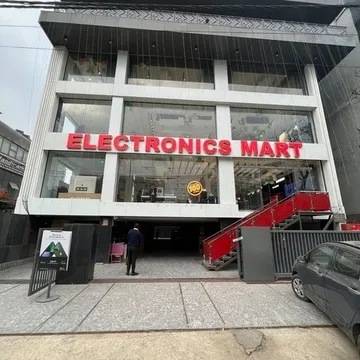
1. At a Glance – Blink and You’ll Miss the Margins
Electronics Mart India Limited (EMIL), trading at ₹106 with a market cap of ₹4,079 Cr, currently looks like that over-crowded electronics showroom on a Sunday afternoon: lots of footfall, decent billing, but profits hiding somewhere behind the washing machines. The stock is down ~21% in the last 3 months, ~26% over one year, and yet still commands a P/E of 44x, which frankly is braver than most Indian parents during a Diwali sale.
Q3 FY25 (Dec 2025 quarter) delivered ₹19,396.5 mn revenue (₹1,940 Cr) with PAT of ₹296.5 mn (₹29.6 Cr). Revenue grew 7.5% YoY, but profits declined 3.4% YoY. Operating margins stayed stuck around 6%, a number EMIL seems emotionally attached to.
Debt stands at a chunky ₹1,963 Cr, interest coverage is 1.83x, and ROCE sits at 10.4%—which in retail terms means: you’re running very fast on a treadmill that’s plugged into a bank loan.
So the big question before we dive deep:
Is Electronics Mart a scalable retail machine… or just a high-volume, low-margin EMI aggregator with showrooms?
Let’s open the balance sheet drawers and check what’s inside.
2. Introduction – From Bajaj Electronics to Stock Market Electronics
Founded in 1980, Electronics Mart India Ltd is basically what happens when a regional electronics retailer decides to dream national dreams—starting from Telangana and Andhra Pradesh, and slowly tip-toeing into NCR and beyond.
EMIL is India’s 4th largest consumer durables & electronics retailer by revenue, and the largest in South India. The company sells everything from TVs, ACs, washing machines, mobiles, laptops, printers, geysers, mixers, and probably the charger you forgot to buy.
It operates 191 stores across Telangana, Andhra Pradesh, NCR, and a tiny experimental toe dipped into Kerala. Retail area? 1.69 million sq. ft. Warehouses? 12. Brands? 100+. SKUs? 8,000+.
On paper, this sounds like a retail powerhouse. In practice, it’s a business where growth is easy, margins are hard, and debt quietly grows in the background like that one relative who never leaves your house.
The IPO happened in 2022, promoters diluted meaningfully, institutions entered, and suddenly EMIL was being compared with Avenue Supermarts, Vishal Mega Mart, and V-Mart—despite operating in a completely different margin universe.
Let’s slow down and understand what they actually do.
3. Business Model – WTF Do They Even Do?
Imagine Amazon, but offline.
Now remove Amazon’s tech margins.
Add rent, staff, electricity, and inventory risk.
Congratulations—you’ve understood EMIL.
Product Mix (Q1 FY25):
- Large Appliances – 53%
TVs, ACs, washing machines, refrigerators. Heavy billing, heavy discounts, wafer-thin margins.
- Mobiles – 35%
Oppo, Vivo, OnePlus. High volume, fast obsolescence, even thinner margins.
- Small Appliances, IT & Others – 12%
Laptops, geysers, printers, accessories. Slightly better margins, but smaller ticket sizes.
Store Formats
- 178 Multi-Brand Outlets (MBOs) – the bread and butter.
- 13 Exclusive Brand Outlets (EBOs) – Apple, Samsung, etc.
- Kitchen Stories, Audio & Beyond, Easy Kitchen – niche formats, more aspiration than revenue (for now).
Property Strategy