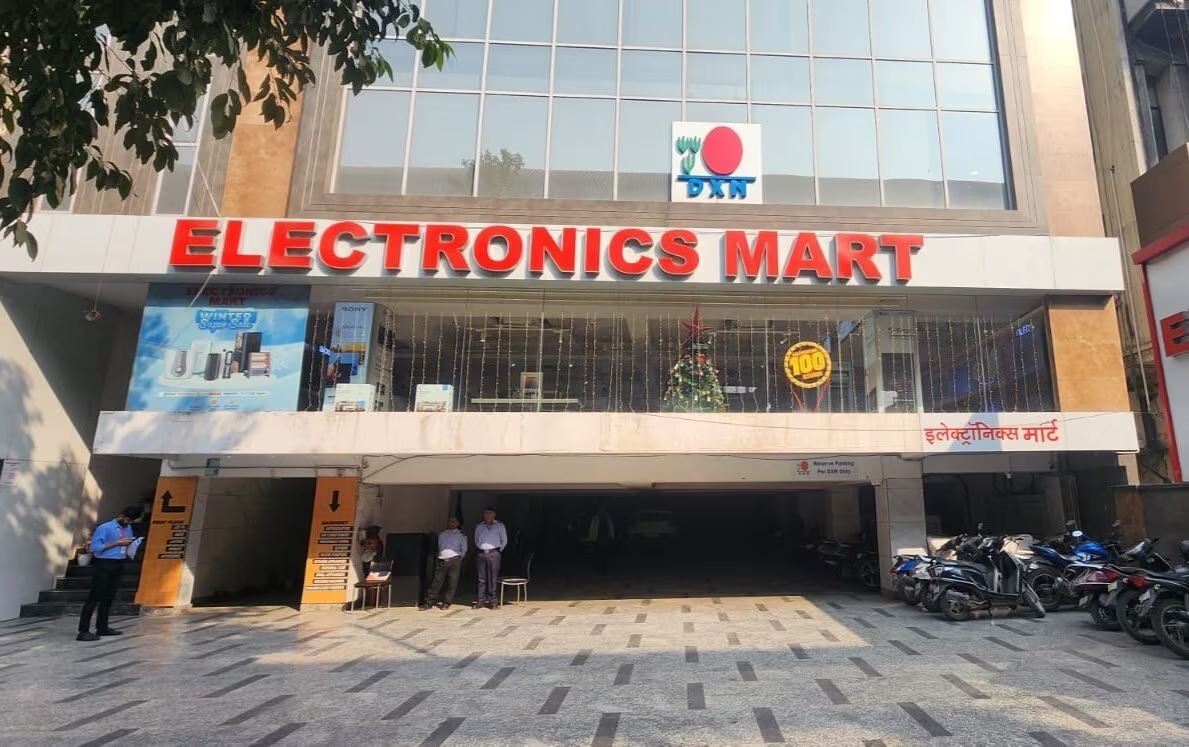
1. At a Glance
Welcome to the electronic dhamaka of Hyderabad—Electronics Mart India Ltd (EMIL), where washing machines spin, TVs shine, and profits fizzle. At a market cap of ₹5,155 crore, EMIL proudly holds its position as India’s 4th largest consumer electronics retailer—the spiritual cousin of Vijay Sales and the over-caffeinated twin of Croma.
As of Q2FY26, the company clocked sales of ₹1,591 crore, a 19.1% YoY rise, while net profit dived dramatically by -73.1% to just ₹6.29 crore. Its stock P/E is 56.5, which means either investors are seeing “future Flipkart” potential—or they just left their calculator on airplane mode.
Return ratios show ROE of 11.1%, ROCE of 10.4%, and a debt-to-equity of 1.26—a respectable structure for a retailer building stores faster than Swiggy opens dark kitchens. The book value per share is ₹40.4, so the stock trades at a 3.3x book, clearly priced for future growth, not current profit.
But here’s the spicy bit—fire at Guntur godown in May 2025 caused damages worth ₹7 crore (thankfully insured). Insurance payout of ₹7.53 crore received by September. Who says only customers get warranty?
So yes, the televisions are high-definition, but the earnings are low-resolution.
2. Introduction – The Great Indian Retail Circuit
Once upon a sale season, a middle-class Indian entered an Electronics Mart store. He was welcomed by 27 brand promoters, 5 EMI schemes, and one confused salesman explaining cashback conditions in Sanskrit.
That’s EMIL for you—a battlefield of brands, where Sony and Samsung share shelves with Havells and Havmor fridges, and the war is fought not on quality but on EMI tenure.
Incorporated in 1980, Electronics Mart India began as a small Hyderabad store and grew into a 191-outlet giant spanning Telangana, Andhra Pradesh, NCR, and a newly entered Kerala market. From 6,000 SKUs in FY20 to 8,000+ SKUs today, the company practically sells everything that needs a plug.
But in FY25 and FY26, the story has been about scaling pain—margin pressure from competitive pricing, fire incidents testing insurance clauses, and a market that’s chasing every smartphone upgrade cycle.
EMIL’s Q2FY26 profit slipped to ₹6.29 crore even as sales rose, showing how retail expansion eats cash like a washing machine swallowing a missing sock. Yet, with average ticket size ₹23,478 and same store growth of 3.8%, the momentum is alive—just slightly wheezing under its own weight.
So, is this India’s next retail powerhouse or just another Big Billion Sale waiting for clearance? Let’s plug in.
3. Business Model – WTF Do They Even Do?
Imagine walking into an electronics store where every brand fights for your retina. That’s EMIL.
The company’s empire runs on two formats:
- Multi-Brand Outlets (MBOs) – 178 stores selling everything from air conditioners to air fryers.
- Exclusive Brand Outlets (EBOs) – 13 stores for brands like Apple and Samsung.
Then there are their premium offshoots:
- Kitchen Stories (6 stores) – for modular kitchen enthusiasts who burn toast in style.
- Audio & Beyond (3 stores) – for people who buy ₹1 lakh speakers to play Punjabi beats.
- Easy Kitchen (3 stores) – appliances and solutions that are “easy” only until you see the bill.
The ownership model is a blend—some stores fully