DOMS Industries FY26: The ₹2,326 Crore Pencil Titan Grappling with Crude Friction
Section 1 — At a Glance
DOMS Industries Limited closed the fiscal year 2026 by delivering a robust top-line performance, with revenue from operations scaling up by 21.6% to reach ₹2,326.37 crore compared to ₹1,912.63 crore in the previous fiscal year. Profit after tax (PAT) followed a similar growth trajectory, expanding by 12.2% to hit ₹239.60 crore. This top-line volume thrust was largely propelled by an explosive multi-product launch strategy—spanning everything from tin-based pencil boxes to expanded writing instrument lines—coinciding perfectly with the domestic back-to-school season. However, this rapid scaling has not been completely friction-free. While the core stationery machine continues to print money, hyper-expansion into non-core, lower-margin segments like baby hygiene via its Uniclan subsidiary, coupled with sudden external commodity shocks, has started eating into the group’s premium profitability profile.
Investors are actively celebrating the company’s aggressive market share consolidation and capital execution, with construction on its massive 45-acre greenfield manufacturing facility in Umbergaon moving ahead in full swing. Conversely, a cause for near-term worry is the visible compression in operating margins. The consolidated EBITDA margin rolled back by 90 basis points from 18.2% in FY25 to 17.3% in FY26. This contraction highlights a vital corporate truth: aggressively chasing structural volume and product diversification without immediate pricing power often triggers severe back-end margin friction against macroeconomic volatility. The market is now closely monitoring whether DOMS can successfully pass on these surging raw material costs to consumers without diluting its shelf space. A teaser of multi-layered channel resistance and heavy execution cycles lies ahead.
Section 2 — Introduction
DOMS Industries Limited has evolved into an indisputable heavyweight within the Indian consumer ecosystem. The publication of its audited full-year FY26 financial statements provides a pristine look into how a modern, backward-integrated manufacturing operation manages real-world scale alongside volatile cost structures. This analysis exists to dissect whether the company’s expensive premium valuation is fully backed by operating cash flows, or if the underlying numbers are signaling an overheating engine.
Over the past few quarters, management has pushed deep into inorganic territory, expanding its core footprint through key corporate actions. This includes raising its ownership stake in Pioneer Stationery Private Limited to 64.0% by March 31, 2026, and rapidly scaling up its recently acquired 51% stake in Super Treads to capture broader paper stationery volume. With its massive Umbergaon mega-facility preparing to initiate commercial production by the end of Q2 FY27, DOMS is running an explosive, multi-front expansion playbook right in the middle of severe inflationary turbulence.
Section 3 — Business Model: WTF Do They Even Do?
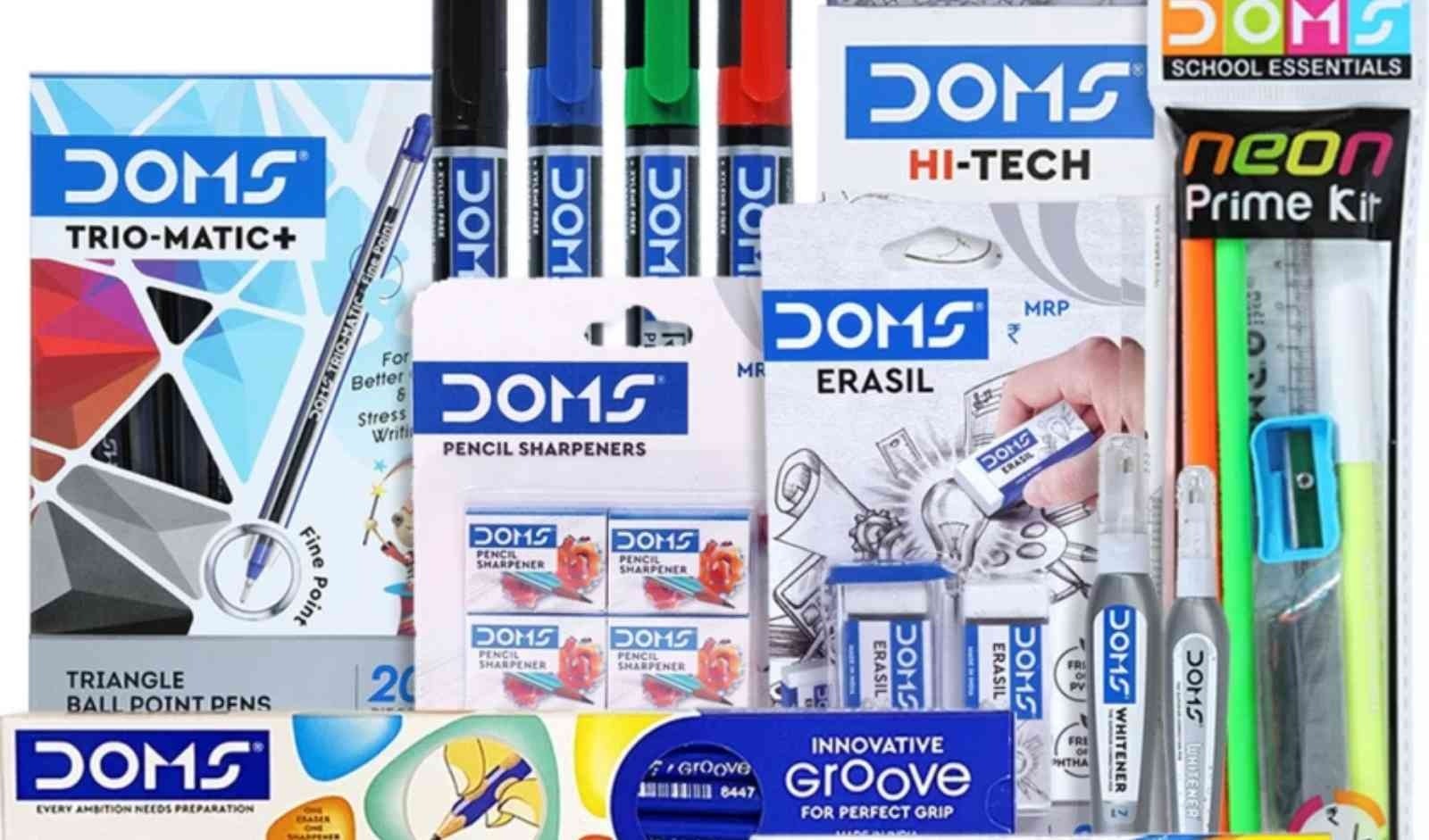
At its core, DOMS is a kids-centric consumer infrastructure company disguised as a wooden pencil business. It occupies the spot of the second-largest branded player in India’s stationery and art products market, commanding absolute authority through its core product portfolio. The business model is heavily anchored on exhaustive SKU replication, managing over 4,700 individual stock-keeping units across nine distinct categories, including scholastic stationery, art materials, paper stationery, office supplies, and kits.
To optimize the lifetime value of a child’s growing years, the group has diversified out of standard geometry boxes into high-margin backpacks via SKIDO and baby hygiene products under the “Wowper” brand via Uniclan Healthcare. Scholastic stationery remains the chief breadwinner at 32% of total FY26 revenue, followed by scholastic art material at 20% and office supplies at 15%. This massive catalog is supported by a robust, backward-integrated manufacturing infrastructure of 18 factories spanning 2 million square feet, where they produce everything internally from sketch pen caps to custom inks. They sell this inventory through a multi-channel army of over 5,900 distributors reaching 1,45,000 retail touchpoints across India.
Section 4 — Financials Overview
Figures are consolidated, in ₹ crore.
Quarterly Performance Trend
Metric
Q4 FY26
YoY (%)
QoQ (%)
Revenue from Operations
604.00
18.7%
2.0%
EBITDA / Operating Profit
100.94
14.4%
-2.4%
Profit After Tax (PAT)
56.74
17.1%
-2.0%
Earnings Per Share (₹)
9.35
17.2%
-2.0%
Note: Data derived from Excel Data Sheet quarters block and consolidated quarterly reporting tables.
The fourth quarter showcased steady sequential top-line growth, but operating profitability compressed as EBITDA margins slipped to 16.7%. In corporate finance, a