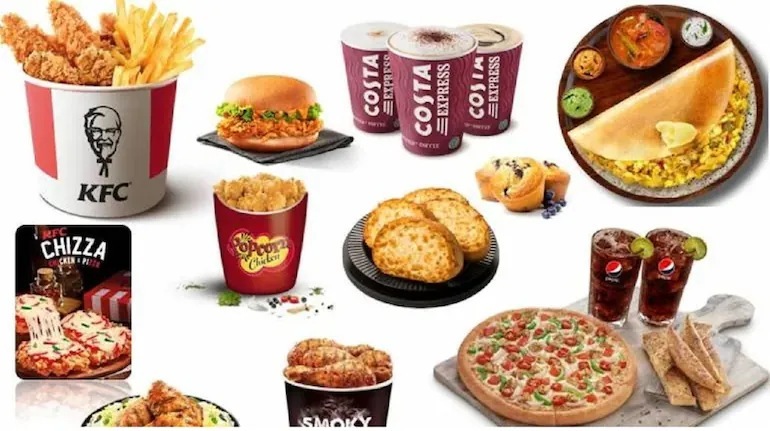
Devyani International:
₹1,441 Cr Revenue. Pizza Hut Is Dying.
Merging With Sapphire Anyway.
2,279 stores across India, Thailand, Nepal, Nigeria. KFC thriving. Pizza Hut hemorrhaging. Sky Gate finally profitable. Debt at ₹3,343 crore. Open offer incoming for Sapphire acquisition. Welcome to organised chaos, Indian QSR edition.
The Franchisee That Ate Too Much, Too Fast
- 52-Week High / Low₹191 / ₹109
- Q3 FY26 Revenue₹1,441 Cr
- Q3 FY26 PAT₹10.9 Cr*
- 9M FY26 PAT₹-26.2 Cr
- EPS (Q3)-₹0.08
- Book Value₹12.6
- Price to Book9.26x
- Dividend Yield0.00%
- Debt (Net)₹3,343 Cr
- Sapphire MergerIn Progress
Welcome to India’s Most Complicated QSR Mess
Devyani International: the company that somehow manages to operate KFC, Pizza Hut, Costa Coffee, Vaango, Sky Gate, Biryani by Kilo, and Goila Butter Chicken under one consolidated cap of ₹14,301 crore. Yes, all of them. No, it’s not working.
The unit economics are a Frankenstein. KFC India is growing and reasonably profitable. Pizza Hut India is imploding — negative same-store sales growth, margin destruction, the works. SKY Gate (acquired April 2025 for ~₹57.5 crore) just posted breakeven EBITDA in December 2025. International ops (Thailand, Nepal, Nigeria) are doing their own thing with mixed results. Corporate overhead is climbing. Debt is ₹3,343 crore. And the company has been loss-making for the first nine months of FY26.
Meanwhile, on January 1, 2026, the Board announced a merger with Sapphire Foods India (another Yum! franchisee, also struggling) at a 177:100 share swap ratio. The stated rationale: eliminate “fractured environment,” centralise tech/supply chain/marketing, unlock ₹210–225 crore in synergies, and create “one of the largest F&B platforms in India.” Expected timeline: 12–15 months for regulatory approvals (CCI, Stock Exchange). Expected cost: ₹320 crore payable to Yum! Brands.
So you have a company that’s already broken, betting its future on merging with another company that’s also broken, hoping that together they’ll become whole. In game theory, they call this “negative expected value.” In India, they call it “growth strategy.”
How to Operate Seven Brands and Fail at All of Them Simultaneously
Devyani’s business model is deceptively simple on paper: Yum! Brands (global parent) grants franchises for KFC and Pizza Hut. Costa Coffee International grants Costa Coffee. Devyani then operates physical stores, manages supply chain (theoretically), pays 6.3% royalty to Yum! on KFC/Pizza Hut, and invests capex aggressively to expand store count. Simple. Except it’s broken.
The company historically operated KFC and Pizza Hut as “operators and executors” — meaning Yum! controlled marketing, innovation, technology, supply chain, pricing. Devyani just showed up, flipped burgers/chicken, and collected cash flow. That was the model. Then in the Sapphire merger, management decided: we’re taking over Pizza Hut marketing, innovation, tech, and supply chain. We’ve never done this before. We’re building the team now. We’ll be ready by June.
For context: Pizza Hut is dying. Negative same-store sales growth for two straight quarters. Margin compressed to nearly zero (0.8% brand contribution in Q3 vs 16.8% for KFC). Store additions paused. KFC, by contrast, is still the crown jewel — 788 stores in India, 69.8% gross margin, though ADS (average daily sales) is flat and SSSG is under pressure due to “cannibalization and aggregator disruption.”
SKY Gate (biryani, butter chicken, etc.) is a bright spot now, but cost ₹57.5 crore to fully acquire and took over a year to stabilise. International operations (Thailand, Nepal, Nigeria) contribute ₹473 crore in Q3 revenue but carry margin risk and FX volatility.
Q3 FY26: The Sinking Feeling
Result type: Quarterly Results | Q3 FY26 EPS: -₹0.08 | 9M FY26 Cumulative PAT: -₹26.2 Cr | Annualised EPS (Q3×4): -₹0.32
Source table
| Metric (₹ Cr) | Q3 FY26 Dec 2025 |
Q3 FY25 Dec 2024 |
Q2 FY26 Sep 2025 |
YoY % | QoQ % |
|---|---|---|---|---|---|
| Revenue | 1,441 | 1,294 | 1,377 | +11.3% | +4.6% |
| Operating Profit | 231 | 213 | 192 | +8.5% | +20.3% |
| OPM % | 16.0% | 16.4% | 13.9% | -40 bps | +210 bps |
| PAT | 10.9 | -8.0 | -24.0 | N/A | N/A |
| EPS (₹) | -0.08 | -0.00 | -0.18 | Neg | +77.8% |
What’s This Company Actually Worth?
Method 1: P/E Based (Unreliable)
Full-year FY25 EPS: ₹0.08. Current stock price: ₹116. P/E = not meaningful. Company is loss-making in 9M FY26. Traditional P/E valuation is broken when earnings oscillate between negatives and single-digit positives.
Verdict: P/E unusable.
Method 2: EV/EBITDA Based
Q3 EBITDA: ₹227 Cr (reported, includes Sky Gate normalization). Annualised run-rate: ~₹900 Cr. Current EV: ₹17,479 Cr. EV/EBITDA = 19.4x. This is expensive for a debt-laden QSR operator with margin compression risk and a debt-to-equity of 2.15x. For comparison, consumer staples trade at 12–18x. DIL trades at the high end of expensive territory.
Fair EV/EBITDA (10x–14x): ₹9,000 Cr – ₹12,600 Cr → Implied Enterprise Value range suggests stock fairly valued to overvalued at current levels.
Range: ₹73 – ₹104 per share
Method 3: Asset-Based / Book Value
Book value: ₹12.6 per share. Price-to-book: 9.26x. Company is trading at nearly 10x book value despite losses, high leverage, and operational underperformance. This is a growth/sentiment premium for the Sapphire merger upside. If merger unravels, reversion risk is significant.
Downside Risk: ₹50 – ₹75 (2–4x book value)
The Superhero Cape That Might Be Made of Paper
🔴 The Big One: Sapphire Foods Merger (Jan 1, 2026)
On January 1, 2026, Devyani International announced a merger with Sapphire Foods India Ltd (SFIL) via a Scheme of Arrangement approved by both Boards. Share swap: 177 DIL shares per 100 SFIL shares. Rationale: “one of the largest F&B platforms in India,” scale to >3,000 stores, annualised turnover ~₹8,000 crore (approaching $1 billion USD). Synergies: ₹210–225 crore net annual (60% realised in Year 1, 100% by Year 2). One-time cost to Yum! Brands: ₹320 crore. Expected timeline: 12–15 months for CCI/regulatory approvals. Strategy: Devyani takes over Pizza Hut marketing, innovation, tech, SCM. Continues to take KFC tech/SCM only (Yum! retains KFC marketing). Management explicitly stated: “we are not under stress to open net new Pizza Hut units.” Translation: Pizza Hut turnaround focus, not growth.
⚠️ Leadership Churn in Progress
- • CEO Virag Joshi: Superannuated effective March 31, 2026
- • Manish Dawar promoted to President & CEO from April 1, 2026
- • New CFO: Anupam Kumar (elevated from EVP Finance)
- • Shivashish Pandey resigned as Yum! Brands CEO (Feb 28, 2026)
- • Sky Gate fully acquired for ~₹57.5 crore (w.e.f. Mar 7, 2026)
- Three leadership transitions in three months. This is not a signal of calm.
✅ Sky Gate Breakeven — A Real Win
- • Sky Gate (Biryani by Kilo, Goila Butter Chicken) reached breakeven brand EBITDA in Dec 2025
- • Achieved ahead of initial expectations — integration nearly complete
- • Started scaling: measured approach, no aggressive expansion yet
- • Vaango crossed 100 stores; Q3 revenue ₹20 crore with healthy unit economics
- • Own brands contribution margin stabilising at 9%
Is the Fort Surrounded or Fortified?
Source table
| Item (₹ Cr) | Mar 2024 | Mar 2025 | Sep 2025 | Dec 2025 (Q3) |
|---|---|---|---|---|
| Total Assets | 4,932 | 5,339 | 6,207 | ~6,400 |
| Net Worth | 1,025 | 1,095 | 1,430 | ~1,550 |
| Borrowings | 2,906 | 3,188 | 3,343 | 3,343 |
| Other Liabilities | 971 | 1,057 | 1,310 | 1,380 |
| Debt-to-Equity Ratio | 2.83x | 2.91x | 2.34x | 2.15x |
₹3,343 crore in borrowings against ₹1,550 crore net worth. D/E ratio: 2.15x (still elevated). For a QSR operator, this is aggressive leverage. Interest burden: ₹70 crore per quarter (~₹280 crore annually). Interest coverage ratio: 0.86x (per Screener) — dangerously low.
Devyani is reinvesting heavily: store additions require upfront capex. Fixed assets at ₹5,480 crore (Sep 2025). CWIP (capital work in progress) minimal at ₹8 crore, suggesting recent completion of major build-outs.
Despite losses in 9M FY26, net worth ticked up from ₹1,095 Cr to ~₹1,550 Cr (likely due to revaluation of acquired entities and equity issuance for Sky Gate). But debt remains stubbornly high.
Sab Number Game Hai
Source table
| Cash Flow (₹ Cr) | FY24 | FY25 | 9M FY26* |
|---|---|---|---|
| Operating CF | +766 | +900 | +620 (est.) |
| Investing CF | -1,551 | -461 | -350 (est.) |
| Financing CF | +889 | -425 | +200 (est.) |
| Net Cash Flow | +105 | +14 | -30 (est.) |
When Almost Every Metric Is Screaming “Caution”
Annual Trends — FY23 to TTM
Source table
| Metric (₹ Cr) | FY23 | FY24 | FY25 | TTM (Apr’25–Mar’26) |
|---|---|---|---|---|
| Revenue | 2,998 | 3,556 | 4,951 | 5,387 |
| Operating Profit | 657 | 565 | 839 | 815 |
| OPM % | 22% | 16% | 17% | 15% |
| PAT | 263 | -10 | -7 | -49 |
| Net Margin % | 8.8% | -0.3% | -0.1% | -0.9% |
The Story: Revenue has more than doubled in three years (FY23 ₹2,998 Cr → TTM ₹5,387 Cr). That’s genuine growth, no accounting tricks. But operating margin compressed from 22% to 15%, and net profit went from +₹263 crore to -₹49 crore. This is a classic case of: aggressive expansion → operational leverage lost → profitability destroyed. Pizza Hut expansion, Sky Gate acquisition, international capex, rising overhead — all contributed to margin death. The company has scale but no profit. A high-growth, zero-return business model.
Devyani vs The Other Broken QSR Guys
Source table
| Company | Revenue (TTM) | PAT (TTM) | ROCE % | Debt/Eq | OPM % |
|---|---|---|---|---|---|
| Devyani Intl | ₹5,387 | -₹49 | 6.4% | 2.15x | 15% |
| Jubilant Foodworks | ₹9,141 | ₹331 | 13.1% | 0.41x | 19.5% |
| Westlife Food | ₹2,573 | -₹9 | 7.1% | 1.26x | 12.7% |
| Sapphire Foods | ₹3,044 | -₹7 | 5.8% | 1.89x | 15.0% |
| Travel Food Inc | ₹1,554 | ₹423 | 41.7% | 0.13x | 38.4% |
The Snapshot: Jubilant Foodworks is the only healthy large-cap QSR player: ROCE 13.1%, zero leverage, ₹331 crore profit. Devyani and Sapphire are the troubled twins: both loss-making, high debt, low ROCE. Westlife Food is barely alive. Travel Food Inc (smallest cap) is a unicorn with 41.7% ROCE but operates in a niche (airport F&B). The message: QSR franchising in India is a broken model right now. Only Jubilant is winning. Everyone else is struggling to reconcile rapid expansion with unit-level profitability.
Follow the Money (and the Debt)
- Promoters (RJ Corp / Varun Jaipuria)61.37%
- Public13.42%
- DIIs (Mutual Funds, Insurance)19.44%
- FIIs5.77%
Pledge: 0.00%. No pledged shares — promoter is confident (or trapped). Total shareholders: 2.43 lakh (Dec 2025), up from 2.38 lakh in Sep. Retail slowly stepping in.
Promoter: RJ Corp / Ravi Kant Jaipuria
Ravi Kant Jaipuria founded RJ Corporation in 1991. Built Varun Beverages (a ₹50,000+ crore empire co-investing with PepsiCo). Owns ice cream (Cream Bell, Daima), healthcare (Medanta hospitals), education ventures across 14 countries. DIL is the QSR jewel that’s not shining. Jaipuria family holds 61.4% — they’re deeply committed (or deeply stuck).
The Merger Wild Card
Sapphire Foods (also RJ Corp-controlled via Samara Capital) is being merged into DIL. The combined entity will be India’s largest Yum! franchisee. Expected to unlock synergies. But integrating two loss-making companies is like merging two sinking ships and hoping the combined hull floats. The bet: scale + cost cuts + operational fix = profitability. That’s a ₹300+ crore bet on execution.
Who’s In Charge and Does It Matter?
✅ Operational Stability (Sort Of)
- ✓ Clean audit history — no material qualifications noted
- ✓ Quarterly concalls held on schedule; management engaging
- ✓ No pledge of promoter shares — confidence signal (or lock-in)
- ✓ Board-approved strategic acquisitions (Sky Gate) and mergers (Sapphire)
- ✓ Postal ballot passed with 95% assent for capital restructuring (Mar 2026)
⚠️ Risk Zone
- ⚠ CEO Virag Joshi retiring March 31, 2026 — transition risk
- ⚠ New President & CEO (Manish Dawar) inheriting Sapphire merger integration
- ⚠ Debt-to-equity at 2.15x — leverage risk if operations deteriorate further
- ⚠ Interest coverage at 0.86x — technically insolvent on debt-service basis
- ⚠ Yum! taking over Pizza Hut ops — if capabilities transfer fails, turnaround stalls
- ⚠ GST demand notice (₹5.42 Mn tax, ₹3.91 Mn penalty, FY18–23) — complian gap
Why Indian QSR Is Broken (And Why DIL Is Broken-er)
India’s QSR market is estimated at 2.5–3 million MT annually, growing at a 3.5–4% CAGR. Nothing flashy. Yum! Brands (KFC, Pizza Hut) represents ~40–50% of the branded QSR market in India. The rest: local brands, unorganised players. The theory: franchising works because unit-level economics are strong. The reality: aggregator disruption (Zomato, Swiggy), changing consumer behaviour post-COVID (delivery vs dine-in), and hyper-competitive pricing have eroded margins below breakeven for many players.
🔥 The Aggregator Problem: DIL’s Achilles Heel
Zomato and Swiggy now command 60–70% of online food orders. Devyani’s KFC ADS is flat YoY despite store additions — a sign of market saturation and cannibalization. Management explicitly cited: “the food sector has evolved after the entry of online players… we need a very differentiated strategy from an online and offline perspective.” Translation: old unit economics are dead. A KFC store used to make ₹12–15 lakh per day. Now, with delivery taking 40% of sales at lower margins, unit profitability has compressed. DIL is trying to adapt, but it’s fighting a structural headwind.
✅ The Console Opportunity: January Green Shoots
In January 2026, management cited “positive SSSG across all our brands except Pizza Hut,” attributed to “experiments with promotions, deals, and channel reallocation.” Sounds great. But management explicitly cautioned: “it is just 1 month… too early.” A single month of positive SSSG does not a recovery make. Data-dependent, but not yet proven.
→ The Sapphire Endgame: Scale or Sink
By merging Sapphire Foods (another loss-making Yum! franchisee) with DIL, the combined entity captures ~60–70% of branded QSR in India. Management envisions >3,000 stores, ₹8,000+ crore revenue, and ₹210–225 crore annual synergies. Sounds compelling. But the merger also introduces integration risk, management distraction, and execution complexity. If the synergies are delayed or fail to materialise, the stock could correct sharply.
🏠 The EV / Hybrid Wildcard: Long-Term Risk
EV penetration in India’s vehicle parc is still <2–3%, but growing. Hybrid vehicles (especially strong hybrids from Maruti, Toyota) still require engine oil and brake fluid. Management notes this as a tailwind, not a headwind — correctly so. But if EV adoption accelerates faster than expected, QSR footfall may be impacted (fewer vehicles = fewer service/delivery occasions). This is a 5–10 year tail risk, not imminent.
Competitive positioning: Jubilant Foodworks (Domino’s franchisee) is the only healthy large-cap competitor. Higher margins, zero leverage, profitable operations. Devyani, by contrast, is a high-volume, low-margin, leveraged operation betting on scale to fix broken unit economics. That’s a risky game.
The Brutal Truth
Devyani International is a company in transition. It has scale (2,279 stores, ₹5,387 crore revenue), but no profitability (loss-making 9M FY26, negative ROCE). It has debt (₹3,343 crore at 2.15x D/E), and a merger gamble (Sapphire, ₹210–225 crore synergy bet). The stock at ₹116 is priced for merger success. If the merger fails or synergies are delayed, reversion to ₹70–80 is plausible.
Q3 FY26 Execution: Revenue +11.3% YoY, which is solid. But operating profit barely moved, and PAT swung between tiny profits and losses. The business is growing, but unprofitably. This is the crux: revenue up, profit down, debt up. Unsustainable trajectory.
Pizza Hut Is The Anchor Dragging Everything Down: The brand is loss-making, with negative same-store sales growth for two quarters. Management is now taking over marketing, innovation, tech, and supply chain from Yum! — functions DIL has never handled at scale. Turnaround expected “in a couple of years.” That’s a long time to wait for a turnaround that may not happen.
KFC Is Strong But Hitting Limits: The crown jewel has flat ADS, suggesting market saturation and cannibalization from aggressive expansion. Same-store sales growth pressure is real. Without pricing power (aggregators are commoditising), KFC’s profit pool shrinks.
Sky Gate Reaching Breakeven Is Real Progress: The biryani/butter chicken acquisition is finally stabilising. This proves management can acquire and turn around brands (if given time). But one success doesn’t offset two major problems.
Historical Context: DIL went from profitable (FY23: +₹263 Cr PAT) to loss-making (FY25: -₹7 Cr PAT) in two years. The expansion has not paid off yet. The merger with Sapphire is a bet that consolidation + synergies will fix the broken model. It’s a binary bet.
✓ Strengths
- 2,279 stores across India, Thailand, Nepal, Nigeria
- KFC India has 51% market share in branded QSR (strong moat)
- Revenue growth still double-digit (+13% TTM)
- Operating CF positive at ~₹900 Cr (business-level cash gen)
- Sky Gate acquisition now profitable — M&A capability proven
- Merger with Sapphire unlocks ₹210–225 crore annual synergies (if realised)
✗ Weaknesses
- Loss-making for 9M FY26 (cumulative -₹26.2 crore PAT)
- Pizza Hut is a zombie — negative SSSG, near-zero margin, turnaround “2 years away”
- ROCE 6.42% vs industry 15–20% — capital destruction
- Debt ₹3,343 crore, D/E 2.15x, interest coverage 0.86x — leverage at risk
- ADS flat despite store additions — market saturation real
- Promoter at 61.4% — limited public float, insider control risk
→ Opportunities
- Sapphire merger: scale to 3,000+ stores, ₹8,000 Cr+ revenue, $1bn USD target
- Synergies: G&A consolidation, procurement leverage, vendor negotiations
- Pizza Hut turnaround if DIL can deliver on marketing/innovation/tech takeover
- Aggregator strategy refinement — channel reallocation (Jan 2026 positive SSSG)
- International expansion (Thailand, Nepal, Nigeria) still underpenetrated
- New brand incubation (Sanook Kitchen, Asian cuisine) — greenfield potential
⚡ Threats
- Merger execution: CCI approval uncertain, timeline delays possible, integration risk high
- If merger fails, stock reversion from ₹116 to ₹70–80 likely
- Debt covenant breaches if operating cash flow deteriorates further
- Pizza Hut turnaround failure would compound losses and debt burden
- Aggregator pressure continues — unit economics may never recover to pre-COVID levels
- EV adoption long-term; delivery model disruption accelerating
Devyani International is not a growth story anymore. It’s a restructuring story.
The company has expanded aggressively, acquired strategically, but profitability has evaporated. The stock trades at a merger premium (₹116 with upside optionality to ₹150–165 if Sapphire closes successfully). But downside risk is sharp (₹70–80 if execution falters). The business is binary: either the merger unlocks synergies and both brands stabilise, or the combined entity struggles with legacy debt and margin pressure. There’s no middle ground here. The current price bakes in merger success. If you’re buying, you’re betting on Devyani + Sapphire management pulling off the largest Indian QSR restructuring in a decade. If you’re selling, you’re betting on CCI rejection or merger delay. For income seekers, the stock yields 0%. For growth seekers, the story is execution-dependent. For value seekers, the valuation is expensive on historical metrics and binary on forward metrics. Your thesis must be: “I believe the Sapphire merger will close and unlock ₹210+ crore annual synergies within 2 years.” If that resonates, enter. If not, wait for clarity or a repricing lower.