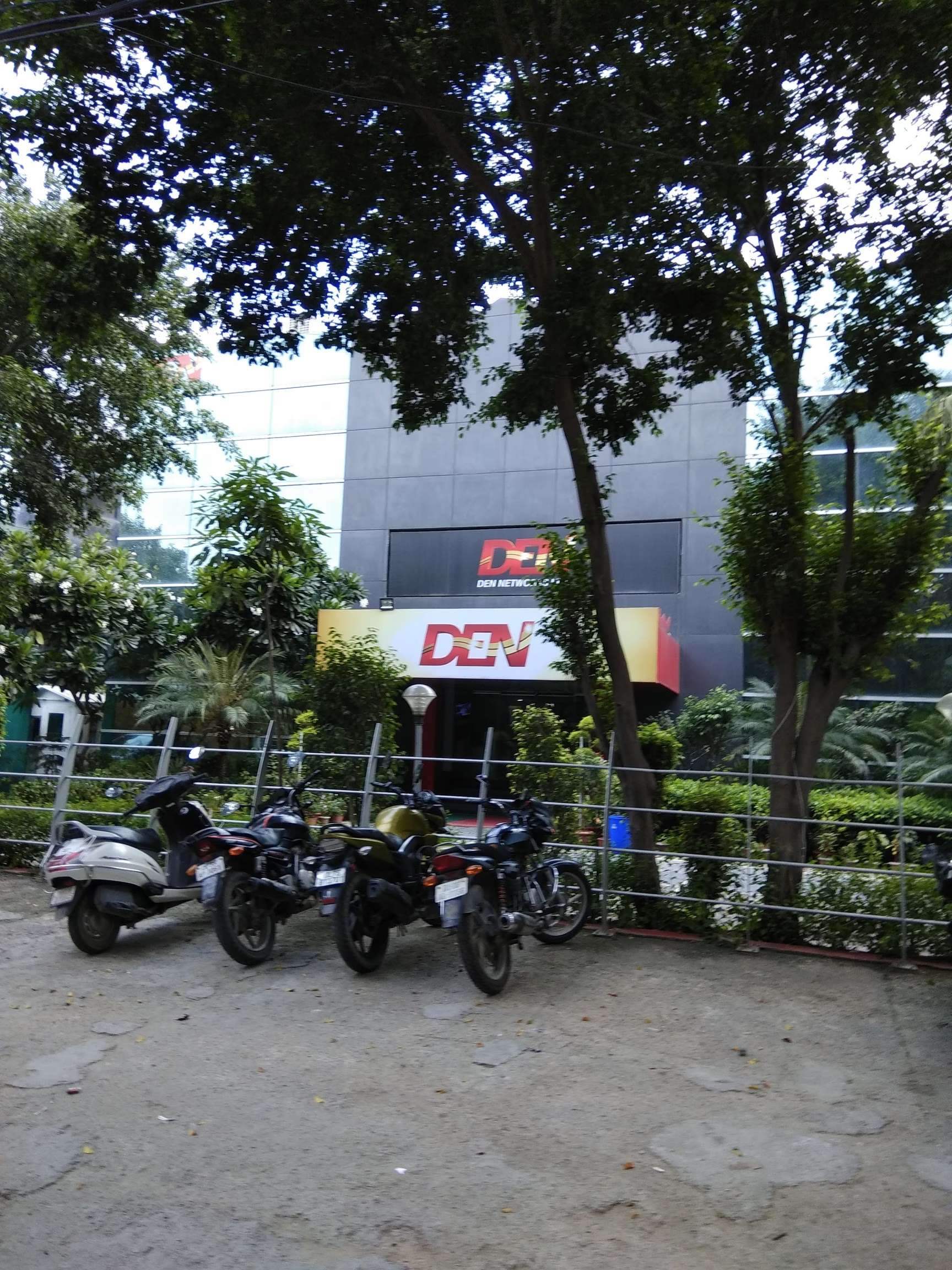
Den Networks Q4 FY26: ₹3,283 Cr Cash Hoard, Yet EBITDA Margin Crashes to 6% — Is This a Cable TV Company or a Sleeping Treasury?
1. At a Glance
There are companies that are drowning in debt, bleeding cash, and begging banks for survival. Then there is DEN Networks.
DEN is sitting on cash and cash equivalents of ₹3,283 crore while its entire market capitalization is only around ₹1,376 crore. That means the market is literally valuing the operating business at less than zero. Enterprise value stands at negative ₹1,742 crore. In simple English, if someone bought the company today, they would theoretically get the cable TV business for free and still have a mountain of cash left over.
Now here comes the twist.
Despite this insane cash pile, DEN’s core business is moving like an old cable box that takes five minutes to switch channels.
FY26 revenue fell 3% YoY to ₹974 crore. EBITDA crashed 39% to ₹68 crore. PAT fell 16% to ₹166 crore. Operating margins have fallen from 11% in FY25 to just 7% in FY26. Q4 FY26 EBITDA margin came in at only 6%, versus 11% in Q4 FY25.
The business has become a strange combination of boring, cash-rich, slow-moving and heavily dependent on other income. In FY26, other income stood at ₹233 crore, which is actually higher than reported PAT of ₹166 crore. That means without treasury income, interest income and investment returns, the core business profitability would look far weaker.
This is the kind of company where the balance sheet looks like a billionaire, but the operating business behaves like a tired kirana shop owner who has lost interest in expanding.
Reliance Industries owns nearly 75% of the company. So there is always a possibility that DEN becomes part of a larger Jio content, broadband or distribution ecosystem someday. But investors have been waiting for that magical Reliance integration story for years. So far, it has mostly been like waiting for your cable operator to come fix the signal problem during an India-Pakistan match.
Meanwhile, cable TV as an industry is slowly being eaten alive by OTT, smart TVs, cheap mobile data and changing viewing habits. DEN still reaches over 13 million households across 13 states and 450+ cities, but the big question remains:
Can a cable TV business reinvent itself before the entire industry becomes the next landline telephone?
That is the real story here.
2. Introduction
DEN Networks is not some flashy new-age tech company promising AI, EVs, drones, space travel and blockchain in one investor presentation.
This is an old-school cable TV distribution company.
The business makes money from subscriptions, placement income, activation charges and broadband services. The problem is that almost every one of these businesses is under pressure.
Cable subscriptions are shrinking because customers are shifting to OTT platforms. Younger viewers are watching content on mobile phones, not television boxes. Even people who still watch TV are increasingly choosing smart TVs and bundled streaming apps.
DEN’s revenue mix tells the story clearly.
Subscription income contributes about 53% of revenue, placement income contributes 36%, activation income contributes 5%, and internet plus other revenue contributes 6%.
Placement income is basically money that broadcasters pay cable operators to place their channels in prime positions. But as more people move away from traditional TV, even that revenue stream becomes vulnerable.
Broadband could have been DEN’s big growth engine. The company operates broadband across 41 cities and towns, and broadband revenue is mostly subscription-driven. But even here, competition is brutal. DEN has to compete against JioFiber, Airtel Xstream, ACT, local fiber operators and half the neighborhood’s WiFi uncle.
The irony is amazing.
DEN is owned by the same Reliance ecosystem that disrupted telecom through Jio. So on one side, Reliance-backed Jio created cheap mobile internet that accelerated OTT adoption. On the other side, Reliance-owned DEN is now dealing with the damage that cheap internet caused to cable TV.
That is like setting your own house on fire and then selling fire extinguishers.
Q4 FY26 was not pretty.
Revenue came in at ₹241 crore versus ₹248 crore in Q4 FY25. EBITDA fell from ₹28 crore to ₹15 crore. PAT fell from ₹60 crore to ₹36 crore.
Yet the company still looks financially solid because of its gigantic cash balance and near-zero debt.
This is what makes DEN so confusing.
The business is weak.
The balance sheet is fantastic.
The stock trades at just 8.3 times earnings and 0.36 times book value.
So is the market missing something, or is the market simply telling you that the business is slowly becoming irrelevant?
3. Business Model – WTF Do They Even Do?
DEN has three main businesses.
First is cable TV distribution.
This is still the largest business. DEN distributes TV channels across over 450 cities and towns in 13 states. It works through a network of local cable operators and franchisees. Customers pay monthly subscription fees, broadcasters pay placement income, and DEN keeps the distribution machine running.
Second is broadband.
DEN Broadband operates fixed internet services across multiple cities. Broadband revenue is mostly recurring and has much better long-term potential than cable TV.
Third is OTT.
DEN TV Plus is the company’s OTT platform. It offers over 130 live TV channels, 2,500+ movies and recorded shows.
Now here is the slightly awkward part.
Every cable operator today wants to become a broadband company. Every broadband company wants to become an OTT company. Every OTT company wants to become a content company. And every content company wants to become a tech company.
Eventually everyone ends up making the same investor presentation with slightly different fonts.
DEN’s real advantage is its last-mile network and large subscriber base. It already has millions of cable households. If it can successfully upsell broadband, OTT bundles and digital services, it could remain relevant.
But if it fails, then it risks becoming the financial version of an old DVD rental shop sitting beside a Netflix billboard.
The company also launched its LCO Light House application in FY23 to improve engagement with local cable operators. It includes courses, announcements, contests, schemes and industry news.
That is actually smart because local cable operators are the backbone of the business.
If they are unhappy, subscribers disappear.
If they leave, broadband expansion becomes harder.
And if they switch loyalty to another network, DEN loses its distribution edge.
4. Financials Overview
Since the latest official heading is “Quarterly Results”, this is treated as quarterly data. Q4 FY26 EPS of ₹0.80 is not annualised because full-year FY26 EPS is already available at ₹3.47.
Metric
Q4 FY26
Q4 FY25
Q3 FY26
Revenue
₹241 Cr
₹248 Cr
₹251 Cr
EBITDA
₹15 Cr
₹28 Cr
₹13 Cr
PAT
₹36 Cr
₹60 Cr
₹40 Cr
EPS
₹0.80
₹1.30
₹0.80
Q4 looked ugly.
Revenue fell only slightly, but EBITDA almost halved. That means costs are refusing to go down at the same pace as revenue.