When corporate earnings releases sound like a legal defense brief, wise investors look for what is being swept under the rug. On May 14, 2026, the board of Deep Industries approved its audited financial statements, stamped with a clean bill of health by its statutory auditors. Headline hunters immediately cheered a 55% jump in full-year consolidated operating revenue to ₹891 crore.
However, a massive discrepancy emerged beneath the operational surface. The company recorded a massive historical exceptional loss of ₹208.28 crore, dragging its reported standalone net profit into a deeply negative zone. This absolute wipe-out stems from the finalization of the Kandla Energy and Chemicals merger, where a 12-month reconciliation revealed that old trade receivables were completely unrecoverable.
With the stock trading at a price of ₹447, creating a market capitalization of ₹2,861 crore, the street is pricing this business at a seemingly cheap price-to-earnings multiple of 7.76. But this multiple is highly deceptive. It relies on management’s adjusted profit metrics that gracefully ignore the massive cash destruction of the past.
Furthermore, structural operational risks are accelerating. Just weeks before this balance sheet cleanup, the company suffered a provisional business suspension from its principal client, ONGC, following a drilling rig sabotage incident. Simultaneously, an uncontrolled gas leak at Well Mori #5 triggered a strict regulatory stop-production order from the pollution control board.
Introduction
Deep Industries has historically positioned itself as a key execution partner in the domestic oil and gas services industry. It operates across multiple service lines, ranging from gas compression to chartered rig hire. The corporate narrative is built entirely around an astronomical order book, which reached ₹3,050 crore by late 2025. This provides an apparent multi-year revenue runway that keeps public investors optimistic.
The core onshore fleet is currently running at 100% utilization, which means any incremental revenue growth will require immediate, heavy capital expenditures for new rigs. Growth is no longer a matter of deploying idle capacity; it requires real cash layout.
The true financial reality of this business can only be assessed by evaluating consolidated performance. Standalone financial metrics completely miss the massive capital allocations directed toward its structural maze of subsidiaries and step-down entities. Deep Industries holds a heavy 75% stake in Dolphin Offshore Enterprises, alongside several newly minted international subsidiaries across free zones in the UAE.
The primary analytical problem here is distinguishing true operating cash flow from purely engineering-driven accounting adjustments. Management has actively guided the market to look exclusively at adjusted profitability, which isolates core operations from exceptional write-offs. Our analytical objective is to strip away these promotional adjustments to determine if the business can successfully sustain its capital-intensive expansion.
Business Model – What Do They Actually Do?
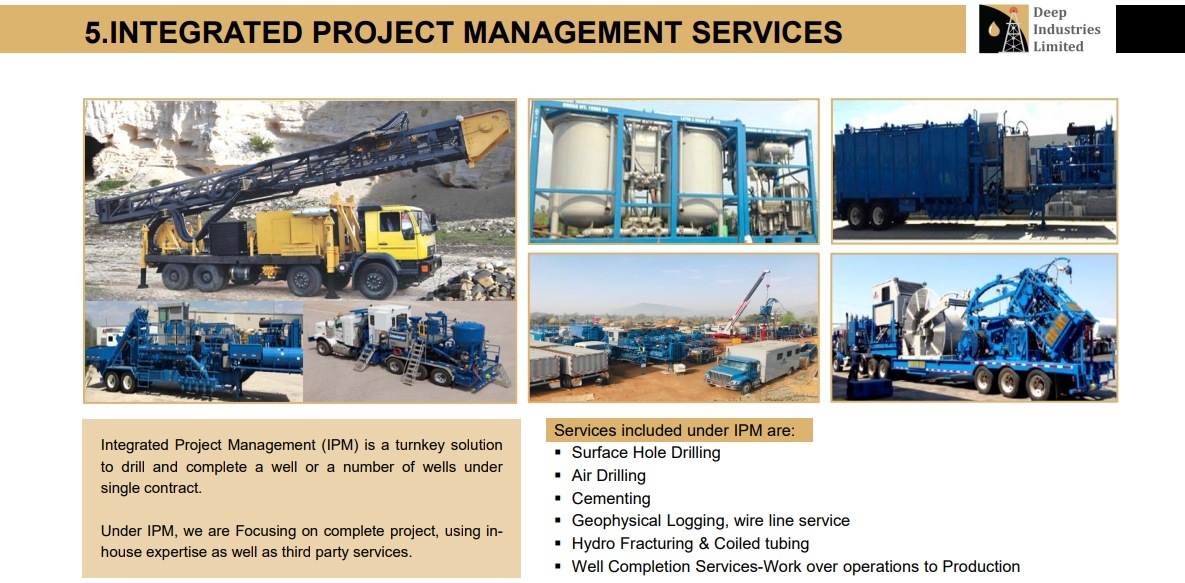
Deep Industries functions as a critical asset-heavy rental factory for energy exploration giants. Rather than taking direct exploration risks, the company purchases high-capacity equipment and leases it on a charter hire basis to public and private oil exploration firms.
- Gas Compression & Dehydration Services: The company commands a dominant domestic market share of over 70% in post-exploration natural gas services. It builds, owns, and operates massive gas compression packages that facilitate pipeline transmission.
- Drilling and Workover Rigs: Deep Industries maintains a mobile fleet of drilling units deployed across mature public fields. This segment is highly capital-intensive, requiring near-continuous utilization to recover structural equipment costs.
- Production Enhancement Contracts (PEC): This is the newest long-term growth driver, exemplified by a massive 15-year contract with ONGC for the mature Rajahmundry field. The company manages field operations to extract incremental gas over baseline projections.
- Offshore Support Services: Executed through Dolphin Offshore, this segment leases dynamically positioned accommodation barges and anchor handling vessels to international clients.
The entire commercial engine relies on winning large public tenders, primarily from ONGC and Oil India. While asset deployment looks highly efficient on paper, it binds the company to the capital expenditure cycles of a tiny, hyper-concentrated pool of institutional buyers.
Financials Overview
The financial results for the quarter ended March 31, 2026, highlight the massive divergence between structural business growth