1. At a Glance
Deccan Cements Ltd (DCL) is what happens when a 1979-born cement company decides to stay small but dream big. With a market cap of ₹1,414 crore, a current price of ₹1,009, and a stock P/E of 42.6, it’s trying to prove that size doesn’t matter—margin does. The latest quarterly result (Q2 FY26, ended Sept 2025) showed revenue of ₹140 crore and PAT of ₹9.07 crore, representing a YoY growth of 324%. If that’s not cementing a comeback, we don’t know what is.
But hold the applause—ROE is just 0.75% and ROCE stands at 1.53%, which means the company makes more on selling snacks at the AGM than it does from capital employed. With a debt of ₹760 crore and a capex project worth ₹1,120 crore underway, DCL is clearly playing the “spend now, pray later” game.
Still, the stock has delivered a 73% return in one year—cement investors are suddenly acting like this is UltraTech’s little cousin. But dig deeper, and you’ll find that Deccan’s story is equal parts ambition, dust, and debt. Let’s mix this up properly.
2. Introduction
If cement were a Bollywood genre, Deccan Cements would be that middle-class drama where the hero is overworked, underpaid, but somehow still manages to build a house. Founded in 1979, this Hyderabad-based company has been quietly churning out cement, hydro, and wind power—basically, trying to be Ambuja in a small-town version of the same story.
But don’t underestimate this smallcap veteran. With its 1.8 MTPA capacity, and another 1.8 MTPA plant on the way by the end of FY25, DCL is doubling its ambitions faster than its EBITDA. The expansion cost of ₹1,120.61 crore, funded by ₹670.56 crore debt, sounds like an adrenaline shot for a company whose profits have seen more ups and downs than a construction elevator.
Financially, Deccan is that friend who looks rich in photos but is drowning in EMIs. Over the last three years, profit growth has fallen 62%, sales have declined 12.7%, and ROE slipped from 10% (5-year avg) to under 1%.
Yet, Q2 FY26 brought back a flicker of hope—revenues stabilized, margins improved, and net profit rebounded 324% YoY. Investors are beginning to whisper: “Maybe the worst is over.”
Or maybe this is just the cement industry’s version of an intermission. The next act could either be blockbuster or bankruptcy.
3. Business Model – WTF Do They Even Do?
Let’s break down Deccan’s operations like we’re mixing concrete.
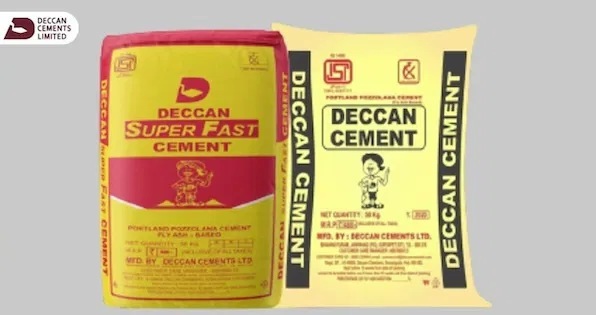
Core Business: Cement manufacturing. The company produces three main types:
- Ordinary Portland Cement (OPC): Available in 33, 43, and 53 grades.
- Portland Pozzolana Cement (PPC): Used in hydraulic structures and mass concreting.
- Portland Slag Cement (PSC): Best for coastal construction.
- Specialty Cements: Sulphate-resistant, High Alumina, and even Oil Well Cement for the brave ones drilling in heat and humidity.
Power Division: The company’s side hustle. It runs a 2.025 MW wind project, a 3.75 MW hydel project, and a 7 MW Waste Heat Recovery Plant (WHR)—so at least some of its electricity bills are self-paid.
Distribution Network: Over 1,000 dealers spread across South and Central India—Andhra, Telangana, Tamil Nadu, Kerala, Karnataka, Maharashtra, MP, and Odisha. Basically, if there’s dust and humidity, DCL is already there.
Revenue Mix (FY23):
So