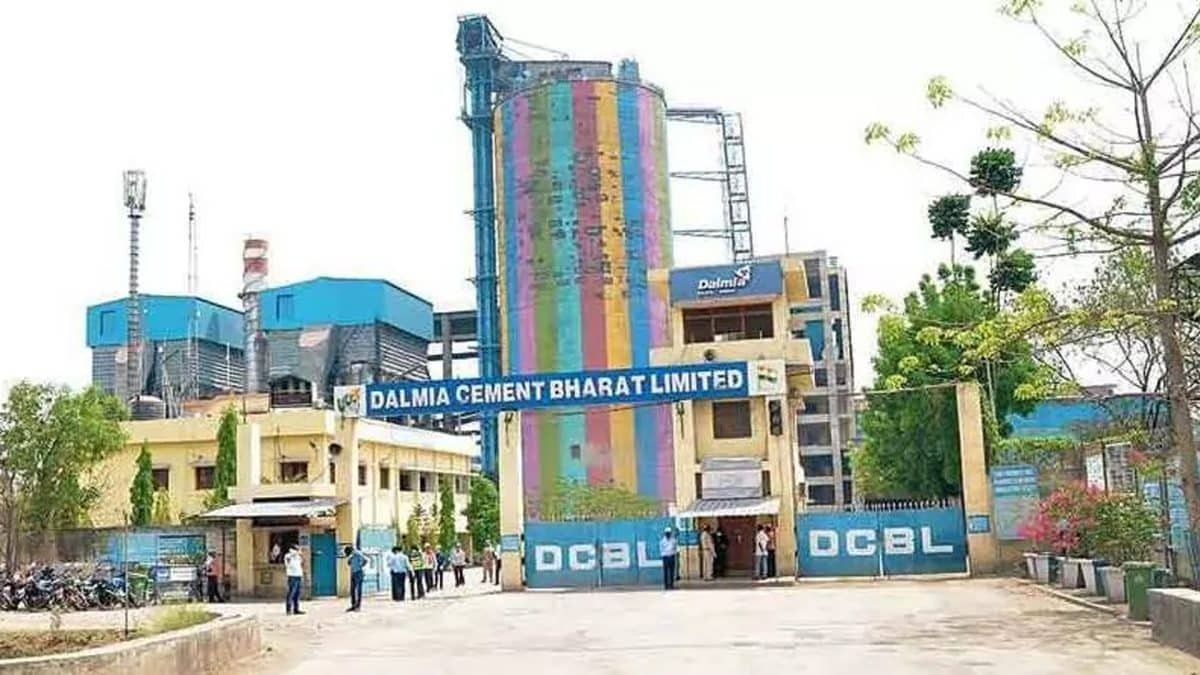
01 — At a Glance
The Fourth-Largest Cement Maker That Nobody Talks About (Until Results Drop)
Dalmia Bharat is India’s fourth-largest cement manufacturer by installed capacity—49.5 MTPA as of June 2025, with plans to practically double it to 110–130 MTPA by 2031. Yes, you read that correctly: they want to add a UltraTech’s worth of capacity in six years. The stock trades at ₹1,836, market cap of ₹34,429 crore, with a P/E of 28.8x that screams “priced for growth.” But here’s the thing: Q3 FY26 delivered the goods. 7.3 MnT volume (+9.5% YoY). ₹602 crore EBITDA (+18% YoY). Revenue up 10% YoY. Yet the stock is down 3.47% in the last three months. Welcome to cement investing, where the best-performing quarter somehow makes the stock fall. Dividend yield: 0.47%. Return over 1-year: 12%. ROE: 4.15% (yes, really). ROCE: 5.58% (no, that’s not a typo). This is a company printing money on expansion capex while trading like it’s the future Amazon of concrete.
The Setup: When a cement maker’s volumes grow faster than demand growth, capacity ramps faster than pricing recovers, and the stock is down despite record earnings—you’re looking at either a long-term bargain or a value trap dressed up with capex announcements. Dalmia is betting on being the former.
02 — Introduction
Why Dalmia Matters Even Though Nobody Uses the Word “Dalmia” Outside Tamil Nadu
Let’s establish reality: most investors can name three cement companies—UltraTech, Ambuja, ACC. Dalmia? That gets a blank stare, followed by a Google search, followed by “oh, they’re the fourth-largest.” And yet, this fourth-largest company is growing faster than the combined market in the regions where it operates, has EBITDA per tonne competitive with the biggies despite lower realizations, and just announced a capex plan that reads like a strategic memo to become relevant. Founded in 1939, Dalmia is an old-money, family-run business with diversified exposure across East (44% of capacity), South (34%), Northeast (16%), and West (6%). The East is India’s most under-penetrated cement region per capita consumption—and Dalmia owns close to 40% of the capacity there. That’s not a market position. That’s a strategic advantage.
Q3 FY26 results, announced in January 2026, showed management executing on market share gains while navigating price softening. Volumes surged 9.5%, EBITDA margins held steady despite GST-led pricing corrections, and cost initiatives delivered structural savings. Meanwhile, the ED attached ₹793 crore of land in a legacy CBI case from 2011, and instead of folding, management is fighting it through proper channels with “optimism for a good outcome.” This isn’t a company in distress. This is a company on a capex spree betting that consolidation in cement will eventually reward scale and execution.
Jan 2026 Concall Clarity: Management explicitly stated: “Price is a bonus… not dependent. Focus on market prioritization, cost efficiency, disciplined capital allocation.” Translation: they’re not betting on prices to deliver returns; they’re betting on volume growth and cost takeout to do the heavy lifting.
03 — Business Model: Cement, Clinker, and Ambition
The Unglamorous Art of Mining Limestone, Burning Clinker, and Grinding Cement
Dalmia manufactures Portland Slag Cement (PSC), Portland Composite Cement (PCC), Portland Pozzolana Cement (PPC), and Ordinary Portland Cement (OPC). Translation: they make cement in four flavors, with PSC being the star—they account for 84% of PSC blending ratios in FY25, meaning they’re the go-to PSC producer in the country. The distribution? 49,300+ channel partners across 23 states. Trade channel accounts for 62% of sales in Q3 (down from late-60s, per management—they expect normalization). Premium cement at 23% of mix. Direct dispatches at 62% of shipments. Lead distance at 277 km—lower than the industry average, which means better logistics, lower freight cost. The economics are straightforward: mine limestone in captive/long-term tie-ups, burn it into clinker at their own plants (49.5 MTPA clinker capacity), grind it into cement, and sell through a massive distribution network. Margins depend on: (1) raw material costs, (2) power/fuel costs, (3) freight/logistics, (4) realization per tonne. In Q3, raw materials were ₹780/ton (+2% YoY), power & fuel ₹1,019/ton (+1% YoY), logistics down 5.6% YoY, and realization down due to GST-driven price corrections across East and South. The cost stack is improving structurally—renewable energy, direct dispatches, local coal blending—but realizations are under pressure. Management’s playbook: grow volumes faster than price declines, take costs out faster than realizations soften, and scale capacity to capture the next growth leg.
Capacity Q349.5 MTPAClinker
Q3 Volumes7.3 MnT+9.5% YoY
Market Share~16%National cement
Utilization63%FY25 vs 69% FY23
The Structural Advantage: Dalmia’s dominance in PSC and presence in the under-penetrated East gives it a tailwind as demand shifts toward blended cements (lower cost to producer, higher durability for end-user). While others fight for volume in saturated markets, Dalmia is growing in markets with structural demand tailwinds.
04 — Financials Overview
Q3 FY26: The Numbers That Tell the Story
Result type: Quarterly Results | Q3 FY26 EPS: ₹6.50 | Annualised EPS (Q3×4): ₹26.00 | 9M FY26 EPS: ₹39.72
| Metric (₹ Cr) |
Q3 FY26
Dec 2025 |
Q3 FY25
Dec 2024 |
Q2 FY26
Sep 2025 |
YoY % |
QoQ % |
| Revenue | 3,506 | 3,181 | 3,417 | +10.2% | +2.6% |
| EBITDA | 602 | 511 | 696 | +17.8% | -13.5% |
| EBITDA Margin % | 17.2% | 16.1% | 20.4% | +110 bps | -320 bps |
| PAT | 128 | 66 | 239 | +93.9% | -46.4% |
| EPS (₹) | 6.50 | 3.25 | 12.58 | +100% | -48.3% |
The Reality Check: Q3 PAT of ₹128 crore includes exceptional labour code provisions of ₹32 crore. Strip that out, and normalized PAT is ~₹160 crore. Annualised EPS of ₹26/share implies a forward P/E of ~70.5x—absolutely absurd. But hold on: 9M FY26 EPS stands at ₹39.72. If Q4 delivers another ~₹8–10 crore PAT (reasonable), full-year FY26 EPS ~₹49–50, implying forward P/E of ~37x on FY27 guidance (if volumes/margins stay flat). Still pricey, but less absurd. The point: cement results are lumpy. Q2 was stellar (₹12.58 EPS). Q3 took a hit from price softening. Q4 will depend on: realizations, volume, and whether cost initiatives offset any further price declines.
05 — Valuation: Is ₹1,836 Fair or Fairytale?
What Does a Fourth-Largest Cement Maker That’s Spending ₹6,800 Cr on Capex Actually Cost?
Join 10,000+ investors who read this every week.