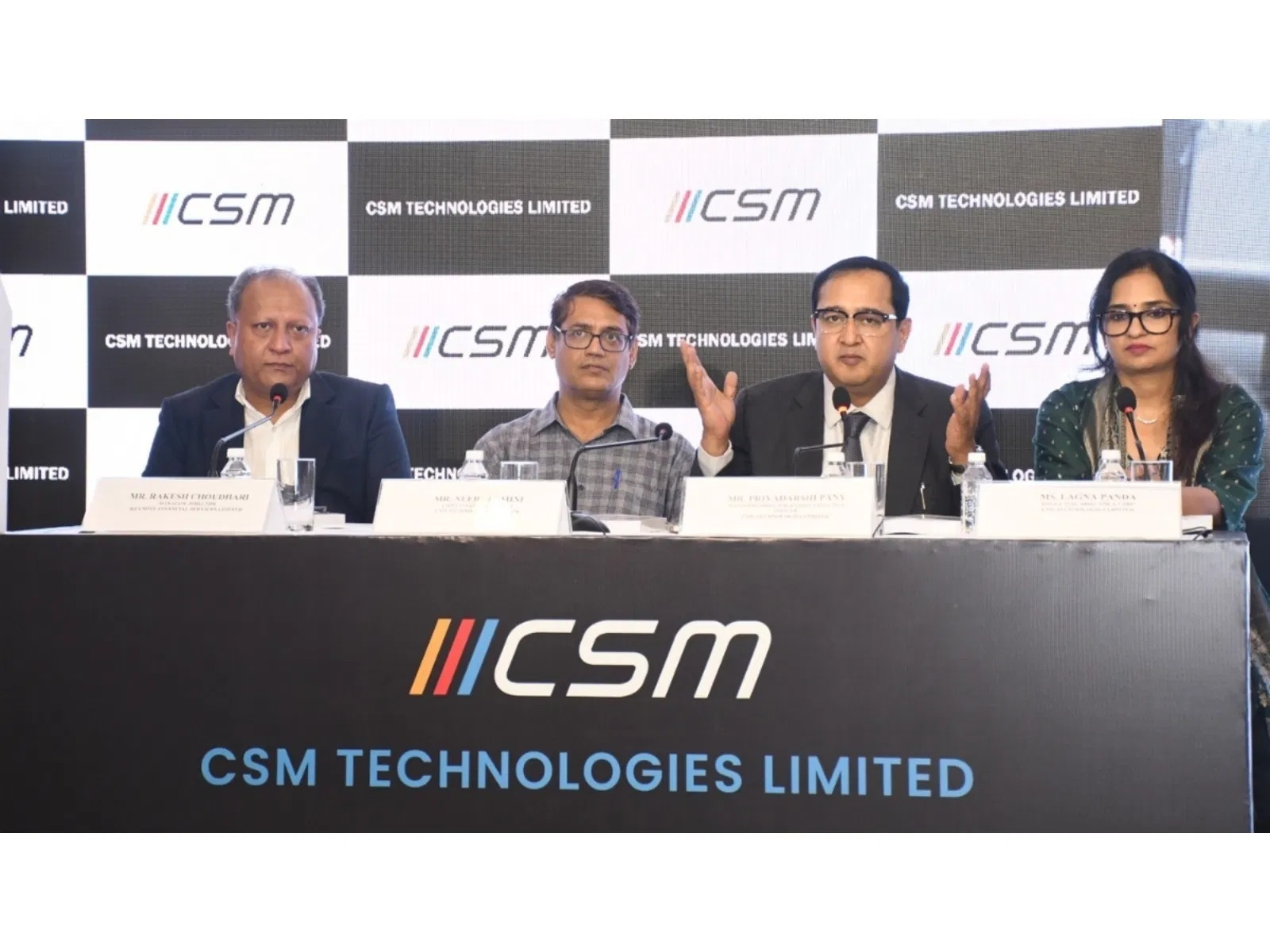
CSM Technologies IPO: A 27-Year GovTech Veteran Asks ₹146 Crore at ~30x, With a 20-for-1 Bonus in Its Past
Spotted a factual error — a wrong number, date, or fact? Tell us and we will check the source.
General information and entertainment, not investment advice. The author is not a SEBI-registered adviser or research analyst. No recommendation, no promised returns. Markets carry risk including loss of capital. Figures may not be current. Consult a registered adviser before acting.
1. At a Glance
CSM Technologies has spent 27 years quietly building e-governance plumbing for state governments, and is now asking the public market for ₹145.78 crore in fresh capital at a post-issue market capitalisation of ₹583.12 crore. The arithmetic the company puts forward: a post-IPO P/E near 30x on annualised FY26 earnings, against an offer-document peer set scattered between roughly 4x and 24x.
The tension sits in the income statement. Total income climbed from ₹161.50 crore in FY23 to ₹200.63 crore in FY25, yet profit after tax went the other way over the same stretch — ₹15.82 crore in FY23 down to ₹14.09 crore in FY25. The top line grew; the bottom line wobbled. The order book at March 31, 2026 stood at ₹357.63 crore, about 1.8x the latest full-year income.
Two numbers worth holding as the page turns: the promoters’ average cost of acquisition is ₹0.49 per share, against an issue price band of ₹107–₹113. And a 20-for-1 bonus in March 2023 followed by a 5-for-1 bonus in June 2025 means today’s share count is a very different animal from yesterday’s. The record is what follows.
2. Introduction
Incorporated in 1998, CSM Technologies is a Bhubaneswar-based IT solutions company that has spent nearly three decades designing and running digital infrastructure for government agencies. It describes itself as a long-term digital-transformation partner to the public sector, with a presence across 14 countries per the Red Herring Prospectus, including India, Ethiopia, Kenya, Rwanda, Gambia, Gabon, Malawi, Cape Verde, the United States and Canada.
The recent corporate history is mostly a capital story. The company raised equity at a fixed price of ₹438 per share in January, February and May 2025. It issued bonus shares 20-for-1 in March 2023 and 5-for-1 in June 2025. It adopted a formal dividend policy in August 2025. And now it arrives with a maiden book-built IPO — entirely fresh capital, no offer-for-sale — opening June 24 and closing June 29, 2026, listing tentatively July 2.
The issue raised ₹20 crore from anchor investors on June 23, 2026. The offer constitutes 25% of post-IPO paid-up equity. Of the net proceeds, ₹56.00 crore is earmarked for working capital, ₹22.63 crore for repaying borrowings, and the remainder for unidentified acquisitions and general corporate purposes — the company is shopping, it just hasn’t said for what yet.
3. Business Model: WTF Do They Even Do?
CSM sells software to governments. Specifically, it builds the platforms citizens shuffle through without ever knowing a company in Odisha wrote the back end — farmer registries, scholarship portals, school-admission systems, grievance-redressal engines.
The project list reads like a tour of state machinery: KRUSHAK Odisha and SAFAL for farmers, SAMS Odisha and OFSS Bihar for student admissions, the Mo Sarkar AI grievance system, single-window investor portals like GO-SWIFT. Abroad, it has done seed certification in Kenya, a wheat-rust warning system in Ethiopia, and donor-aid tracking in Rwanda and Mozambique. The export slice runs above 15% of the order book.
Here is the structural feature of selling to governments: it is a high-entry-barrier business with long, sticky relationships, which the company lists as a competitive strength — and it is also a business where the customer pays slowly and the cheque clears on its own calendar. The model lives and dies on working capital, which is precisely why ₹56 crore of the IPO — the single largest use — funds working capital rather than a product, a factory, or an idea.
The company reports 1,327 employees as at March 31, 2026. For an outfit spanning 14 countries and a project list this long, that is a lean payroll doing a great deal of governing.
Does a government order book worth 1.8x annual income count as visibility, or as a very polite queue?
4. Financials Overview
Figures are restated consolidated, in ₹ crore. The latest reported period is the nine months ended December 31, 2025 (9M FY26).
Metric
9M FY26 (Dec’25)
FY25
FY24
FY23
Total Income
167.05
200.63
198.65
161.50
EBITDA
30.07
29.27
23.71
27.87
PAT
14.70
14.09
12.55
15.82
Net Worth
88.88
76.18
59.75
50.31
The shape is the story. Income rose roughly a quarter from FY23 to FY25, but FY24 PAT fell to ₹12.55 crore — a drop of about 21% from FY23’s ₹15.82 crore — even as the top line grew. EBITDA recovered to ₹29.27 crore in FY25 and the nine-month FY26 figure of ₹30.07 crore already exceeds the