Coromandel International Ltd Q2 FY26 – When Fertilizers Grow Faster Than GDP and Drones Buzz Above Kisan Fields
1. At a Glance
In a country where farmers still check soil moisture by kicking it, Coromandel International Ltd (CIL) has quietly built a ₹64,152 crore empire fertilizing both crops and investor portfolios. The Q2 FY26 results? A bumper harvest. Revenue bloomed 29.9% YoY to ₹9,654 crore, while PAT shot up 21.3% YoY to ₹805 crore — all without government subsidy tantrums. EPS rose to ₹27.31 for the quarter, implying an annualized ₹109.2. The stock, currently sitting at ₹2,174, trades at a P/E of ~30x — because who doesn’t love profits that grow faster than urea prices?
Return metrics continue to flex — ROCE 23.2%, ROE 16.9%, debt-to-equity 0.12x — making it the gold standard for capital discipline in the fertilizer universe. Over 6 months, the stock slid 3%, perhaps because investors mistook “crop protection” for “portfolio protection.” Still, 32% annual returns over one year say the soil is fertile.
The company just completed its acquisition of NACL Industries (53% stake), got approval for a ₹550 crore letter of comfort, and greenlit brownfield expansions. The chemical cocktail is working — even the board is sowing confidence, reappointing the Chairman with a postal ballot.
If fertilizer companies had IPL teams, Coromandel would be the Chennai Super Kings — disciplined, data-backed, veteran, and somehow always in the top two.
2. Introduction
In India, fertilizer subsidies are as sacred as cricket matches and election promises. Yet somehow, Coromandel International manages to make money without losing its sanity to subsidy receivables. Founded in 1961, and now part of the Murugappa Group, this company turned the dull business of phosphates and potash into an agri-chemical empire spanning fertilizers, crop protection, bioproducts, retail, and now — drones. Yes, from phosphate bags to UAVs.
While the rest of the fertilizer industry is busy attending subsidy grievance hearings, Coromandel has been expanding into bio-based solutions, nano fertilizers, and drone technology through its majority stake in Dhaksha Unmanned Systems. Picture this: an Indian farmer, guided by a Coromandel crop advisor, spraying nano-DAP via drone — the kind of tech leap our grandparents would call witchcraft.
With 18 manufacturing facilities, 760 retail stores, and a reach across 3 million farmers, CIL is basically India’s rural Reliance Retail — but with more soil testing and less Jio. The company’s Q2FY26 results prove that the transition from chemical-heavy to bio-smart agriculture is not a far-off fantasy — it’s a spreadsheet reality.
Question: When was the last time a fertilizer company made you want to check its EBITDA margins before breakfast?
3. Business Model – WTF Do They Even Do?
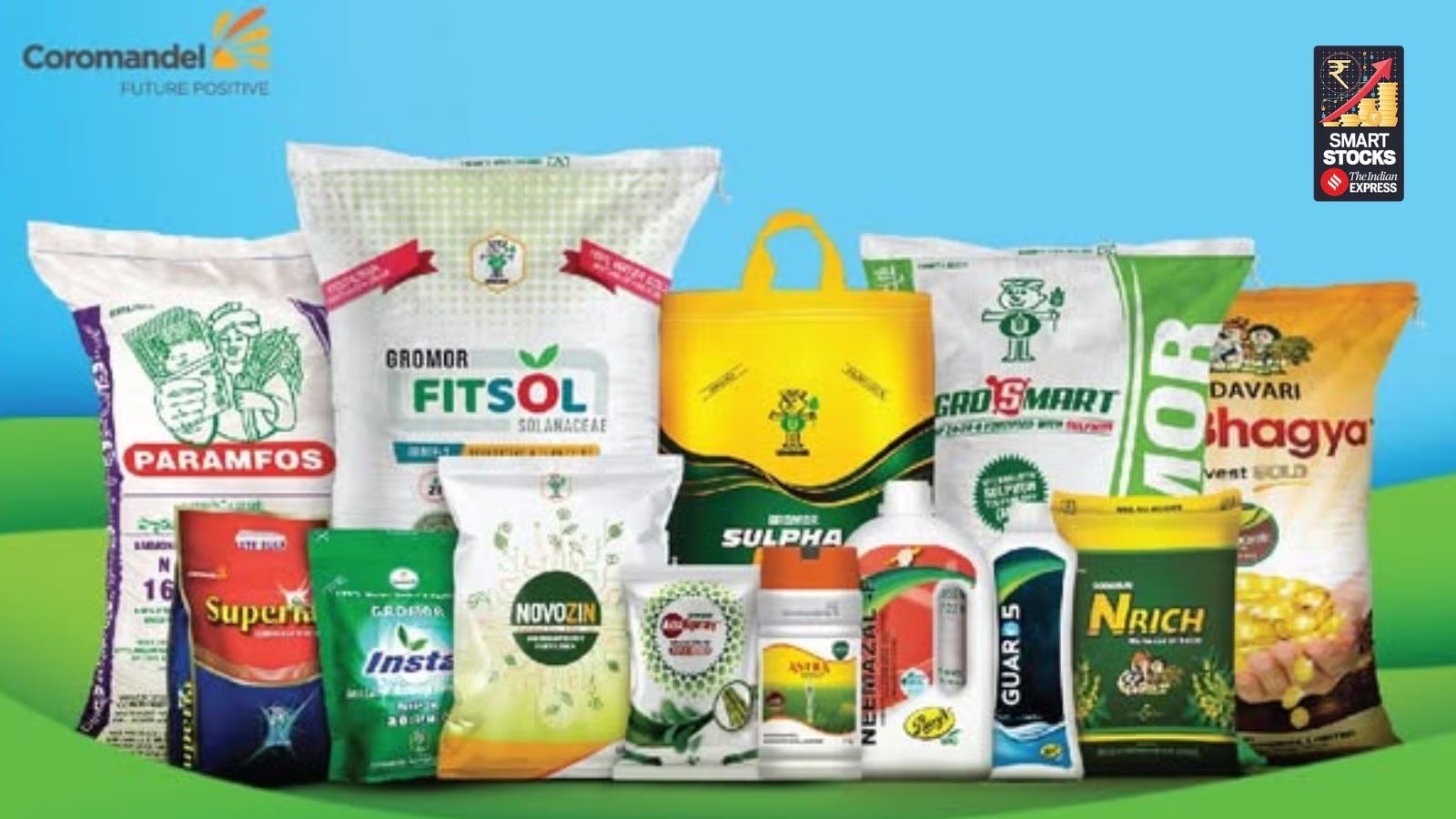
Coromandel sells stuff that makes crops grow and pests die — elegantly packaged as “Nutrient” and “Crop Protection” segments. Around 89% of revenue comes from Crop Nutrition (fertilizers, specialty nutrients, organics, nano-DAP) and 11% from Crop Protection (pesticides, bio-products, and mancozeb — the world’s least sexy but most essential fungicide).
The Crop Nutrition business includes 13 NPK and 5 SSP variants, giving farmers options as if they’re ordering from Zomato. Coromandel dominates the phosphatic market, holding ~15% market share and being the #1 SSP manufacturer. The newly launched Nano DAP, a patented liquid fertilizer, is the Tesla of plant nutrition — small, efficient, and probably misunderstood by half the market.
The Crop Protection business includes insecticides, herbicides, and fungicides sold under 60+ brands. Coromandel is the 3rd largest mancozeb producer globally and ships 37% of this segment’s revenue overseas. Then there’s Bio Products, derived from neem and microbes — where Coromandel controls 65% of the global Azadirachtin export market.
And because Murugappa Group doesn’t believe in half-measures, they also run 760 retail outlets across AP, Telangana, and Tamil Nadu, providing soil testing, farm mechanization, and seed-to-sale advice. It’s like Amazon meets Krishi Mela.
So yes — Coromandel doesn’t just sell fertilizers; it sells trust, technology, and occasionally, drones.
4. Financials Overview
Metric
Latest Qtr (Q2 FY26)
YoY Qtr (Q2 FY25)
Prev Qtr (Q1 FY26)
YoY %
QoQ %
Revenue
₹9,654 Cr
₹7,433 Cr
₹7,042 Cr
+29.9%
+37.1%
EBITDA
₹1,147 Cr
₹962 Cr
₹782 Cr
+19.2%
+46.7%
PAT
₹805 Cr
₹659 Cr
₹502 Cr
+21.3%
+60.4%
EPS (₹)
27.31
22.55
17.13
+21.1%
+59.4%
Annualised EPS = ₹109.2 → P/E = 19.9x (on annualised basis, vs 30.2x trailing).
Commentary: Coromandel’s quarterly profits grew faster than most startups’ burn rates. EBITDA margins of ~12% are stellar for a fertilizer company, where government approvals often move slower than photosynthesis. The consistent double-digit growth YoY shows that even in a subsidy-driven sector, efficiency can be profitable.
5. Valuation Discussion – Fair Value Range Only
Let’s do some math that even the CFO would approve of: