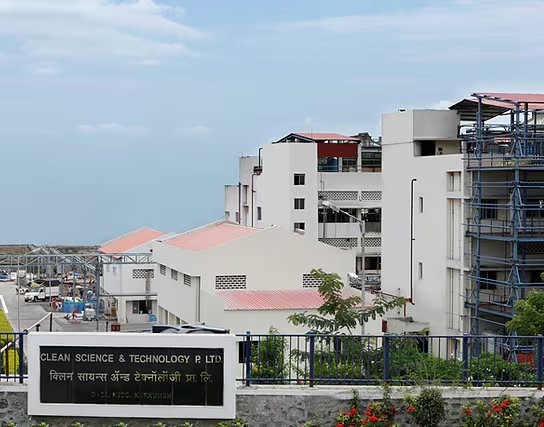
Clean Science & Technology Ltd Q2FY26 – From Chemical Perfection to Promoter Chaos: When a “Clean” Company Gets Its Hands Dirty
Date of Publishing -
Spotted a factual error — a wrong number, date, or fact? Tell us and we will check the source.
1. At a Glance
Clean Science & Technology Ltd (CSTL) – India’s self-proclaimed “poster child” of green chemistry – just delivered another quarter that was both impressive and ironic. At ₹981 per share and a market cap of ₹10,415 crore, the company still smells of innovation, though a bit of promoter sweat lingers in the air after their 24% stake dump in August 2025. With a quarterly sales of ₹211 crore (down 7.3% QoQ) and profit of ₹64.6 crore (down 4.15%), CSTL’s performance looks like that of a disciplined student who stumbled on a wet lab floor.
The stock trades at a P/E of 35.4x – modest compared to the chemical royalty like Pidilite and Gujarat Fluorochemicals – but with the same elite confidence. The operating margin? Still dazzling at 43.8%. Debt? Practically invisible. ROCE at 29.3% and ROE at 21.9% prove the core business is purring, even if the promoters just decided to “share the love” with FIIs and DIIs.
It’s rare to find a chemical company with such squeaky-clean balance sheets, but when 24% promoter holding disappears overnight, you can’t help but check if someone accidentally spilled acid on the register.
2. Introduction
Let’s start by giving Clean Science its due: this Pune-based molecule magician has done what most Indian chemical firms can’t—go global without smelling like a compliance violation. Founded in 2003, the company crafts functionally critical specialty chemicals that quietly power your sunscreen, cough syrup, and baby diapers.
But 2025 hasn’t been entirely sunshine and surfactants. The company’s promoter family, who once owned 75% of the firm, mysteriously decided to offload nearly a quarter of their stake in August 2025—supposedly due to “erroneous larger sell orders” (translation: someone clicked ‘Sell All’ instead of ‘Sell Some’). SEBI probably sighed and muttered, “Classic.”
Operationally, CSTL continues to expand its HALS (Hindered Amine Light Stabilizers) business—a mouthful that basically helps polymers avoid getting roasted by the sun. In FY25, HALS contributed ₹80 crore in revenue, with expectations to triple by FY26. Add to that a ₹300 crore capex plan and a HALS plant so big it makes other stabilizer makers look unstable.
In short, the company’s chemistry is still “clean,” but its corporate governance recently got a little messy.
3. Business Model – WTF Do They Even Do?
Think of Clean Science as that nerdy kid in school who wins every science fair by making “eco-friendly rocket fuel” while everyone else makes a baking soda volcano.
CSTL produces performance chemicals, pharma intermediates, and FMCG chemicals – all of which are niche but omnipresent.
Performance Chemicals (69% of revenue): The money-minting category. MEHQ, BHA, and TBHQ – names that sound like K-pop bands but actually stop polymers from exploding prematurely. These are used in food preservation, UV stabilization, and cosmetic formulations. The HALS line, launched through its subsidiary Clean Fino Chem, is India’s largest, making the country less dependent on Chinese imports.
Pharma & Agro Intermediates (19%): This is the chemical middleman’s paradise—making Guaiacol (for cough syrups), DCC (used in anti-retrovirals), and Veratrole (for agrochemicals). They don’t make the final drug, but without these intermediates, Big Pharma is basically out of ingredients.
FMCG Chemicals (12%): Ever wondered what makes your sunscreen smell like sophistication? That’s 4-MAP and Anisole talking. CSTL’s versions dominate the global market, with Anisole mostly used in-house—because why buy what you can make better yourself?
So, what do they actually sell? Invisible chemistry that’s everywhere—from your baby’s diaper to your grandma’s moisturizer.