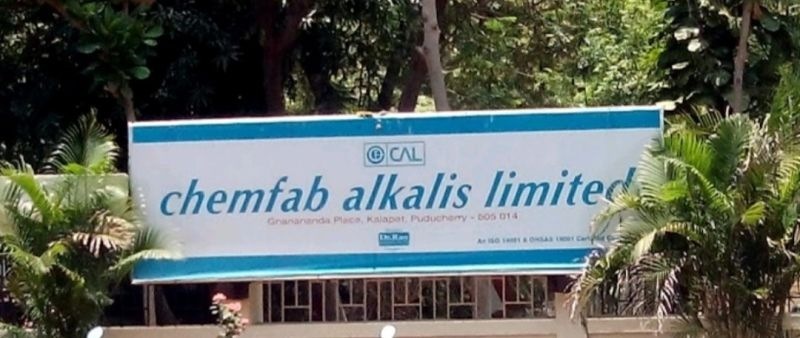
A chemical manufacturing business with growing asset bases and heavy asset additions is currently gaining substantial investor attention. Chemfab Alkalis Ltd (CAL) presents a deeply complicated situation where massive capital deployment stands directly opposite to declining operational cash generation.
The entity operates across two core divisions: a traditional Chlor-Alkali manufacturing segment and an Oriented Poly Vinyl Chloride (OPVC) piping vertical. On paper, the story is structured as a textbook structural pivot: utilizing the volatile cash flows of a legacy commodity chemical architecture to fund entry into a high-margin, modern infrastructure piping segment.
The financial truth of the matter is severely challenging. While gross asset block has escalated from ₹348 crore in FY20 to ₹577 crore in FY26, the structural profitability of the underlying business has eroded.
The erosion is visible in the consolidated financial numbers. The operating profit margin has collapsed from a peak of 33.47% in FY23 to 8.75% in FY26.
The net outcome is that the business has swung into an absolute net loss at a consolidated level, recording a loss of ₹3.43 crore for the full year ended March 31, 2026, compared to a net profit of ₹65.26 crore in FY23.
The balance sheet is absorbing significant pressure. Borrowings have climbed from zero in FY23 to ₹126 crore by March 2026. This debt accumulation does not account for the extensive leverage required to execute the planned greenfield expansion via its wholly-owned subsidiary, Chemfab Alkalis Karaikal Limited.
The credit infrastructure has responded to this structural pressure. India Ratings and Research (Ind-Ra) downgraded the company’s bank loan facilities from ‘IND A-’ to ‘IND BBB+’ on March 13, 2026, maintaining a Negative Outlook. This downgrade targets a severe weakening of key credit metrics and a substantial contraction of available liquidity buffers.
The structural thesis depends on whether the recently modernised chemical facility and expanded pipe capacity can outpace the debt obligations coming due over the next 24 months.
2. Introduction
Chemfab Alkalis Ltd is a medium-sized manufacturer of basic inorganic chemicals and specialized PVCO/OPVC pipelines. The corporate structure includes manufacturing infrastructure located in Puducherry for the core Chlor-Alkali business, along with a dedicated processing setup in Sri City, Andhra Pradesh for the high-orientation polymer pipeline unit.
To assess the operational viability of the business model, one must examine the baseline input costs and global macro cycles. The chemical vertical relies heavily on electro-chemical processing architectures, where power forms the single largest components of the manufacturing cost structure.
The company has historically absorbed major margin shocks due to structural power cost differentials relative to major producers based in Western India, who benefit from closer proximity to cheaper input energy and gas infrastructure.
The structural diversification into Oriented PVC (OPVC) pipes, initiated around 2018 through technical collaborations with European technology providers, was designed to balance this commodity vulnerability. OPVC pipelines represent an advanced technological iteration over standard unplasticized PVC or ductile iron lines, displaying significantly elevated tensile properties and higher hydraulic transfer efficiencies.
The structural demand for these pipeline assets is directly tied to central and state budgetary allocations for water infrastructure, particularly the central government’s Jal Jeevan Mission (JJM) and the secondary AMRUT 2.0 urban renewal outlays.
The core financial vulnerability for the company manifests when both structural cycles experience simultaneous downward trends. Over the FY25–FY26 timeframe, global chlor-alkali markets entered a prolonged oversupply phase driven by capacity additions in East Asia, which compressed electrochemical unit (ECU) realisations across domestic processors.
Concurrently, fund flows under the flagship Jal Jeevan Mission experienced structural field-level slowdowns and procedural delays across various state execution agencies. This stalled the volume off-take at the exact moment the company completed its major capacity increments at Sri City.
3. Business Model – WTF Do They Even Do?
The mechanics of the operation break down into a basic industrial sequence: splitting salt water with high-voltage electricity and molding polymer resins under heavy pressure.
In the Chlor-Alkali vertical, the core asset is a series of membrane cell electrolysers. The plant processes purified chemical brine (NaCl+H2O) into Sodium Hydroxide (NaOH or Caustic Soda), alongside co-produced streams of Liquid Chlorine (Cl2) and Hydrogen Gas (H2).
In industrial chemistry, Chlorine is an unavoidable co-product. If a manufacturer operates in a geography lacking dense downstream vinyl or chlorination clusters, Chlorine realisations turn sharply negative. In simple terms, you must pay someone or expend capital to safely neutralize and dispose of the gas.
To resolve this geographic challenge, the company operates a forward integration framework consisting of an Anhydrous Aluminium Chloride facility at Karaikal, which absorbs a portion of the captive chlorine output to generate a higher-value chemical intermediary used in pharma synthesis.
The secondary business unit alters the formulation entirely. The plant imports high-K-value PVC resin, processes it via specialized multi-stage extrusion machinery licensed from Molecor (Spain), and induces structural molecular orientation. This process transforms conventional polymer configurations into Class 500 OPVC pipes.
The core commercial objective is to displace traditional Ductile Iron (DI) pipelines in municipal tenders. An OPVC pipeline provides equivalent pressure tolerances while reducing structural weight by a factor of nearly ten, significantly reducing field installation costs for engineering, procurement, and construction (EPC) contractors.
The commercial challenge is that the target customer base is not the retail agricultural sector. Nearly 70% to 80% of the forward order pipeline is controlled by state-backed EPC contractors executing public water distribution mandates.
When a public agency pauses its structural funding mechanisms, the entire factory infrastructure experiences low capacity utilization, leading to unabsorbed fixed overheads.
4. Financials Overview
The financial results for the quarter and financial year ended March 31, 2026, confirm that the business is facing significant pressure across its core operational lines.
The calculations for the core operational trends utilize the official consolidated accounting reports signed off by the board during the May 2026 review cycles.
Consolidated Financial Performance Matrix
The financial parameters below present the absolute figures along with sequential and year-over-year variations.
Financial Parameter
Latest Quarter (Q4 FY26)
Previous Quarter (Q3 FY26)
QoQ Variance (%)
Same Quarter Last Year (Q4 FY25)
YoY Variance (%)
Gross Revenue
₹74.78 cr
₹68.14 cr
+9.74%
₹92.32 cr
-19.00%
Operating EBITDA
₹8.52 cr
₹1.93 cr
+341.45%
₹13.34 cr
-36.13%
PAT
₹0.48 cr
₹-4.45 cr
Turned Positive
₹-9.19 cr
Turned Positive
Reporting EPS (₹)
₹0.33
₹-3.10
—
₹-6.40
—
Annualised EPS (₹)
₹1.32
—
—
—
—
Operational Performance Analysis
The sequential revenue improvement from ₹68.14 crore in Q3 FY26 to ₹74.78 crore in Q4 FY26 indicates a baseline volume stabilization within the chemical vertical. The management’s official disclosures note that the Electrochemical Unit (ECU) realisations recorded a mild sequential recovery, moving from ₹38,500 per metric ton to ₹39,100 per metric ton during the final quarter of the financial year.
The operational profitability margins reflect the pressure from unabsorbed fixed costs. The full-year consolidated operating profit dropped to ₹27 crore, representing a single-digit margin of 8.75% against a historic base of over 33%.
The structural finance costs have expanded significantly, rising from ₹0.04 crore in Mar 2023 to ₹2.14 crore in the latest quarter. This trend matches the structural debt onboarding required for the capital programs.
Reviewing historical communication protocols reveals a clear divergence between historical management projections and execution outcomes. During previous analyst interactions, the executive team outlined