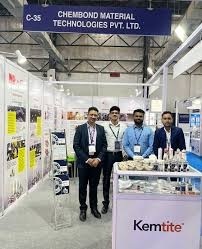
1. At a Glance – Blink and You’ll Miss the Plot Twist
Chembond Material Technologies Ltd is what happens when a 50-year-old specialty chemicals company wakes up one day, looks at its balance sheet, and says, “Too much baggage, boss. Let’s go on a corporate diet.” With a market cap of roughly ₹220 crore, a current price hovering around ₹162, and a stock that has politely disappointed investors by falling over 60% in one year, this is not a momentum darling. This is a rehabilitation case.
The latest quarterly numbers show consolidated revenue of ₹62.9 crore and PAT of ₹1.59 crore, which is down sharply YoY. EPS for the quarter came in at ₹1.19, reminding everyone that profitability here is currently on a controlled ration plan. Return ratios like ROE (~10.5%) and ROCE (~11.5%) are decent enough to avoid embarrassment at a chemicals conference, but nowhere near flex-worthy.
And yet, despite shrinking scale, auditor changes, demergers, and rating downgrades, the company remains almost debt-free, promoter holding is a comfortable 67%+, and dividends still show up like that one loyal friend who comes even when the party is boring. So the question is simple: Is this a cleaned-up chemicals play preparing for a second innings, or just a slimmer version of the same old slow mover?
Let’s put on our forensic gloves.
2. Introduction – A 1974 Vintage with a 2025 Reset Button
Incorporated in 1974, Chembond is older than most portfolio managers pretending to be long-term investors on Twitter. For decades, it operated as Chembond Chemicals Ltd, doing what Indian specialty chemical companies love doing: a little bit of everything. Metal treatment chemicals, construction chemicals, water technologies, animal health, industrial biotech — basically a thali, not a single dish.
Then came FY25. Management looked at the structure and said, “This is too cluttered even for Indian corporate standards.” Cue a Composite Scheme of Arrangement approved by the NCLT on April 7, 2025. Multiple entities merged, businesses demerged, shares got issued, capital got reduced, and suddenly Chembond emerged reborn as Chembond Material Technologies Ltd.
Post-restructuring, the company retained only Metal Treatment Chemicals and Animal Health businesses. Construction chemicals and water technologies were spun off into a separate entity. Translation: revenue went down, scale reduced, but focus theoretically improved.
Now here’s where it gets interesting. Investors usually hate restructuring because numbers look ugly during transition years. But sometimes, after the dust settles, you’re left with a cleaner, more predictable business. The big question: Is Chembond now focused… or just smaller?
3. Business Model – WTF Do They Even Do Now?
Post-demerger, Chembond is no longer the “everything everywhere all at once” chemicals company. It now operates in two clear verticals:
1. Specialty Chemicals (84% of FY25 revenue)
This is primarily metal treatment chemicals — products used to clean, coat, and prepare metal surfaces before painting, plating, or industrial use. These are not glamorous products. You won’t see influencers unboxing phosphating chemicals on Instagram. But they are sticky. Once an automotive or engineering client approves a formulation, switching suppliers is a headache.
These chemicals are used across automotive, engineering, and industrial manufacturing. Volumes track industrial activity, and margins depend heavily on raw material discipline and pricing power.
2. Animal Health Products (16% of FY25 revenue)
This includes feed additives, vitamins, minerals, probiotics, and prebiotic enzymes. Essentially, Chembond makes sure cows, poultry, and other animals live their best gut-health lives.
This segment has different economics: more volume-driven, linked to agri cycles, and sensitive to commodity inputs. But it also provides diversification away from pure industrial cyclicality.
So the business model today is simpler: industrial chemicals + animal nutrition, no real estate dreams, no water utopia,