01 — At a Glance
The Fertiliser Stock That Looks Like A Bargain But Hides Complexity
- 52-Week High / Low₹742 / ₹409
- 9M FY26 Revenue (TTM)₹20,457 Cr
- 9M FY26 PAT (TTM)₹1,914 Cr
- Annualised EPS (Q3×4)₹58.56
- TTM Full-Year EPS₹47.78
- Book Value₹246
- Price to Book1.80x
- Dividend Yield2.31%
- Debt / Equity0.01x
- Stock Return (1Y)-23.4%
The Catch: Q3 FY26 revenue surged 20% YoY to ₹5,898 crore, but here’s the plot twist — your P/E at 9.17x screams cheap. Sector median is 18.6x. Coromandel’s at 28x. So either Chambal is being gifted at 50% discount, or there’s something the market already priced in. Spoiler: it’s complex fertilisers destroying margins. DAP is a fixed-margin business where profit per tonne = ₹1,000 on sales of ₹60,000. Yes, that’s 1.6% actual margin on DAP alone. Meanwhile, crop protection chemicals are earning 22–24% EBIT margins. The stock reflects this tension perfectly.
02 — Introduction
The Quiet Revolution Nobody Noticed: From Urea Farmer To Chemistry Guy
Chambal Fertilisers is India’s largest private-sector urea manufacturer. It controls ~13% of national urea production. Has three plants in Kota, Rajasthan, runs at 98%+ capacity utilisation, and has been cranking out stable urea volumes for 15 years. Boring? Absolutely. Cash generation? Obscene.
Until December 2025, that was the entire story. Then management looked at the P&L and thought: “You know what? Margins on bulk fertiliser are being crushed by government policy. Let’s pivot.” So they launched an all-in bet on crop protection chemicals (CPC) — weedicides, insecticides, fungicides, bio-pesticides — and hit a growth rate of 33% in Q3 with EBIT margins north of 22%. By 9M, this segment contributed 10% of EBITDA. They’re targeting ₹1,750 crore revenue from CPC alone by FY27.
And then came the TAN project. Technical Ammonium Nitrate. A ₹1,645 crore investment to make specialty chemicals that actually have better margins than commodity urea. Commissioning is end-April 2026. Management expects 75–80% utilisation day-one if the market absorbs it. Vertical and horizontal expansions are already on the drawing board.
So when you look at this stock trading at P/E 9.17x with -23.4% annual return, you’re looking at a company in the middle of a strategic pivot — half old-world commodities, half new-world specialties — and the market is struggling to price it. Let’s unpack what’s actually happening.
Concall Intel (Feb 2026): Management explicitly stated they expect post-TAN “vertical and horizontal expansions.” They won’t disclose specifics until the board formulates proposals. Translation: more capex is coming. They also clarified that TAN profitability hinges on market absorption, not production readiness. Market absorption = farmer acceptance = government policy = unpredictable as monsoon timing.
03 — Business Model: Who Buys What, And Why They Cry
Urea: The Stable Cash Machine. DAP: The Margin Destroyer. CPC: The Hidden Gem.
Chambal’s business is split into three buckets. Urea (anchor), complex fertilisers (growth + pain), and crop protection (margin gold).
Urea: ₹3,708 Crore Revenue (Q3) — This is the backbone. 9.83 lakh MT sold in Q3 (flat YoY). Three plants (G-I, G-II, G-III) each running at 100%+ capacity utilisation. G-III gets support from the New Urea Investment Policy (NIP-2012), which guarantees a 12% floor and 20% ceiling on post-tax RoE. That’s government-backed profitability. The catch? NIP-2012 expires in December 2026. What happens post-December is unresolved. ICRA notes this will become template policy for other NIP units (Matix, HURL). High stakes. Low transparency.
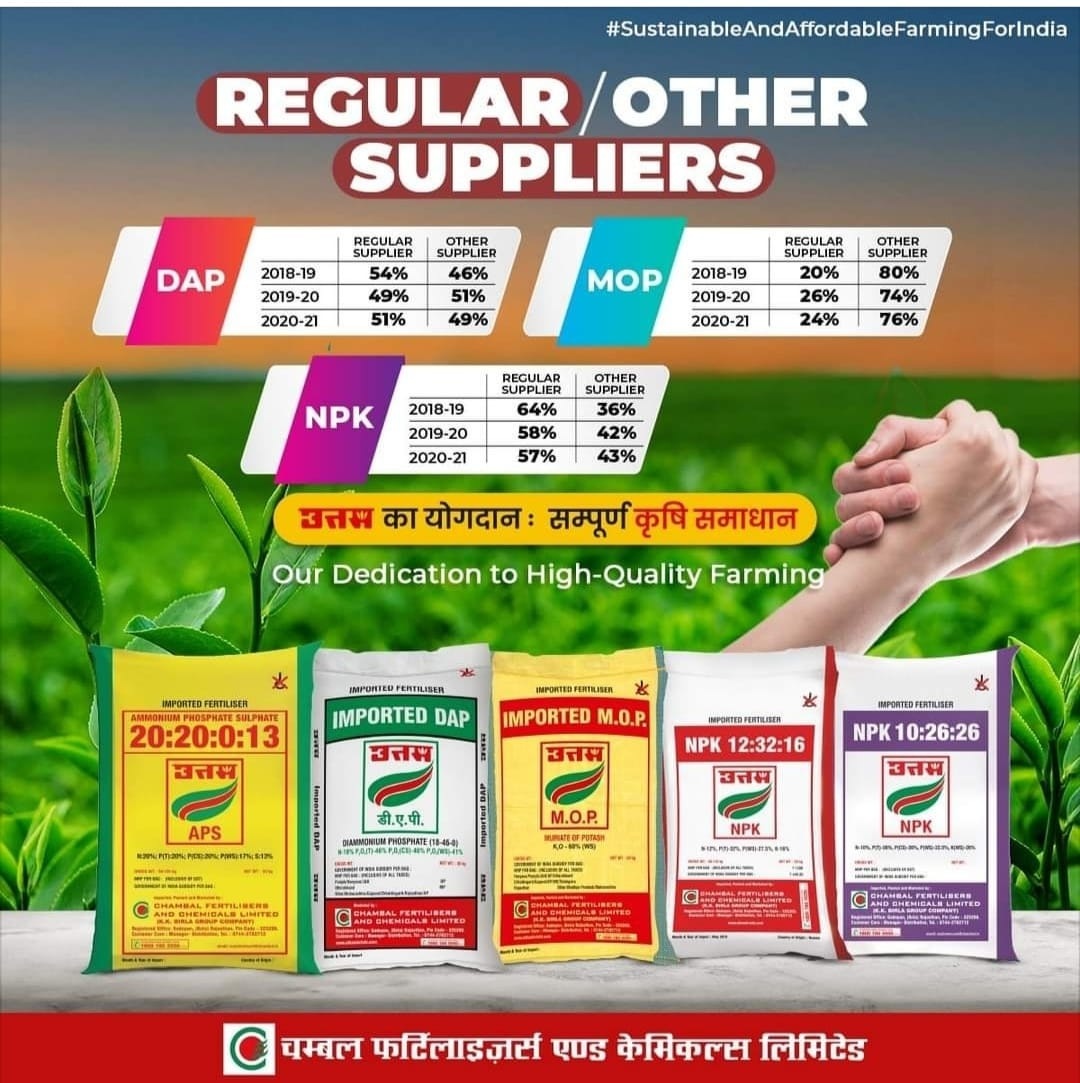
Complex Fertilisers (DAP, NPK, MOP, TSP): ₹1,850 Crore Q3 Revenue — This segment grew 81% YoY in volumes but EBIT margins collapsed to 1.4%. Why? DAP is government-subsidised at a fixed absolute margin (₹1,026 per tonne, roughly 4% of MRP). When global DAP prices spiked to $850 per tonne, Chambal’s fixed margin meant selling at ₹60,000 MRP with a profit of just ₹1,000 per tonne. The 9M margin on complex fertilisers? 4.4%, down from 6.87% last year despite 180% revenue growth. This is not a business. This is a pipeline for cash to flow through. The government subsidises, Chambal trades, and margin evaporates.
NPK and MOP have better margins because they’re not fixed-price subsidised goods. But NPK profitability is hostage to relative pricing vs DAP. Management flagged: “There is a tipping point after which consumption will drop.” Substitution risk is real.
Crop Protection Chemicals (CPC): ₹340 Crore Q3 Revenue — EBIT margin 22.8%. Revenue up 33% YoY. By 9M, this segment grew 30% YoY in contribution. Management launched five new products in Q3 alone. The pipeline for FY27: 12 new CPC products + 1 specialty nutrient. The long-term bet is biologicals (bio-pesticides, bio-fungicides, biopesticides). Volumes are up 31% YoY, revenue up 58% YoY. Uttam Pranaam (bio-nano-phosphorus) is up 250% YoY. The play: exclusive commercialisation rights through a TERI (Tata Energy Research Institute) partnership. Joint IP ownership. Products expected FY27–28 onwards.
The distribution network: 3,800+ dealers, 60,000+ retailers, spread across 10 states. Rajasthan, MP, Punjab, Haryana are lead markets. This infrastructure is now being weaponised for CPC. A dealer who stocks Chambal urea now also stocks Chambal weedicides. That’s leverage.
Urea Sales Vol9.83 LMTQ3 FY26 (flat YoY)
Complex Fert Growth+81% YoYVolume, but margin crushed
CPC Growth+33% YoY22.8% EBIT margin
The Management Memo No One Read: On Q3 concall, when asked about DAP profitability, management said: “DAP is a fixed margin business. Government gives you a fixed… 1,026. Because it is 4% of the MRP.” They called it a “very small amount” on a ₹60,000 sales value. The honesty is refreshing. They then pivoted to NPK momentum. Translation: DAP is now a volume game for shelf-space. Real profit must come from CPC, NBS growth, and speciality crops.
💬 Here’s the hot take: If DAP is destroying margins, why does Chambal keep expanding it? Leave a comment — is this strategic patience or trapped cash?
04 — Financials Overview
Q3 FY26: The Numbers That Confuse Everyone
Result type: Quarterly Results | Q3 FY26 EPS: ₹14.64 | Annualised EPS (Q3×4): ₹58.56 | Full-Year TTM EPS: ₹47.78
| Metric (₹ Cr) |
Q3 FY26
Dec 2025 |
Q3 FY25
Dec 2024 |
Q2 FY26
Sep 2025 |
YoY % |
QoQ % |
| Revenue | 5,898 | 4,918 | 6,413 | +19.9% | -8.0% |
| Operating Profit | 821 | 778 | 842 | +5.5% | -2.5% |
| OPM % | 13.9% | 15.8% | 13.1% | -190 bps | +80 bps |
| PAT | 586 | 534 | 649 | +9.7% | -9.8% |
| EPS (₹) | 14.64 | 13.34 | 16.19 | +9.7% | -9.6% |
The headline: +19.9% revenue growth, but -190 bps OPM compression. Here’s what happened. Q3 revenue ₹5,898 crore is up 20% YoY because complex fertilisers (DAP, NPK, MOP) exploded in volumes. But DAP margins are structurally 1.4% EBIT margin. Q3 also included a ₹31 crore labour code hit that management mentioned. Adjusting for this one-time item, underlying EBIT was roughly ₹852 crore instead of ₹821 crore. Still, the 9M EBITDA is ₹2,424 crore (+4% YoY), margin 13.46%. The company paid out a ₹31 crore one-time labour provision in Q3, but that’s not material to normalised earnings.
The Real Story: 9M FY26 revenue ₹18,009 crore (+27% YoY), PAT ₹1,804 crore (+16% YoY), EBITDA ₹2,424 crore (+4% YoY). The PAT growth of 16% vs EBITDA growth of 4% is because tax rate compressed and finance costs are near-zero (debt is ₹100 crore). Urea EBIT margin held steady at ~17%, but complex fertiliser EBIT margin fell from 6.87% (9M FY25) to 4.4% (9M FY26) due to DAP price dynamics. CPC and speciality nutrients are the only bright spot with 23.69% EBIT margin on 9M basis.
P/E Recalculated: TTM EPS ₹47.78 ÷ CMP ₹437 = P/E 9.17x (matches screener). Annualised EPS (Q3×4) = ₹58.56 ÷ ₹437 = P/E 7.46x. Sector median P/E is 18.6x. Chambal at 9.17x is trading at ~50% discount. Coromandel (market leader) trades at 28.25x P/E. The valuation gap exists because the market is pricing in: (1) DAP margin compression, (2) NIP-2012 policy expiry in Dec 2026, and (3) TAN execution risk. All three are real, but the discount feels extreme given CPC growth + improved asset position.
05 — Valuation Discussion
Fair Value Range: Why 9.2x P/E Is (Probably) Broken
Join 10,000+ investors who read this every week.