1. At a Glance – Blink and You’ll Miss the Container
Cargotrans Maritime Ltd is a ₹74.6 crore market cap SME stock quietly loading containers while the market is busy chasing the next AI buzzword. Current price sits around ₹160, having already run like a truck late for customs clearance — up ~83% in three months and ~70% over one year. And this is not a penny-stock hallucination; this is backed by numbers. Latest half-year sales clocked ₹51.03 crore with PAT of ₹2.58 crore, translating into a chunky 76.7% YoY profit jump for the period. ROCE is flexing at 23.6%, ROE at 18.2%, and debt-to-equity at a manageable 0.67 — not exactly a leveraged Titanic. Operating margins have expanded to 8.15% in the latest half year, which in logistics terms is like finding extra diesel mileage without stealing fuel. Dividend yield exists (0.31%), which itself is rare in SME-land where dividends are usually discussed only in AGM speeches. The stock P/E of ~16.4 sits below the industry average of ~22.6, making it look reasonably priced for a company that just delivered accelerating profits. The big question — is this just a lucky freight cycle, or is the ship genuinely being steered well?
2. Introduction – Logistics Without the Bollywood Item Number
Logistics companies usually don’t get fan clubs. No dramatic brand recall, no glamorous consumer interface, no IPO day DJ. Yet, every export container, every import consignment, every customs stamp keeps the economy breathing. Cargotrans Maritime Ltd sits right in this unglamorous but critical middle — the guy who actually makes sure your tiles reach Dubai and your pharma shipment clears on time.
Founded in 2012, CTML is not a pandemic baby or a one-cycle wonder. It has been grinding through ports, paperwork, and port congestion for over a decade. What’s interesting now is timing. After years of modest scale, the company suddenly shows operational leverage kicking in — margins expanding, profits compounding faster than revenue, and capital returns that don’t scream “working capital disaster”.
But this is also an SME logistics stock. That means you don’t blindly trust glossy presentations. You read balance sheets like an auditor, sniff governance changes like a journalist, and ask uncomfortable questions like a customs officer at 3 a.m. Is growth organic or financial engineering? Is the Singapore subsidiary strategic or just passport envy? Is the recent preferential allotment fuel or dilution drama?
So buckle up. We’re unpacking containers, not headlines.
3. Business Model – WTF Do They Even Do?
In simple words: Cargotrans Maritime Ltd moves other people’s stuff across oceans and borders — and gets paid for not messing it up.
At its core, CTML is an international freight forwarding and logistics solutions provider. Its bread and butter is ocean freight forwarding — both FCL (full container load) and LCL (less than container load). If you don’t know the difference, think of FCL as booking an entire Uber for yourself and LCL as sharing it with strangers who may or may not smell like onions.
Beyond ocean freight, the company provides customs clearing (with its own license — very important), inland transportation using its own fleet of trailers, warehousing, and value-added services like documentation, shipment certifications, and insurance facilitation. Basically, CTML positions itself as a one-stop logistics shop for exporters and importers who don’t want to deal with 12 vendors and 15 excuses.
The company also handles project cargo, vessel chartering, and bulk movement — higher complexity, higher ticket size, and higher execution risk. This is not e-commerce parcel delivery. This is heavy, boring, industrial logistics where relationships matter more than branding.
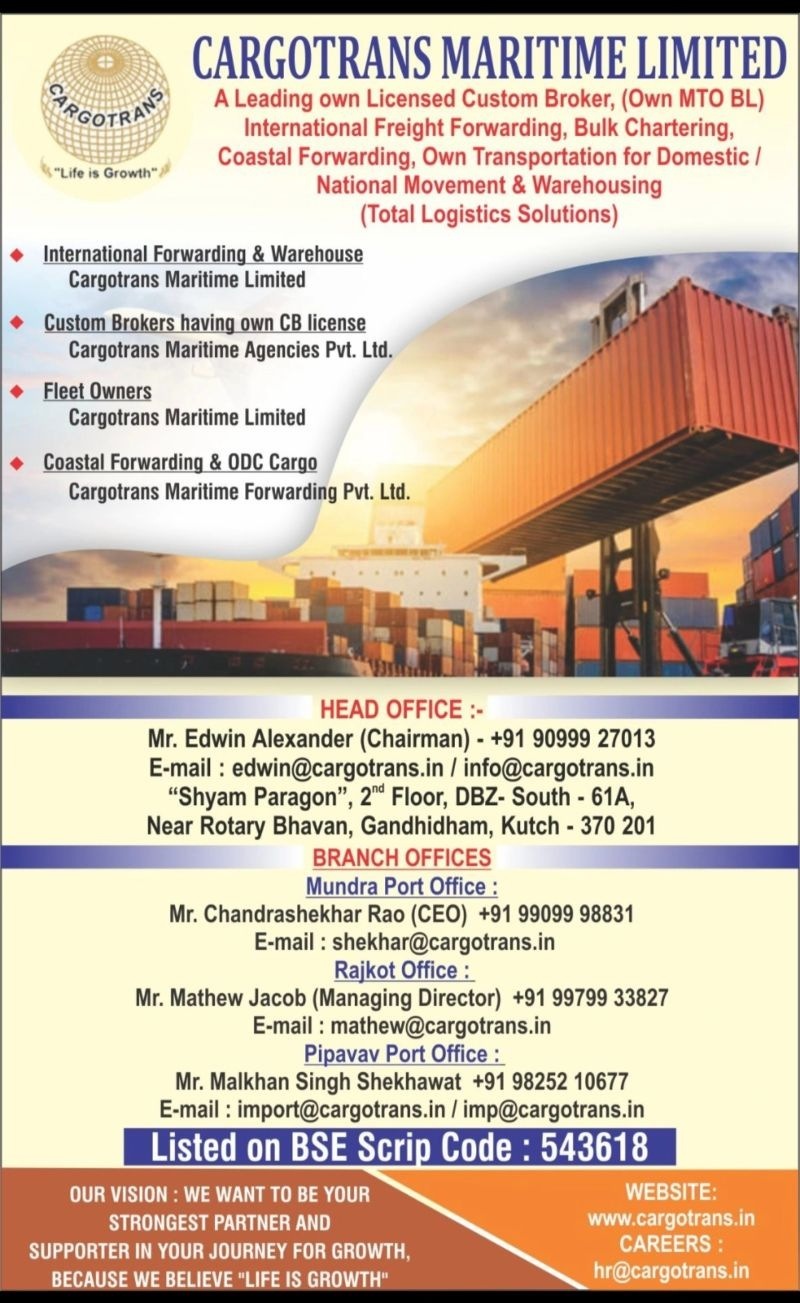
CTML operates through wholly owned subsidiaries — Cargotrans Maritime Agencies Private Limited and Cargotrans Maritime Forwarding Private Limited — helping it cover customhouse agency services and coastal transportation within India. On top of that, it has set up a wholly owned subsidiary in Singapore, Cargotrans Lines Pte. Ltd., aimed at international shipping activities.
Its client exposure spans agriculture, metals, pharma, fertilizers, tiles, granite, sanitaryware, machinery, auto parts — basically everything that India exports when the