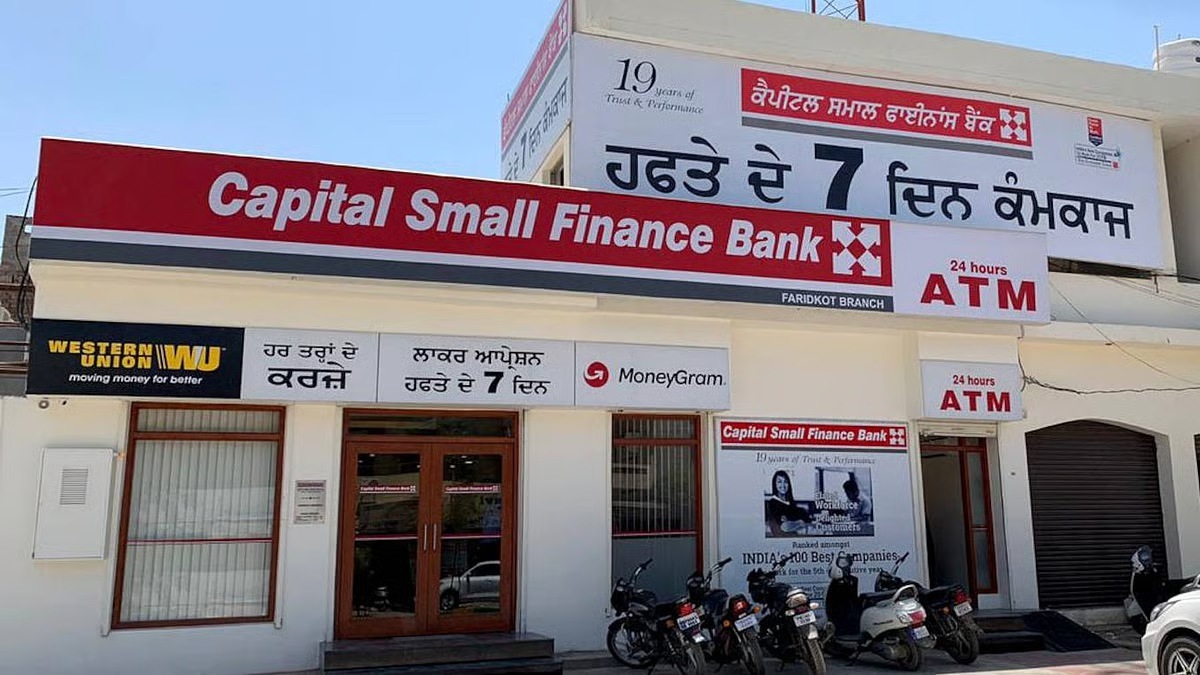
Capital Small Finance Bank Ltd Q2FY26 – Punjab’s Banker Grows Up: 24% CAR, 2.7% GNPA, and Still No Drama
1. At a Glance
If there were an RBI reality show titled “Small Finance Banks: The Civilised Ones,”Capital Small Finance Bank Ltd (CSFBL) would walk in wearing a neatly ironed turban and holding a spotless balance sheet. At ₹287 per share and a market cap of ₹1,299 crore, this Punjab-based banker is India’s first Small Finance Bank, and perhaps the only one that didn’t start by lending to goats.
In Q2FY26, the bank clocked revenue of ₹256 crore (up 14.7% YoY) and PAT of ₹34.9 crore (up 4.6% YoY). It now boasts ₹9,317 crore in deposits, ₹7,907 crore in advances, and a Capital Adequacy Ratio (CAR) of 24.2%—so high that RBI inspectors probably ask for tips.
The P/E ratio stands at 9.6×, and price-to-book at 0.93×—which is market slang for “undervalued but unfashionable.” While the street is busy buying AI-powered IPOs at 300× earnings, Capital SFB quietly compounds profits at 39% CAGR (5 years) and offers 1.39% dividend yield.
Gross NPA? 2.7%. Net NPA? 1.4%. Almost 100% secured loan book. Basically, it’s the Amul of small banks—utterly professional, mostly rural, and quietly profitable.
2. Introduction
India’s first Small Finance Bank was born not out of fintech wizardry, but old-school discipline. Incorporated in 1999 as Capital Local Area Bank, this modest institution from Jalandhar became the first to upgrade into an SFB in April 2016, years before fintechs began burning money to “revolutionize inclusion.”
Back then, while other banks obsessed over metro malls, Capital SFB built its fortress in Punjab’s dusty lanes—handing loans to shopkeepers, farmers, and small traders. Fast forward to FY26: it now runs 195 branches and 197 ATMs across 41 districts and 7 states/UTs, serving 7.6 lakh customers with 2,096 employees—which, if you do the math, is about 360 customers per banker. That’s higher than some public banks’ actual working ratio.
The fun part? The bank’s focus remains on secured lending. Over 99.8% of its advances are backed by collateral. There’s no microfinance circus here, no unsecured personal loan binge. The CEO, Sarvjit Singh Samra, is a conservative banker in an age where everyone wants to be a neobank influencer.
Q2FY26 results confirm this consistency: Advances up 16% YoY, Deposits up 17% YoY, and CASA ratio at 36%. Not flashy, but quietly efficient—like a government clerk who never takes leave.
3. Business Model – WTF Do They Even Do?
Unlike fintech wannabes who issue credit cards before they have credit, Capital SFB is a textbook example of how to run a real bank.
Here’s how their money wheel spins:
a) Lending Book: They specialise in secured retail and MSME loans.
Agriculture Loans (30%) – Kisan Credit Cards and term loans with yields of 12.67%.
MSME/Trading (27%) – Working capital and business loans at 11.55% yield.
Mortgage Loans (22%) – Home loans and LAP at 10.70% yield.
Corporate Loans (14%) – NBFC exposure, average yield 10.91%.
Consumption Loans (7%) – Gold, auto, personal loans at 9.75%.
b) Deposit Engine: Total deposits stand at ₹9,110 crore, with term deposits ₹6,199 crore and CASA ₹2,911 crore. CASA ratio of 35.9% gives them cheap funds, a solid advantage against other SFBs still begging for deposits.
c) Fee-Based Income: Insurance, forex, demat, money transfer, and locker services. Basically, they’ve turned every square foot of their branch into a revenue generator.
d) Technology: While they’re not shouting “AI” in every investor call, the bank offers internet, mobile, debit cards, and even mobile passbooks—enough to keep Tier-2 customers happy and RBI auditors awake.
Essentially, Capital SFB is a boring bank—and that’s the compliment.
4. Financials Overview
Metric (₹ Cr)
Q2 FY26
Q2 FY25
Q1 FY26
YoY %
QoQ %
Revenue
256
224
247
+14.7%
+3.6%
Profit Before Tax
46
44
43
+4.5%
+6.9%
PAT
34.9
33.4
32
+4.6%
+9.1%
EPS (₹)**
7.7
7.5
7.1
+2.6%
+8.4%
Annualised EPS: ₹30.8 → P/E = 9.3×
Commentary: A 15% YoY revenue bump and a PAT climb of 5% show that the bank is balancing growth and stability. Margins are holding steady despite rising borrowing costs. Unlike some SFBs that treat NPAs as “lending experiments,” Capital SFB treats them like Covid—contain, isolate, and vaccinate early.
5. Valuation Discussion – Fair Value Range Only
Let’s put the calculator where the mouth is:
(a) P/E Method
Current P/E: 9.6× Industry average (SFBs): 22× EPS (FY25): ₹29.9
Fair Value = 12× to 18× × ₹29.9 → ₹360 – ₹540 per share
(b) P/B Method
Current P/B: 0.93× SFB peers trade between 1.3× (Jana, Suryoday) and 3.6× (AU SFB). If Capital’s ROE normalises to 12%, a fair P/B range = 1.2×