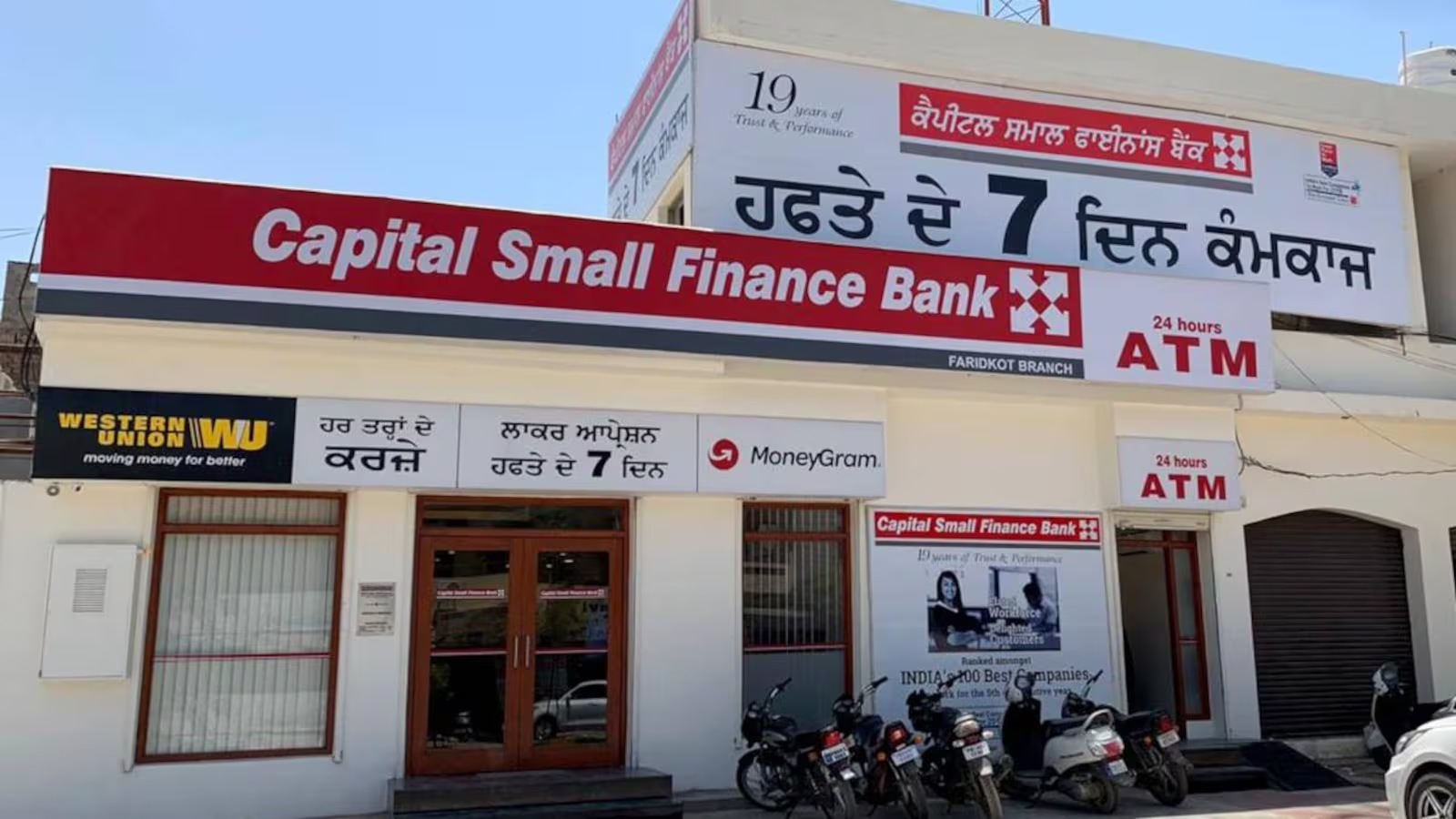
1. At a Glance
India’s first Small Finance Bank, Capital SFB, has a market cap of just ₹1,289 Cr, trades at a P/B of 0.94, and still flaunts a respectable ROE of 10.4%. The catch? A debt-to-equity of 7x, which makes it look like your local moneylender—but with ATMs and a mobile app. Despite NPAs under control (GNPA 2.7%), the bank’s promoter holding is as thin as hostel chai (18.8%).
2. Introduction
Once upon a time in 1999, when banks were still distributing free diaries and pens to open savings accounts, Capital Local Area Bank was born in Punjab. Two decades later, it grew into Capital Small Finance Bank (CSFB) — the first officially approved SFB in India. While most SFBs went gung-ho on microfinance, CSFB acted like the uncle who refuses to dance at weddings: conservative, secured-loan focused, and allergic to MFIs.
Now, this “Baniya-style banker” has grown into a ₹7,437 Cr advances book, with 74% retail loans and 90% retail deposits. Imagine running a tight ship in Punjab’s semi-urban towns, convincing shopkeepers and farmers to park money in CASA accounts at a 36% ratio—that’s like convincing Delhiites to eat without butter chicken.
The bank is expanding cautiously into Haryana, Himachal, J&K, and NCR, while trimming dependence on Punjab. But here’s the paradox: despite profit growth of 39% CAGR over 5 years, its stock has delivered negative 3% in the past year. Either the market is blind, or the market is seeing something shareholders can’t.
So, should we treat this like a boring fixed deposit in disguise, or is it secretly a compounding machine with a Punjabi accent?
3. Business Model – WTF Do They Even Do?
Capital SFB is basically a “middle-class banker for middle-class India.” No fintech drama, no BNPL circus, no high-risk MFIs. Just plain vanilla secured lending.
- Agriculture (30%): From Kisan Credit Cards to tractor loans—basically, anything with soil attached. Yields a healthy 12.67%, proving farmers are better borrowers than Twitter influencers.
- MSME & Trading (27%): The neighborhood trader, shopkeeper, and manufacturer class. Yield: 11.55%.
- Mortgage Loans (22%): Housing + LAP. Yield: 10.7%, lower risk, but hey, Punjab homes are often bigger than IT parks.
- Corporate Loans (14%): Mostly NBFCs. Yield: 10.91%, but let’s be honest, lending to NBFCs is like lending alcohol to a drunkard.
- Consumption Loans (7%): Gold, auto, personal loans at 9.75%—aka the “beta” portfolio for aspirational weddings and new cars.
Deposits? A neat mix:
- Savings ₹2,632 Cr,
- Current ₹279 Cr,
- Term ₹6,199 Cr.
With CASA ~36%,