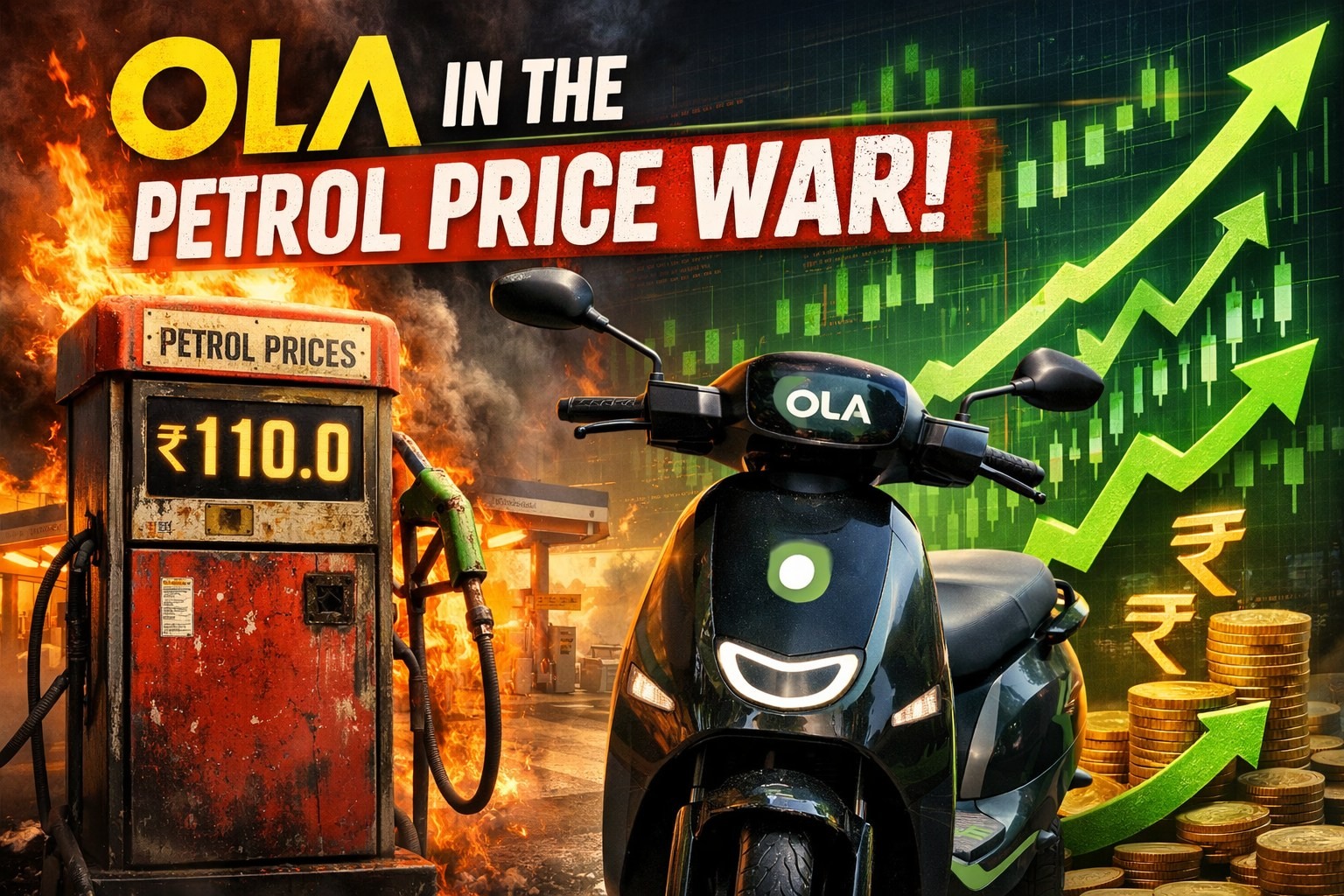
Can OLA Electric Thrive in the Petrol Price War?
OLA Electric was supposed to be India’s Tesla moment. Instead, it’s become India’s most entertaining corporate soap opera — a show where the stock chart looks like a scooter rolling downhill with no brakes, customers express feedback through fire and hammers, and the CEO picks fights with comedians while 80,000 service complaints pile up monthly.
The question everyone’s asking: with petrol prices going haywire thanks to the Iran war, surely this is OLA’s moment to shine? Right? Right?
Let’s investigate.
The Numbers That Make Investors Cry
OLA’s Q3 FY26 results were a masterpiece of corporate horror: revenue crashed 55% to ₹470 crore, the net loss stood at ₹487 crore, and vehicle deliveries collapsed 61%. In February 2026, OLA sold fewer than 4,000 scooters — a 47% drop — while TVS casually moved 31,600 units. That’s like showing up to a race and discovering your competitor already lapped you thrice during the national anthem.
Citi slashed its target to ₹22 with a “Sell” rating. Emkay went further, stating OLA’s trajectory “casts doubts on survival.” SoftBank has quietly trimmed its stake. Tiger Global holds less than 1%. The rats aren’t just leaving the ship — they’ve started reviewing the lifeboat on Google Maps.
Customer Feedback: Now With Hammers and Fire
Forget 1-star reviews. OLA customers have invented entirely new genres of protest:
A man received a ₹90,000 repair bill one month after buying his scooter. His response? Lay the scooter on the showroom floor and smash it with a hammer while the internet watched. The video crossed 930,000 views. Somewhere, a PR manager quietly updated their LinkedIn.
Another customer waited seven months for a battery replacement, then set his scooter on fire in the middle of the road. A separate OLA scooter caught fire directly in front of the company’s own showroom in Bengaluru. You can’t make this stuff up. Even Bollywood screenwriters would reject this for being too on-the-nose.
The best part? A customer’s S1 Pro had persistent defects. After multiple failed repairs, the scooter was handed to a dealer and then vanished entirely. OLA couldn’t locate it. The consumer court set bail at exactly ₹1,47,499 — the scooter’s purchase price. Chef’s kiss.
Bhavish vs. Kunal Kamra: The Fight Nobody Asked For
When comedian Kunal Kamra posted photos of neglected scooters outside a service center, Aggarwal clapped back by mocking Kamra’s comedy career and inviting him to the service center. The stock dropped 8% the following Monday. Turns out, telling a comedian to visit your service center when your service centers are the joke is not the strategic flex you think it is.
Then there was the time Aggarwal claimed OLA was the “world’s fourth-largest EV company” — with fine print reading “excluding China.” The internet’s response was instant: “I’m AIR 1 in JEE if you exclude everyone who scored higher.”
But Wait — Petrol Is Expensive Now! EV Time?
Here’s where the story gets deliciously ironic.
The US-Israel strikes on Iran sent crude oil surging past $100/barrel. India imports 40% of its crude through the threatened Strait of Hormuz. But the Indian government just slashed excise duty by ₹10/litre to keep pump prices stable — petrol in Delhi remains at ₹94.77. Translation: the one macro tailwind that could save EVs is being actively neutralized by election-year arithmetic.
Meanwhile, the Competition Is Thriving
TVS iQube leads with ~28% market share. Bajaj Chetak holds ~23%, riding nostalgia and metal builds. Ather Energy commands ~18%. Hero Vida posted a staggering 718% year-on-year sales growth. The common thread? All of them can actually fix the scooters they sell.
OLA’s response: the Roadster X motorcycle, home battery storage (Ola Shakti), and a desperate ₹49,999 scooter offer with free OLA cab vouchers for service delays — essentially admitting the service problem while trying to bribe their way out of it. It’s the corporate equivalent of a restaurant giving you a coupon after food poisoning.
So, Will the Stock Rebound?
OLA Electric’s problem was never petrol prices. It was never GST. It was never even the Iran war. It was selling a dream and delivering 80,000 complaints a month.
The company that once held 35% of India’s EV scooter market now fights for 3.5% — not because Indians don’t want EVs, but because they don’t want EVs that vanish at the service center. A rebound would require fixing the product, rebuilding trust, and keeping the CEO off Twitter. Two of those are hard. One appears impossible.
Verdict: The scooter may be electric, but the stock needs a miracle.
This article is humorous commentary, not financial advice. The author owns zero OLA scooters and, after this research, intends to keep it that way.