BMW Ventures Q4 FY26: Steel Trading Scales, Margins Hold Flat
General information and entertainment, not investment advice. The author is not a SEBI-registered adviser or research analyst. No recommendation, no promised returns. Markets carry risk including loss of capital. Figures may not be current. Consult a registered adviser before acting.
1. At a Glance
BMW Ventures closed FY26 with ₹2,278 crore revenue—up 10.5% YoY—but net profit ₹37.5 crore fell short of the prior-year ₹50-52 crore trend before IPO dilution.
Operating margins held steady at 3.6%, a stability that masks a trading business fighting for every basis point. ROCE inched down from 14% to 12%, while ROE softened to 11.5% from the prior year.
The company carries ₹258 crore debt post-IPO equity cushion, and has planted flags in fabrication—winning a ₹336 crore BHEL order in Feb 2026.
Is a balance sheet with nothing to hide enough when returns are struggling?
2. Introduction
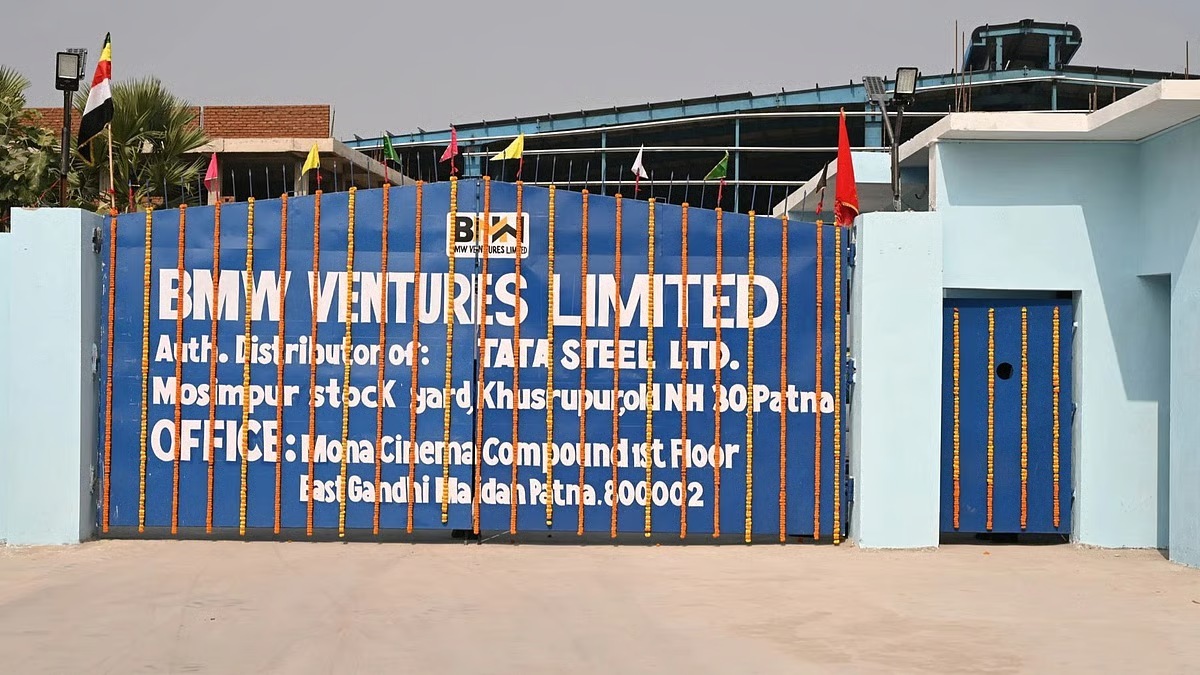
BMW Ventures is Bihar’s steel distribution spine: sole authorized distributor for Tata Steel long and flat products across 29 districts, moving 1,000+ dealers and institutional buyers. Listed in October 2025 after raising ₹231.66 crore gross (net ₹195 crore used), it’s a three-decade relationship with India’s largest steelmaker that pays rent in scale but extracts little margin.
The company also dabbles in PVC pipes, roll forming, pre-engineered buildings (PEB), and tractor engine distribution—diversification on paper, steel in practice.
Promoters Bijay Kumar and Nitin Kishorepuria hold 73% through various vehicles; the IPO was timing, not capitulation. CRISIL lifted the credit outlook to Positive in November 2025, noting the capital structure had “improved financial risk profile.”
3. Business Model: WTF Do They Even Do?
Steel distribution is a margin-thinning floor. Buy TMT bars, sell TMT bars. The spread between Tata’s factory gate price and the retail customer is where profit lives—and in Bihar’s competitive stockyard ecosystem, that spread is a millimetre.
Revenue split: 98.4% steel (long and flat), 0.55% tractor engines, 0.36% fabrication, 0.14% roll forming, 0.03% PVC pipes, 0.5% miscellaneous.
Manufacturing assets sit idle. FY26 PEB fabrication: 2,136 MT produced against 12,000 MT capacity (17.8% utilization). Steel girders: zero FY26 revenue, pending deliveries. PVC pipes: 63 MT against 800 MT capacity (7.9%). Roll forming: ~32% utilization. These aren’t businesses; they’re cost centres waiting for enough orders to turn on.
Distribution is the core—and it’s a stockyard model: buy 35,000–88,000 MT at bulk terms, hold in six Bihar locations, sell to 1,251 dealers on credit. The math: gross margin 3–4%, operating expense 0.5–1%, net margin fights south of 2%.
FY26 is a post-IPO composite year: the company raised ₹231.66 crore and used ~₹135 crore to pay down working capital debt. Debt fell from ₹428 crore (Mar 2025) to ₹258 crore (Mar 2026)—a ₹170 crore swing, split between equity raise and organic deleveraging.
Revenue grew, but earnings compressed. Net profit rose ₹4.7 crore, yet EPS contracted because shares jumped from 6.33 crore (pre-IPO, split-adjusted) to 8.67 crore post-IPO dilution.
Q4 FY26 (Jan–Mar 2026):
Sales: ₹729 crore
Net profit: ₹10.8 crore
EPS: ₹1.25
Seasonal strength—Q4 is typically the year-end push for dealers to square inventory before March balance sheets. Operating margin held at 2.9% quarterly, still compressed.
5. Valuation Discussion: Fair Value Range (Educational Only)