1. At a Glance
If diamonds are forever, Bluestone’s losses are certainly catching up fast. At a market cap of ₹10,763 crore and share price of ₹712, this freshly listed jewellery darling is still trying to polish its profit margins. The Q2FY26 numbers are dramatic — revenue up 37% YoY to ₹5,131 million (₹513 crore), yet PAT remains a deep red ₹49 crore loss. That’s right: it’s shining bright on sales but dull on earnings.
With an EV/EBITDA ratio of a whopping 88.6x and negative ROE (-34.8%), Bluestone currently sells more stories than sparkle. The company’s book value stands at ₹111 per share — meaning investors are paying six times that for the privilege of watching red ink flow. Promoter holding? A delicate 16.4%. And here’s the sparkle — 37.2% of that is pledged. Perfectly fitting for a jewellery brand that’s mastered encumbered glitter.
So yes, the company grew its top line faster than your Diwali wishlist, but profitability remains as elusive as your gold savings after a family wedding. Shall we dive into how the jeweller to the millennials turned its income statement into a gemstone mystery?
2. Introduction
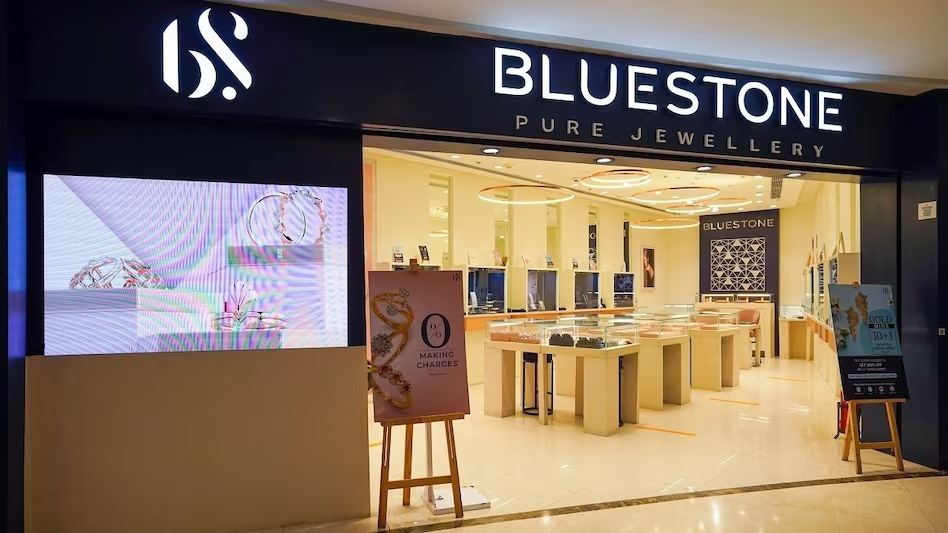
Imagine walking into a Bluestone store — classy lighting, slick glass cases, and a sales pitch smoother than gold plating. Now picture the balance sheet behind that ring. You might just prefer costume jewellery instead.
Bluestone Jewellery & Lifestyle Ltd, once the crown jewel of India’s D2C jewellery revolution, went public in August 2025, raising ₹1,540.6 crore from starry-eyed investors. Within months, the company’s Q2FY26 results have landed — and let’s say it’s not exactly 24-karat clarity. Revenue of ₹513 crore sparkles with a 37% YoY jump, but losses of ₹49 crore dull the shine.
The irony? It boasts a “Cash PAT” of ₹61 million — a phrase that sounds as creative as “gold-plated profitability.” Its adjusted EBITDA of ₹714 million (₹71 crore) shows operational efficiency improving, but depreciation and interest continue to weigh down the bottom line like a chain of 24-karat debt.
Investors expected Bluestone to replicate the Titan playbook — upscale brand, digital-first push, and emotional storytelling — but instead, we have a start-up trying to finance gold with borrowed glitter.
And let’s not ignore the numbers behind the sparkle: ₹1,889 crore in debt, -34.8% ROE, -0.5% ROCE, and zero dividend yield. A balance sheet that would make even a karigar sigh.
Question for you: if jewellery represents value preservation, why does Bluestone’s stock chart look like a discounted clearance sale?
3. Business Model – WTF Do They Even Do?
Bluestone’s tagline could well be: “We sell gold online and losses offline.” The company operates a hybrid jewellery retail model — part e-commerce, part physical store, all aspirational marketing.
Here’s how it works:
- Design & Manufacturing: Bluestone designs in-house fine jewellery and outsources manufacturing.
- Omnichannel Retail: Customers can browse online, try jewellery virtually, or visit stores for “try & buy” experiences.
- Store Count: As of Q2FY26, the company operates 311 stores — 19 added in the last quarter alone. Clearly, they’re scaling faster than their P&L can handle.
- Products: Rings, pendants, necklaces, bangles, and a growing men’s collection. The company thrives on millennial and Gen Z buyers, aiming to position itself between fast-fashion and luxury.
Unlike traditional jewellers like Titan’s Tanishq or Kalyan Jewellers, Bluestone bets on “design innovation + digital convenience.” Think of it as Zomato for jewellery — heavy on tech, thin on margins.
While most Indian jewellers grow profits from gold inventory, Bluestone grows from venture funding. The IPO proceeds (₹820 crore as of